


























Views
Downloads

4th Step Inventory Worksheet | Grade 8 Printable
Paste this activity's link or code into your existing LMS (Google Classroom, Canvas, Teams, Schoology, Moodle, etc.).
Students can open and work on the activity right away, with no student login required.
You'll still be able to track student progress and results from your teacher account.
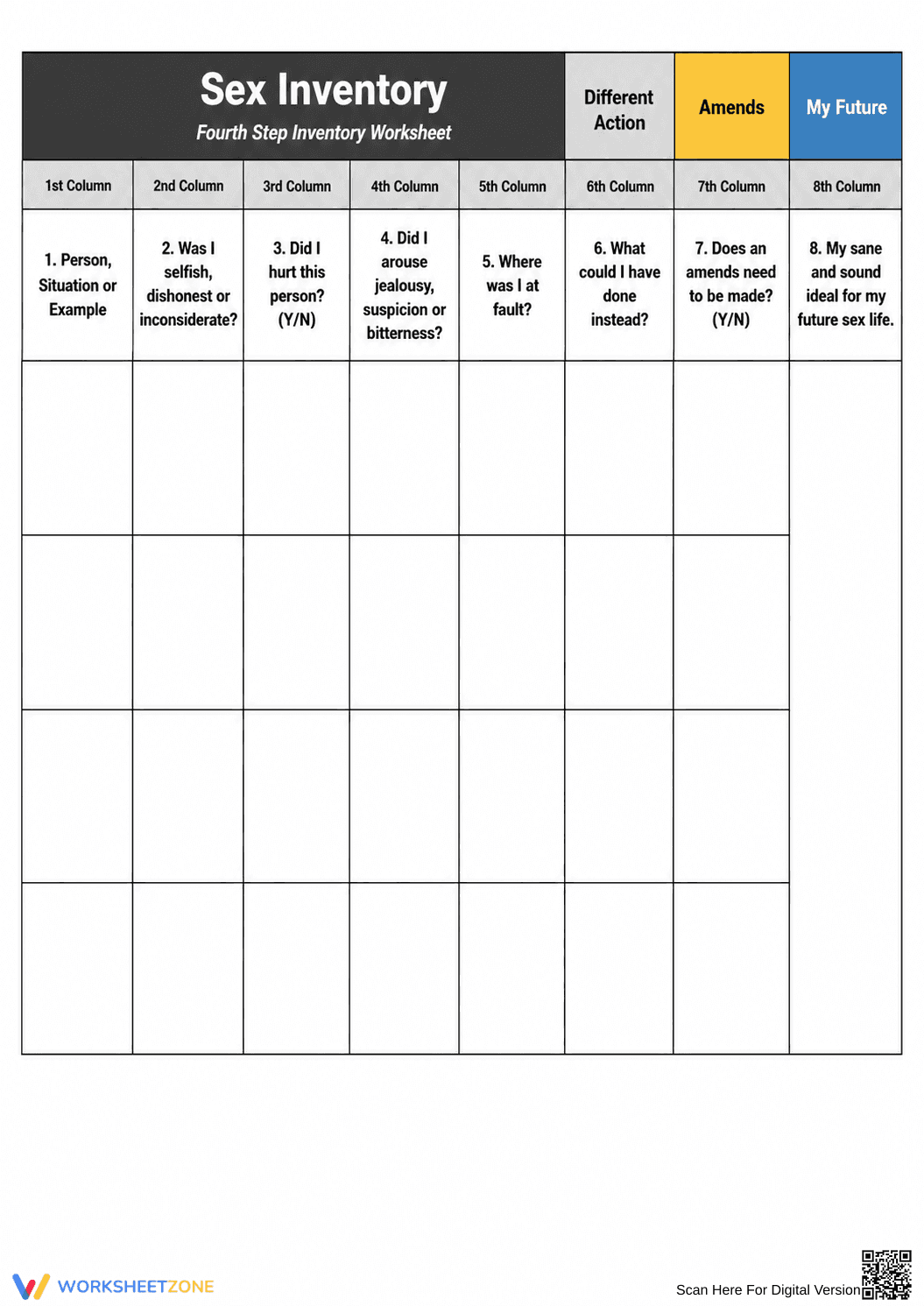
This printable Fourth Step Inventory worksheet provides a structured framework for deep self-reflection and personal accountability. Designed for mature behavioral health or counseling settings, it guides individuals through evaluating past actions, identifying areas of fault, and planning for healthier future interactions.
At a Glance
- Grade: 8 · Subject: Social Skills
- Standard:
CCSS.ELA-LITERACY.W.8.4— Produce clear and coherent writing appropriate to task- Skill Focus: Self-Reflection and Accountability
- Format: 1 page · 5 problems · Answer key not included · PDF
- Best For: Counseling and behavioral therapy
- Time: 30–45 minutes
This single-page resource features a comprehensive eight-column table designed to facilitate thorough behavioral analysis. Users are prompted to list specific situations, evaluate their own selfishness or dishonesty, and assess any harm caused to others. The graphic organizer format ensures that each of the 5 available rows guides the user systematically from identifying the fault to determining if amends are necessary, culminating in a vision for future behavior.
Implementing this reflection tool requires minimal setup for counselors or educators.
- Print (1 minute): Generate the PDF and ensure the columns are clearly legible for detailed writing.
- Distribute (1 minute): Hand out the inventory during a quiet, focused session to allow for privacy and concentration.
- Review (Ongoing): Use the completed rows as a foundation for one-on-one discussions or therapeutic debriefing.
Total prep time is under two minutes, making it an ideal zero-prep resource for immediate intervention or structured behavioral support plans.
This resource aligns with CCSS.ELA-LITERACY.W.8.4, requiring individuals to produce clear and coherent writing in which the development, organization, and style are appropriate to task, purpose, and audience. By articulating complex personal experiences and future ideals within the structured columns, users practice targeted, purpose-driven expression. Both standard codes can be copied directly into lesson plans, IEP goals, or district curriculum mapping tools.
This inventory is highly effective when used during individualized counseling sessions or targeted behavioral intervention programs. Before direct instruction or discussion, assign the worksheet to help the individual independently process a specific conflict or past behavior. During the review phase, observe how the user transitions from identifying faults in column five to formulating alternative actions in column six, which serves as an excellent formative assessment of their growing self-awareness. Expect completion to take between 30 and 45 minutes depending on the depth of reflection required.
This tool is specifically designed for mature students, young adults, or individuals in therapy who are working on personal accountability and relationship management. It provides essential scaffolding for those who struggle to break down complex emotional situations into manageable, objective components. For optimal results, pair this inventory with direct instruction on conflict resolution strategies or a foundational anchor chart outlining healthy relationship boundaries.
Integrating structured self-reflection tools into behavioral intervention significantly enhances personal accountability and emotional regulation. This worksheet aligns with CCSS.ELA-LITERACY.W.8.4 by challenging users to produce clear and coherent writing appropriate to task while engaging in deep self-evaluation. According to Fisher & Frey (2014), providing students and individuals with guided frameworks for self-assessment fosters greater independence and improves long-term behavioral outcomes. By breaking down complex interpersonal conflicts into specific, analyzable components—such as identifying faults and planning future actions—this inventory supports cognitive restructuring and responsible decision-making. The systematic approach ensures that users do not merely dwell on past mistakes but actively construct pathways for making amends and improving future interactions. This evidence-based method of structured journaling is a cornerstone of effective social-emotional learning and therapeutic intervention.


