


























Views
Downloads


Fourth Step Inventory: Flaws | Essential Printable Guide
Paste this activity's link or code into your existing LMS (Google Classroom, Canvas, Teams, Schoology, Moodle, etc.).
Students can open and work on the activity right away, with no student login required.
You'll still be able to track student progress and results from your teacher account.
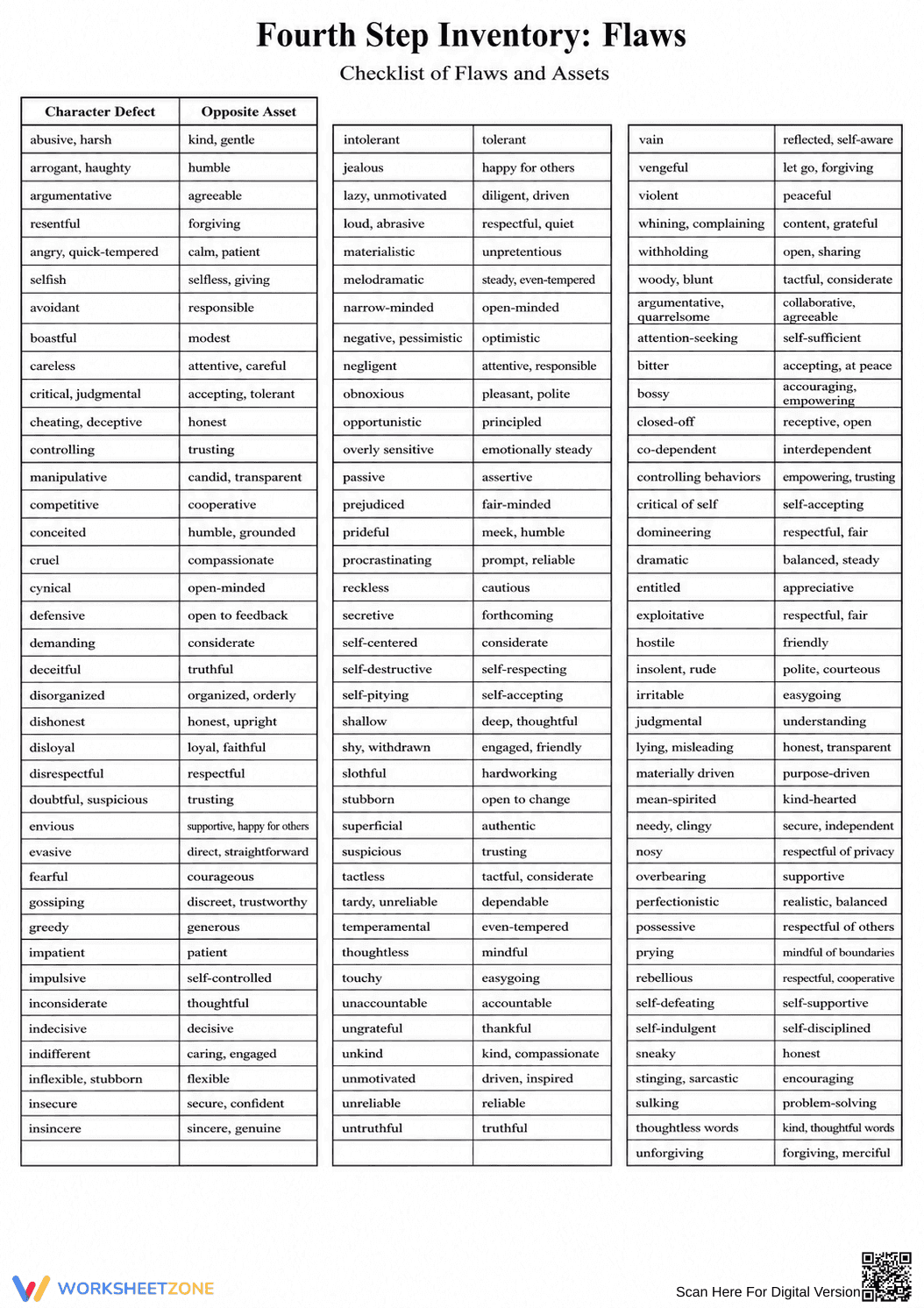
This character inventory worksheet helps students identify personal traits and behavioral patterns through a structured self-assessment. By analyzing a comprehensive A-Z list of defects and assets, learners develop the vocabulary needed to describe complex human behaviors. This tool is designed to foster deep self-awareness and emotional intelligence in secondary education settings.
At a Glance
- Grade: 9 · Subject: English / Social Skills
- Standard:
CCSS.ELA-LITERACY.L.9-10.4.D— Verify the preliminary determination of a word's meaning or phrases.- Skill Focus: Character Trait Vocabulary
- Format: 3 pages · 12 reflective tasks · Self-assessment · PDF
- Best For: Social-emotional learning and character development
- Time: 30–45 minutes
What's Inside
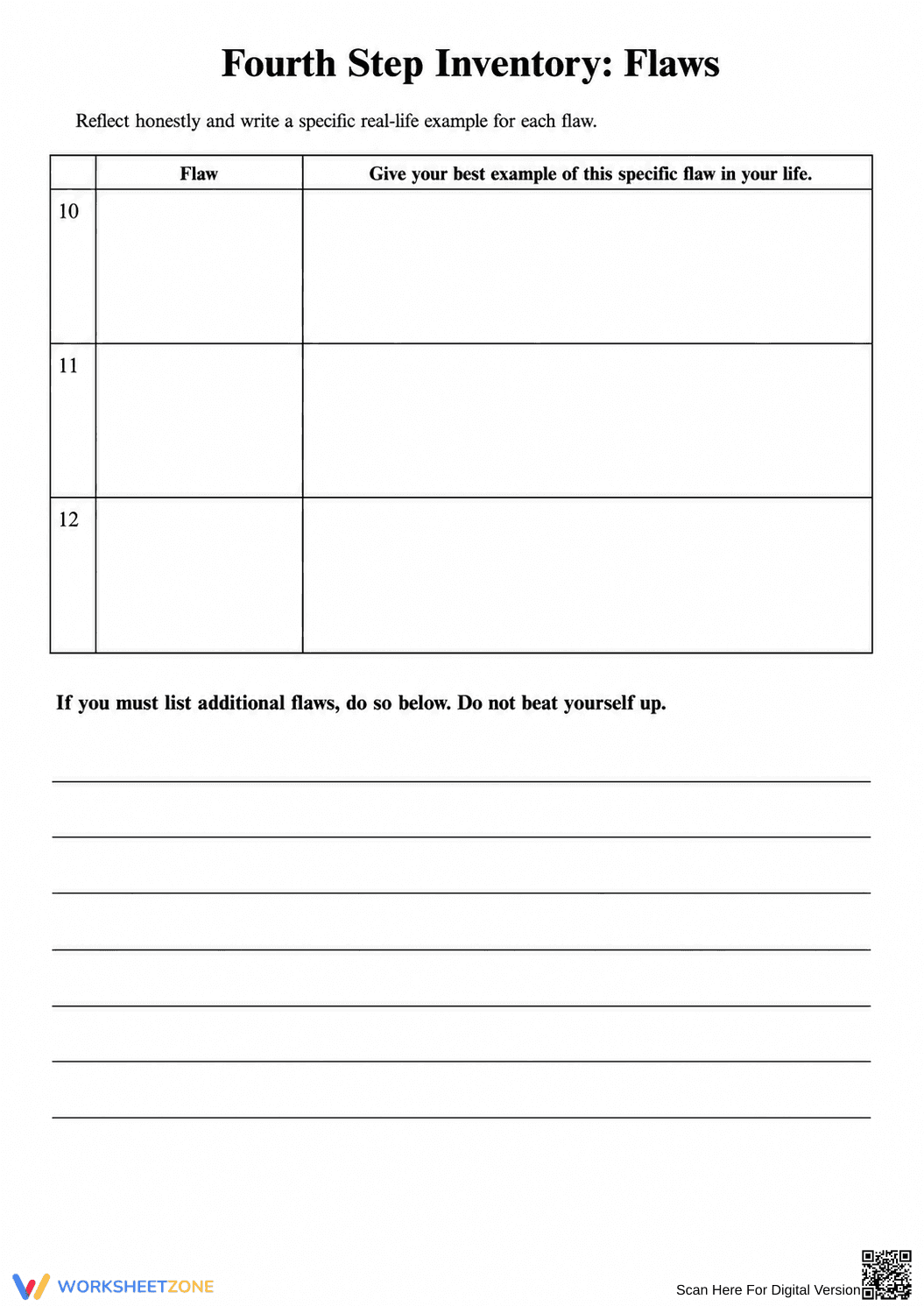
This 3-page PDF includes a massive A-Z checklist of character defects paired with their positive 'opposite assets.' Following the vocabulary bank, students find two pages of structured tables providing space for 12 specific entries. Each entry requires the student to name a flaw and provide a concrete, real-life example of that behavior, ensuring abstract concepts are grounded in personal experience.
Zero-Prep Workflow
- Print: Select the 3-page PDF and print copies (30 seconds).
- Distribute: Hand out the checklist and reflection sheets for independent work (1 minute).
- Review: Facilitate a group discussion or private check-in based on student entries.
Total teacher preparation time is under 2 minutes, making this an ideal resource for sub plans or sudden SEL blocks.
Standards Alignment
The primary standard addressed is CCSS.ELA-LITERACY.L.9-10.4.D, focusing on clarifying the precise meaning of words. Students navigate nuanced vocabulary like 'melodramatic' and 'unpretentious' to accurately self-identify. Both standard codes can be copied directly into lesson plans, IEP goals, or district curriculum mapping tools.
How to Use It
Use this worksheet during a unit on characterization or as a standalone social-emotional learning activity. It serves as an excellent formative assessment for vocabulary acquisition; observe if students can correctly match a real-life scenario to the appropriate trait. Completion typically takes 30 to 45 minutes depending on the depth of reflection.
Who It's For
This resource is tailored for high school students and adults requiring a mature framework for self-improvement. It is effective for students in counseling or those working on behavioral IEP goals. Pair this with a character trait anchor chart or a narrative writing prompt for a complete instructional block.
According to research by Fisher & Frey (2014), the use of structured graphic organizers and checklists significantly enhances a student's ability to internalize complex vocabulary and apply it to real-world contexts. This worksheet utilizes a "Fourth Step" inventory model, a proven method for behavioral self-reflection that aligns with CCSS.ELA-LITERACY.L.9-10.4.D. By requiring students to provide real-life examples for 12 distinct traits, the resource moves beyond rote memorization into the domain of applied metacognition. This approach is supported by the RAND AIRS 2024 report on social-emotional learning, which emphasizes the importance of self-awareness tools in secondary education. The clear pairing of "defects" and "assets" provides a balanced perspective, ensuring that the self-assessment remains constructive rather than purely critical, fostering a growth mindset in diverse learner populations.


