


























Views
Downloads

Essential 4th Step Resentment Inventory | Grades 6-8
Paste this activity's link or code into your existing LMS (Google Classroom, Canvas, Teams, Schoology, Moodle, etc.).
Students can open and work on the activity right away, with no student login required.
You'll still be able to track student progress and results from your teacher account.
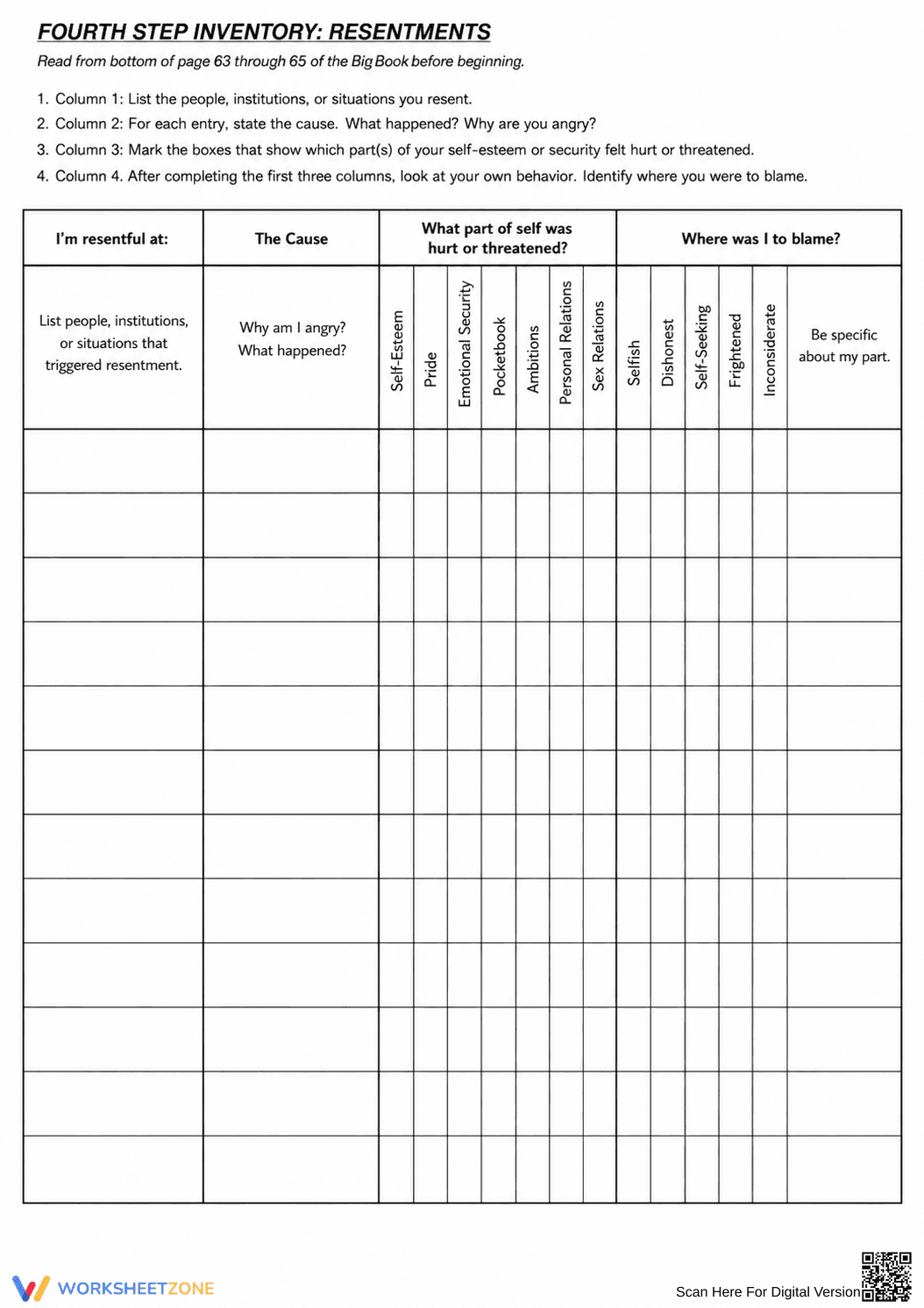
This emotional self-inventory worksheet provides a structured framework for students to identify, analyze, and process interpersonal conflicts and internal frustrations. By guiding learners through a four-stage reflection process, the resource transforms abstract feelings of anger into concrete data points for personal growth. Students move from naming their resentments to identifying their own role in the situation, fostering accountability and emotional maturity.
At a Glance
- Grade: 6-8 · Subject: Social Skills / Behavior
- Standard:
CCSS.ELA-LITERACY.W.8.10— Write routinely for discipline-specific tasks, purposes, and audiences to build self-reflection skills.- Skill Focus: Emotional Self-Inventory
- Format: 1 page · 15 problems · PDF
- Best For: SEL instruction and behavior intervention
- Time: 20–30 minutes
The worksheet features a comprehensive 15-row inventory table designed for deep introspection. It includes four distinct columns that prompt students to list the source of their resentment, the specific cause of the conflict, the internal part of their self-esteem that felt threatened, and a final column for self-blame or personal responsibility. This layout ensures that students do not simply vent their frustrations but instead engage in a rigorous analysis of the underlying mechanics of their emotions.
Zero-Prep Workflow
- Print (1 minute): Generate enough copies for your small group or whole class; the high-contrast black-and-white design ensures clear legibility even on older school copiers.
- Distribute (1 minute): Hand out the sheets during a dedicated Social-Emotional Learning (SEL) block or as part of a restorative justice circle.
- Review (5 minutes): Briefly explain the four columns, emphasizing that the final column is about personal growth rather than self-shaming. Total teacher preparation time is under two minutes, making this an ideal resource for unexpected sub plans or immediate behavioral interventions.
This resource aligns with CCSS.ELA-LITERACY.W.8.10, which requires students to write routinely for discipline-specific tasks. By applying writing skills to social-emotional health, students practice using precise language to describe complex internal states. This standard code can be copied into lesson plans or IEP goals to document the integration of literacy and behavioral health.
Introduce this during a unit on conflict resolution or after a classroom disagreement. Teachers can use completed inventories as formative assessments to see if students can distinguish between external triggers and internal reactions. Completion time ranges from 20 to 30 minutes depending on the depth of reflection and the number of entries completed.
This worksheet is designed for middle school students in Grades 6-8 who are developing the capacity for abstract thought and self-critique. It is particularly effective for students in counseling groups, behavior intervention programs, or those following a 4th Step curriculum. It pairs naturally with anchor charts focused on identifying emotions or direct instruction lessons regarding the difference between intent and impact in social interactions.
According to Fisher & Frey (2014), structured reflection tools are vital for developing metacognitive awareness. This inventory applies those principles to the social-emotional domain, requiring students to categorize feelings and identify the 'part of self' impacted by external events. By utilizing theCCSS.ELA-LITERACY.W.8.10 standard, the worksheet bridges the gap between academic writing and personal development. The 15-row structure provides space for students to practice identifying behavioral patterns. Research indicates that when students have a clear framework for processing resentment, they develop healthier coping mechanisms. This printable PDF serves as a record of emotional progress and a baseline for ongoing behavioral support.


