


























Views
Downloads
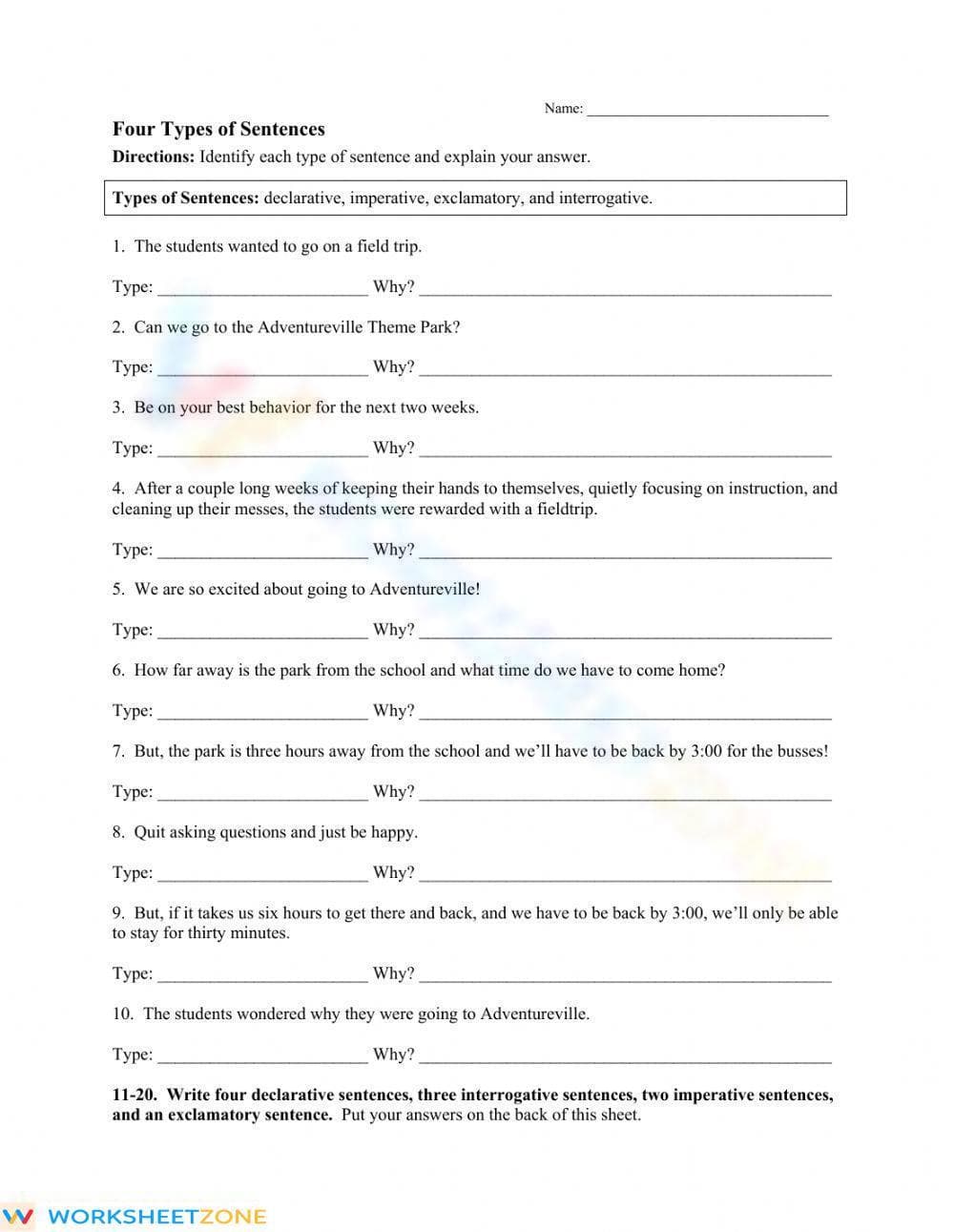

Printable Four Types of Sentences Worksheet (Grades 3-7)
Paste this activity's link or code into your existing LMS (Google Classroom, Canvas, Teams, Schoology, Moodle, etc.).
Students can open and work on the activity right away, with no student login required.
You'll still be able to track student progress and results from your teacher account.
Identifying and writing declarative, interrogative, imperative, and exclamatory sentences is a foundational literacy skill. This worksheet provides structured practice to help students distinguish between these functional sentence types and apply them in their own writing. Students will gain confidence in punctuation and sentence structure through 20 targeted exercises.
At a Glance
- Grade: 3-7 · Subject: ELA Sentences
- Standard:
CCSS.ELA-LITERACY.L.3.1— Produce and expand complete sentences using appropriate grammar and punctuation- Skill Focus: Four types of sentences
- Format: 1 page · 20 problems · Answer key included · PDF
- Best For: Grammar reinforcement and independent practice
- Time: 20–30 minutes
This single-page PDF includes a comprehensive two-part activity set. The first section contains 10 identification tasks where students must categorize sentences as declarative, imperative, exclamatory, or interrogative and explain their reasoning. The second section provides 10 creative writing prompts requiring students to generate their own examples of each sentence type to demonstrate mastery.
To implement this classroom-ready workflow, follow these three simple steps:
- Print: 30 seconds to generate copies for the entire class.
- Distribute: 1 minute to hand out and explain the dual-task structure.
- Review: 5-10 minutes for peer-review or whole-class discussion of the "Why?" explanations.
This worksheet requires zero teacher setup, making it an ideal choice for sub plans, morning work, or quick formative assessments during a grammar unit.
Standards Alignment
CCSS.ELA-LITERACY.L.3.1 focuses on the command of the conventions of standard English grammar and usage when writing or speaking. This resource specifically addresses the ability to produce and recognize different sentence types, which is essential for varied writing and correct punctuation. Both standard codes can be copied directly into lesson plans, IEP goals, or district curriculum mapping tools.
How to Use It
Assign this worksheet after an introductory lesson on sentence functions to assess student comprehension of punctuation cues and intent. It works exceptionally well as a station activity in a literacy rotation, where teachers can observe students' ability to explain the reasoning behind their classifications. This allows for immediate correction of common misconceptions regarding punctuation and sentence intent.
Who It's For
This resource is designed for students in grades 3 through 7 who are refining their understanding of sentence structure. It offers natural scaffolding for English Language Learners (ELLs) by requiring written explanations for each choice, pairing perfectly with a classroom anchor chart on punctuation. It is also suitable for remedial support in higher grades where sentence variety needs reinforcement.
The instruction of sentence types (declarative, interrogative, imperative, and exclamatory) is a critical component of syntactic development in elementary and middle school education. According to Fisher & Frey (2014), explicit instruction in sentence structure and function allows students to develop the writer's craft, enabling them to vary their sentences for effect and audience engagement. Aligned with CCSS.ELA-LITERACY.L.3.1, this worksheet facilitates the transition from basic recognition to active production. Research from EdReports 2024 emphasizes that high-quality, aligned materials must move beyond simple identification to require student-generated evidence of mastery. By combining 10 analysis tasks with 10 synthesis-level writing prompts, this tool ensures students internalize the rules of functional grammar. This structured approach supports the gradual release of responsibility, moving students from guided analysis to independent creative application of linguistic conventions as seen in recent NAEP assessments.


