


























Views
Downloads
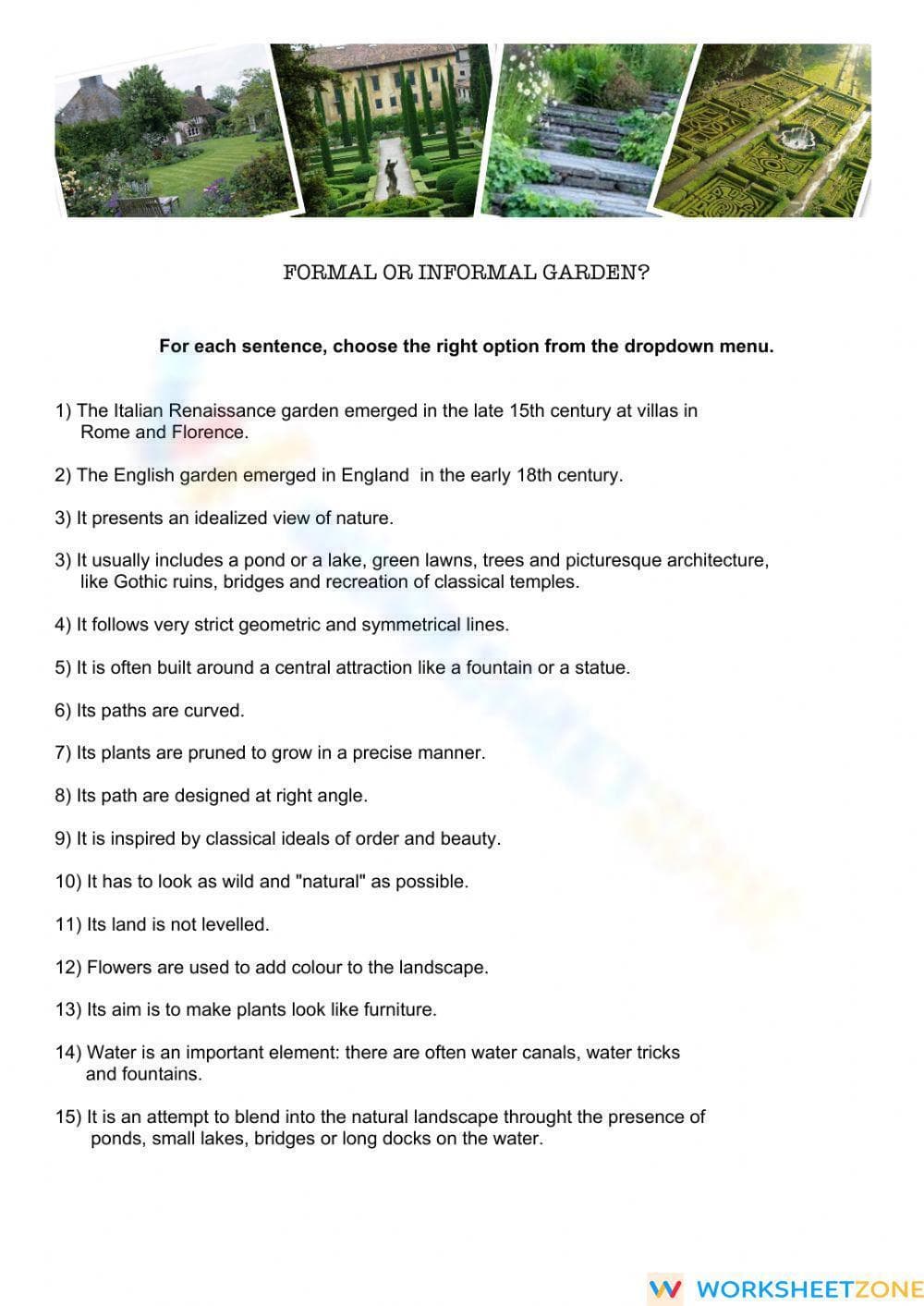

Grade 10-12 Garden Styles — Printable No-Prep Worksheet
Paste this activity's link or code into your existing LMS (Google Classroom, Canvas, Teams, Schoology, Moodle, etc.).
Students can open and work on the activity right away, with no student login required.
You'll still be able to track student progress and results from your teacher account.
This reading comprehension worksheet offers high school students a focused challenge: distinguishing between formal and informal garden architectural styles. By analyzing 15 descriptive statements about history, layout, and botany, learners sharpen their ability to categorize details in complex informational text, a critical skill for college-level reading and analysis.
At a Glance
- Grade: 10–12 · Subject: English Language Arts (ELA)
- Standard:
CCSS.ELA-LITERACY.RI.11-12.1— Cite strong evidence to support analysis of informational texts.- Skill Focus: Text Analysis & Categorization
- Format: 1 page · 15 problems · Answer key included · PDF
- Best For: Independent practice or a quick formative assessment
- Time: 15–20 minutes
What's Inside
This single-page PDF contains a clear task. Students read 15 distinct statements describing features of European gardens and classify each as a characteristic of either a formal or informal style. The clean layout ensures focus on textual evidence. A comprehensive answer key is included on a separate page to facilitate rapid grading or self-correction.
A Zero-Prep Workflow
This resource is designed for maximum efficiency. The zero-prep workflow is a simple, three-step process for busy educators:
- Print (1 Minute): Print the single-page worksheet or distribute the PDF digitally via a learning management system.
- Practice (15-20 Minutes): Students work independently on the self-contained task, which requires no additional materials or direct instruction.
- Review (5 Minutes): Use the provided answer key to lead a brief class review or allow students to self-check for immediate feedback.
This entire activity requires under two minutes of teacher preparation, making it a reliable resource for a substitute plan or bell-ringer.
Standards Alignment
This worksheet directly targets CCSS.ELA-LITERACY.RI.11-12.1, which requires students to "cite strong and thorough textual evidence to support analysis of what the text says explicitly." By mapping descriptive statements to the correct garden style, students practice using textual details to make an evidence-based classification. The standard code can be copied directly into lesson plans or curriculum maps.
How to Use It
Use this worksheet for independent practice after a lesson on analyzing descriptive text or as a formative assessment to check for understanding. It also functions well as a pre-assessment to gauge students' existing categorization skills. During the activity, observe student handling of vocabulary like "picturesque" to identify re-teaching opportunities. Expected completion time is 15 to 20 minutes.
Who It's For
Designed for students in grades 10-12 ELA classes, this activity's high-interest topic engages a wide range of learners. The structured format provides excellent support. For deeper context, it pairs well with a visual anchor chart comparing design principles or a short reading passage from an art history text.
This worksheet provides targeted practice for a critical component of adolescent literacy: using textual evidence to support analysis, as outlined in CCSS.ELA-LITERACY.RI.11-12.1. The ability to read a piece of information and correctly categorize it based on established criteria is a foundational skill for all higher-order thinking. Research from Fisher & Frey (2014) emphasizes that such close reading tasks, which demand attention to detail, are essential for preparing students for the complexities of college and career texts. The worksheet's structure requires students to move beyond simple recall and engage in analytical thinking by connecting specific details (e.g., "Its paths are curved") to a broader concept (informal design). This exercise serves as a practical application of evidence-based reasoning, reinforcing the analytical habits that are proven to build stronger, more discerning readers in all content areas.


