


























Views
Downloads

Food Webs and Food Chains Worksheet | Essential Grade 6
Paste this activity's link or code into your existing LMS (Google Classroom, Canvas, Teams, Schoology, Moodle, etc.).
Students can open and work on the activity right away, with no student login required.
You'll still be able to track student progress and results from your teacher account.
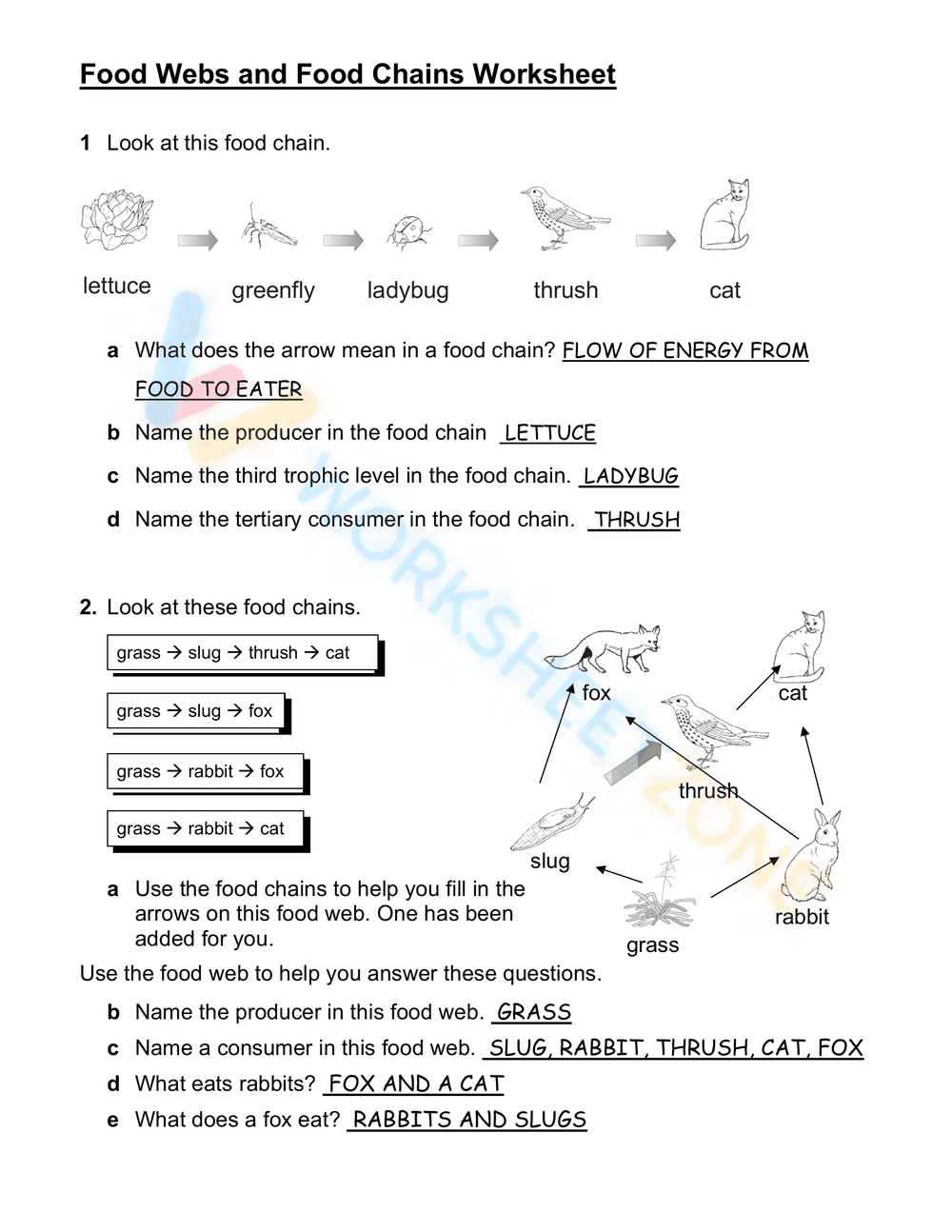
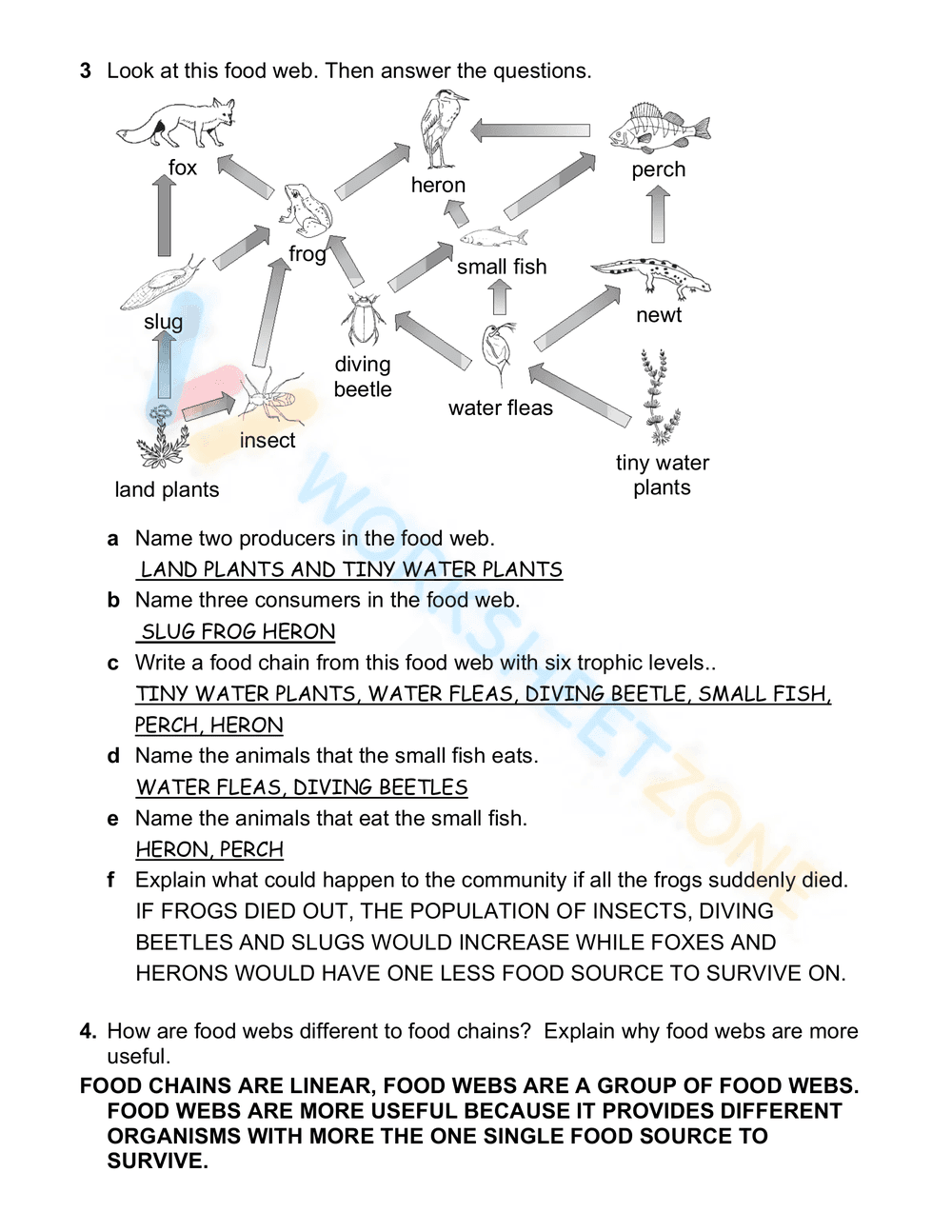
This Grade 6 science worksheet helps students visualize the complex relationships within ecosystems by analyzing food chains and constructing food webs. Students identify producers, consumers, and trophic levels while tracing the flow of energy through various organisms. It provides a clear path from simple linear chains to interconnected biological networks.
At a Glance
- Grade: 6 · Subject: Science
- Standard:
MS-LS2-3— Develop a model to describe the flow of energy among living parts of an ecosystem- Skill Focus: Food web construction and trophic analysis
- Format: 2 pages · 15 problems · Answer key included · PDF
- Best For: Independent practice or formative assessment
- Time: 25–35 minutes
What's Inside
This 2-page PDF features 15 targeted questions across four distinct sections. The first page focuses on a single food chain, requiring students to define energy flow arrows and identify specific roles like tertiary consumers. The second page challenges students to synthesize multiple food chains into a cohesive web and predict the ecological consequences of population changes. A complete answer key is provided for immediate feedback and grading.
Zero-Prep Workflow
- Print: Select the 2-page PDF and print enough copies for your class in under 60 seconds.
- Distribute: Hand out the worksheets as a transition from direct instruction to independent practice.
- Review: Use the included answer key to conduct a 5-minute whole-class review or peer-grading session. Total teacher preparation time is less than 2 minutes.
Standards Alignment
This resource is aligned with MS-LS2-3, which requires students to develop models describing the cycling of matter and flow of energy among living and nonliving parts of an ecosystem. By identifying producers and consumers across six trophic levels, students demonstrate a deep understanding of energy transfer. Both standard codes can be copied directly into lesson plans, IEP goals, or district curriculum mapping tools.
How to Use It
Use this worksheet during the "Explain" or "Elaborate" phase of a 5E lesson cycle. It serves as an excellent formative assessment after students have been introduced to the concept of energy pyramids. Teachers should observe if students correctly orient arrows from the "food" to the "eater" to ensure they grasp the direction of energy transfer. Expected completion time is approximately 30 minutes.
Who It's For
This resource is designed for middle school science students, particularly those in Grade 6 or 7. It is highly effective for general education classrooms, but the visual nature of the food webs also supports English Language Learners and students with IEPs who benefit from graphic organizers. Pair this with a local pond or forest ecosystem anchor chart for maximum instructional impact.
According to the RAND AIRS 2024 report on science literacy, the use of visual modeling in middle school biology significantly improves long-term retention of ecological concepts. This worksheet directly addresses the MS-LS2-3 standard by requiring students to interpret and construct models of energy flow. By distinguishing between linear food chains and complex food webs, students engage in higher-order thinking regarding ecosystem stability and the interdependence of organisms. Research from Fisher & Frey (2014) suggests that scaffolded practice, moving from simple identification to predicting population impacts, is essential for mastering the flow of energy concept. This resource provides 15 specific tasks that facilitate this cognitive progression. The inclusion of an answer key allows for immediate corrective feedback, a practice shown by EdReports 2024 to be a critical component of high-quality instructional materials in the science classroom.


