


























Views
Downloads

Food Web Guided Lesson | Essential Grade 5 Science
Paste this activity's link or code into your existing LMS (Google Classroom, Canvas, Teams, Schoology, Moodle, etc.).
Students can open and work on the activity right away, with no student login required.
You'll still be able to track student progress and results from your teacher account.
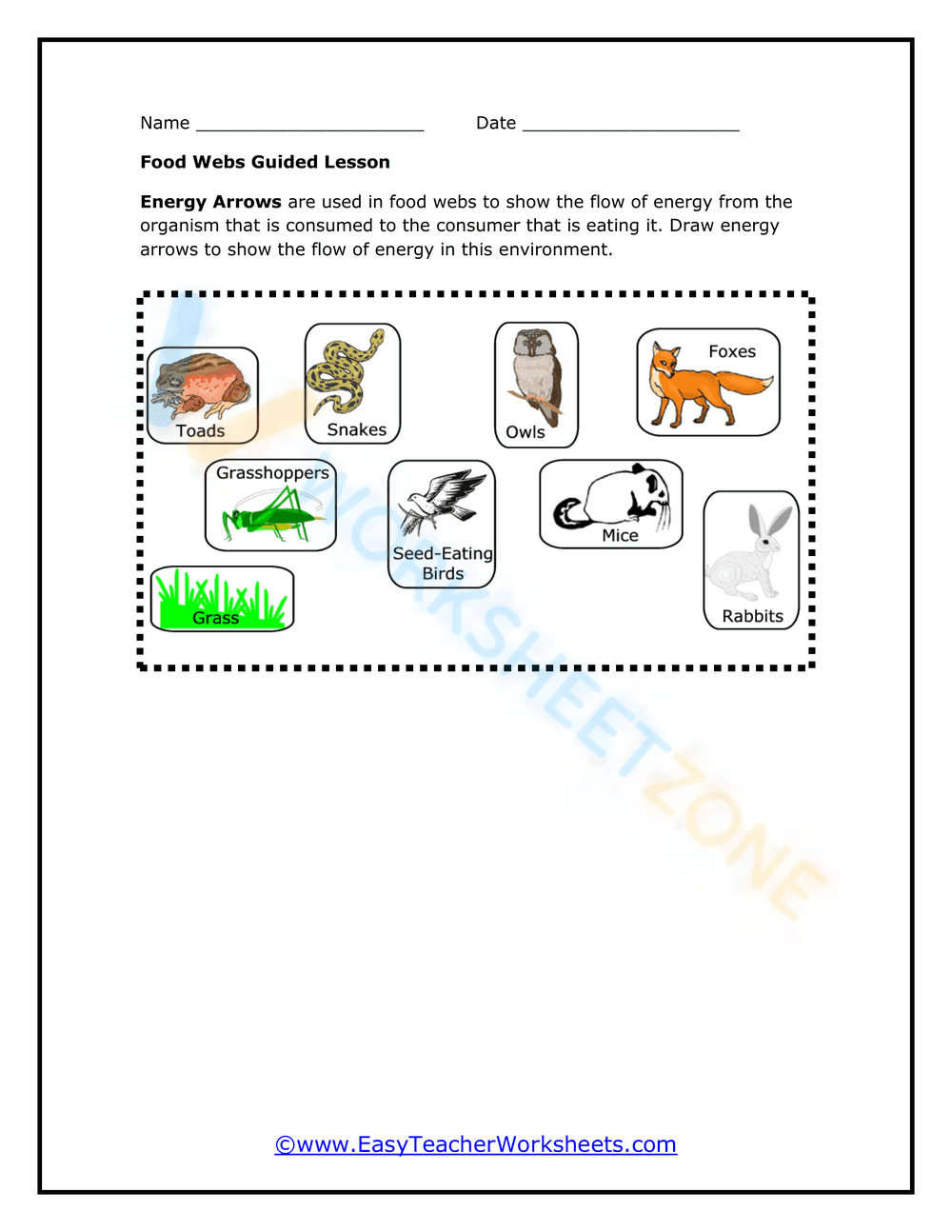
This Grade 5 science worksheet provides a focused guided lesson on constructing food webs. Students learn to identify the direction of energy flow by drawing arrows from producers to consumers within a specific ecosystem model. It transforms abstract ecological concepts into a concrete visual mapping exercise that reinforces the relationship between different organisms.
At a Glance
- Grade: 5 · Subject: Science
- Standard:
5-LS2-1— Model the movement of matter and energy among organisms in an ecosystem- Skill Focus: Energy flow directionality
- Format: 1 page · 10+ connections · Answer key included · PDF
- Best For: Introduction to ecosystem modeling
- Time: 15–20 minutes
The worksheet features a clear, boxed diagram containing nine distinct organisms, including producers like grass and various consumers such as foxes, owls, and toads. A concise instructional header defines "Energy Arrows" to ensure students understand that arrows represent the flow of energy, not just who eats whom. The layout provides ample white space for students to draw clear, intersecting lines.
This resource is designed for immediate classroom implementation with a three-step workflow. First, print the single-page PDF (30 seconds). Second, distribute to students and read the bolded definition of energy arrows aloud (2 minutes). Third, review the completed webs as a whole group to correct common misconceptions about arrow direction (5 minutes). Total teacher preparation time is under two minutes, making it an ideal sub plan or warm-up.
This activity is directly aligned with `5-LS2-1`, which requires students to develop a model to describe the movement of matter among plants and animals. By physically drawing the arrows, students create a functional model of an ecosystem. Both standard codes can be copied directly into lesson plans, IEP goals, or district curriculum mapping tools.
Use this worksheet during the explore phase of a lesson cycle after introducing the roles of producers and consumers. It serves as an excellent formative assessment to check if students understand that arrows point toward the consumer. Expect students to complete the diagram in 15 to 20 minutes, followed by a brief peer-review session to compare their web connections.
This resource is ideal for general education fifth-grade classrooms, but the visual nature makes it highly accessible for English Language Learners (ELLs) and students with IEPs who benefit from graphic organizers. It pairs perfectly with an anchor chart showing a simple food chain before moving to this more complex web involving multiple predators and prey.
Research from EdReports (2024) emphasizes that high-quality science instruction must move beyond rote memorization toward active modeling of phenomena. This worksheet supports that shift by requiring students to apply the 5-LS2-1 standard through the creation of a visual energy model. By identifying the specific direction of energy transfer from producers like grass to apex predators like foxes, students build a foundational understanding of trophic levels and ecosystem stability. Studies in the ScienceDirect TpT Analysis suggest that structured, single-page guided lessons significantly reduce cognitive load for middle-elementary students, allowing them to focus on the conceptual accuracy of the energy flow rather than complex formatting. This resource provides the necessary scaffolding to ensure that students can successfully demonstrate their understanding of ecological interactions in a time-efficient manner.


