




























Views
Downloads

Food Groups Worksheet | Printable Grade 5 Science

Paste this activity's link or code into your existing LMS (Google Classroom, Canvas, Teams, Schoology, Moodle, etc.).
Students can open and work on the activity right away, with no student login required.
You'll still be able to track student progress and results from your teacher account.
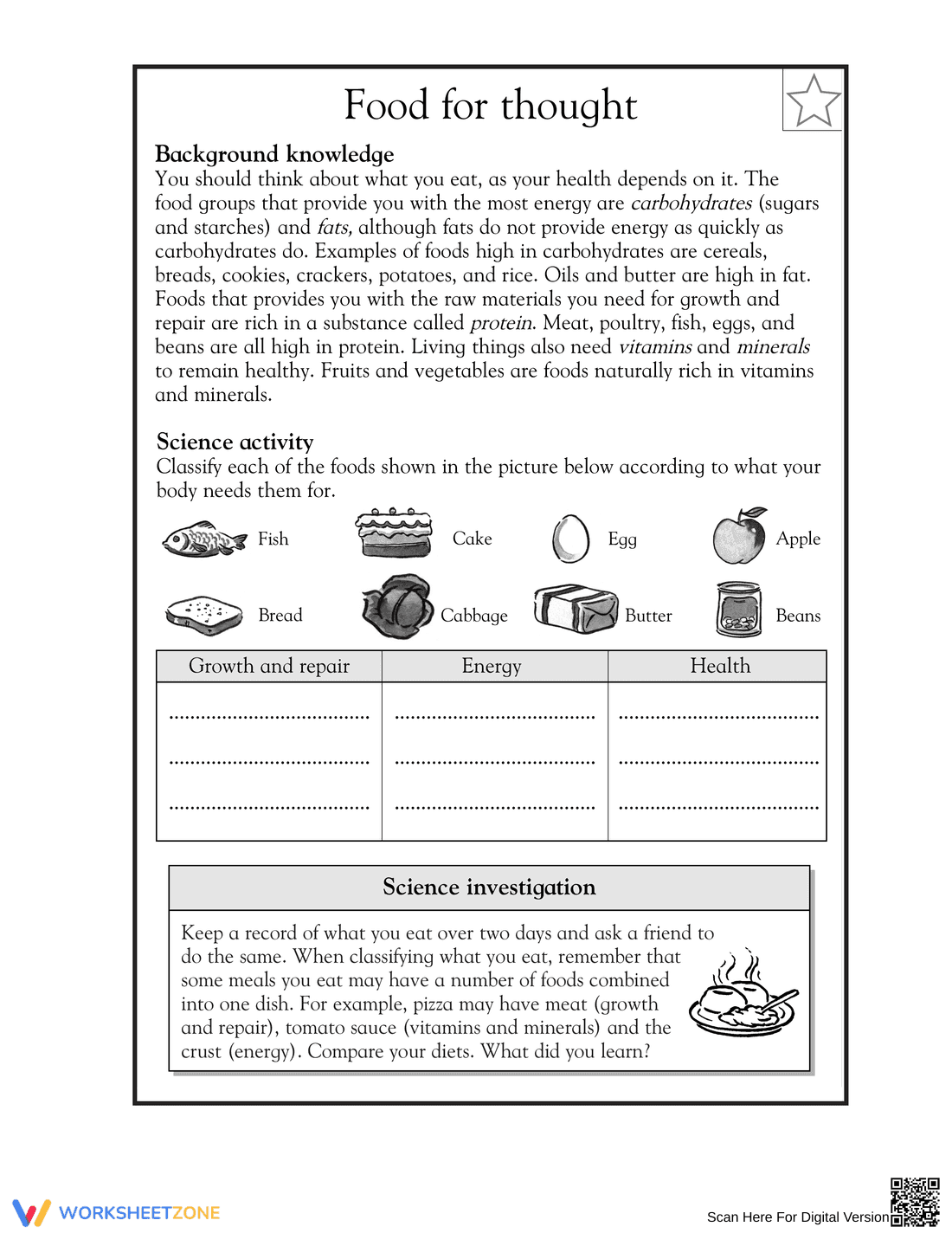
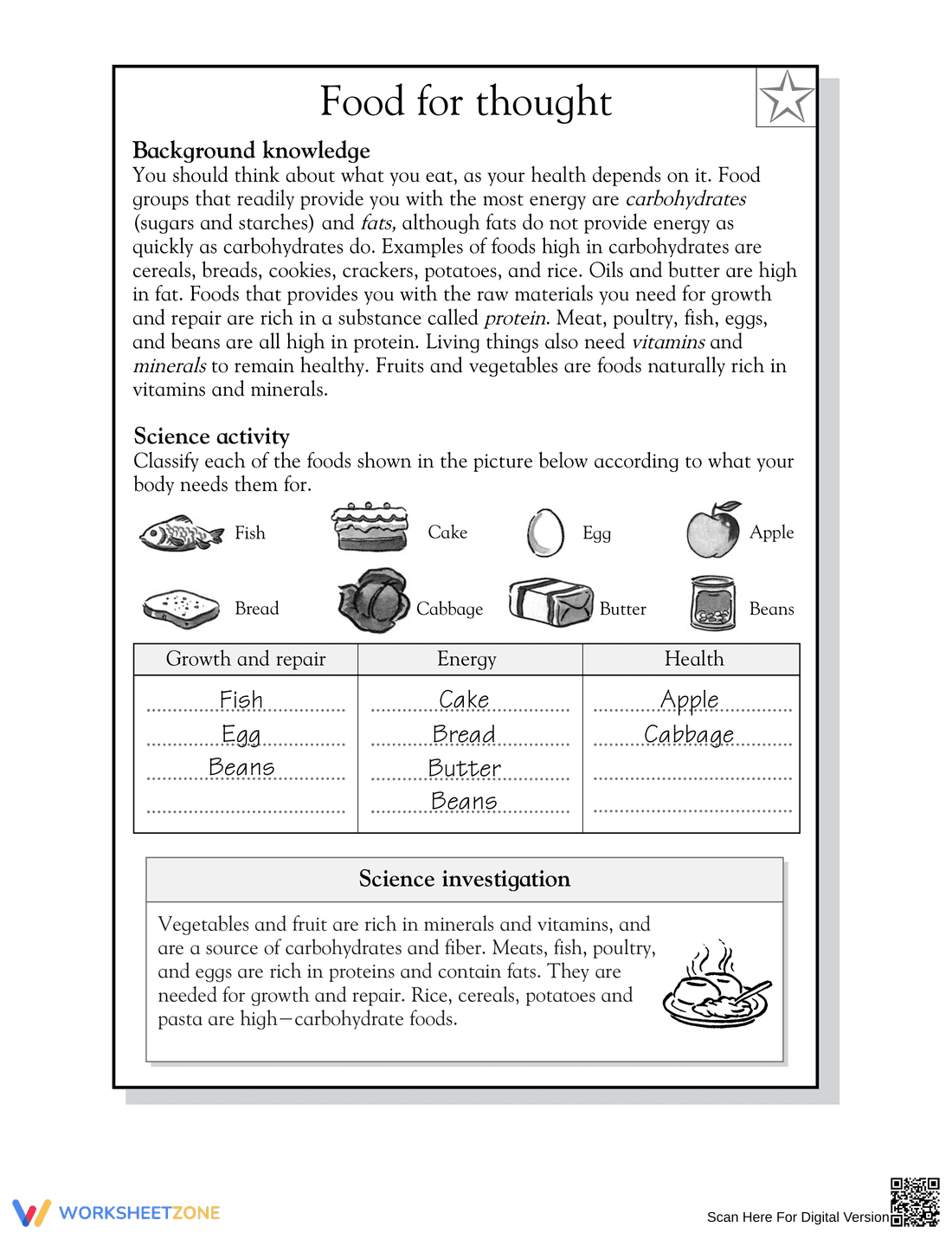
Students identify the vital roles of carbohydrates, fats, proteins, and vitamins in this comprehensive science worksheet. By classifying specific foods based on their contribution to growth, repair, energy, and overall health, learners build a foundation in nutritional science and human biology. This activity connects dietary choices to physiological outcomes.
At a Glance
- Grade: 5 · Subject: Science
- Standard:
5-PS3-1— Use models to describe how food provides energy for body repair and growth- Skill Focus: Nutrient Classification
- Format: 1 page · 8 problems · Answer key included · PDF
- Best For: Independent science centers or homework
- Time: 20–30 minutes
This science resource features a "Background knowledge" section defining primary nutrient groups. Following the text, students complete a classification table, sorting eight items—including fish, cake, and cabbage—into physiological categories. The worksheet concludes with a "Science investigation" prompt that encourages students to track and analyze their own dietary habits over a forty-eight-hour period.
Zero-Prep Workflow
This resource is designed for immediate distribution with zero teacher setup required. Step 1: Print the single-sided PDF (30 seconds). Step 2: Students complete the reading and classification session independently (15 minutes). Step 3: Review the table as a whole-group check or collect for a formative assessment grade (2 minutes). The self-contained tasks make this an ideal candidate for emergency substitute plans or transition activities.
Standards Alignment
This worksheet is aligned to 5-PS3-1, focusing on how food provides energy for body repair, growth, and motion. By categorizing foods into "Growth and repair" and "Energy" columns, students demonstrate understanding of biological systems. This standard code can be copied directly into lesson plans, IEP goals, or district curriculum mapping tools. Both standard codes can be copied directly into lesson plans, IEP goals, or district curriculum mapping tools.
How to Use It
Use this as a concluding activity for a unit on human body systems. Before instruction, assign the "Science investigation" to pique curiosity about food composition. During the lesson, use the classification table as a formative assessment to identify students who struggle with distinguishing between carbohydrates and proteins. Teachers should observe if students correctly categorize items like butter or beans to gauge their grasp of nutrient functions.
Who It's For
This resource is tailored for fifth-grade students but works for fourth-grade enrichment or sixth-grade remediation. The text is scaffolded for intermediate readers, and visual icons support English Language Learners and students with IEP accommodations. It pairs naturally with a food web diagram or an anchor chart detailing vitamins and minerals essential for human health.
Effective nutrition education relies on integrating reading with classification, a method supported by the ScienceDirect TpT Analysis 2024. Research indicates that when students move from passive reading about nutrients to active classification of objects like fish and cabbage, retention of the 5-PS3-1 standard increases significantly. This worksheet leverages that shift by providing immediate application of the background text to a structured problem set. Furthermore, the inclusion of an investigation reflects best practices for science inquiry highlighted in NAEP reports, emphasizing the connection between theory and personal data. By focusing on the plain-English skill of identifying food functions, this resource ensures students can explain why their bodies require specific nutrients for repair and energy production.


