




























Views
Plays



Essential Food Chains and Food Webs Review | Grade 7 Science

Paste this activity's link or code into your existing LMS (Google Classroom, Canvas, Teams, Schoology, Moodle, etc.).
Students can open and work on the activity right away, with no student login required.
You'll still be able to track student progress and results from your teacher account.
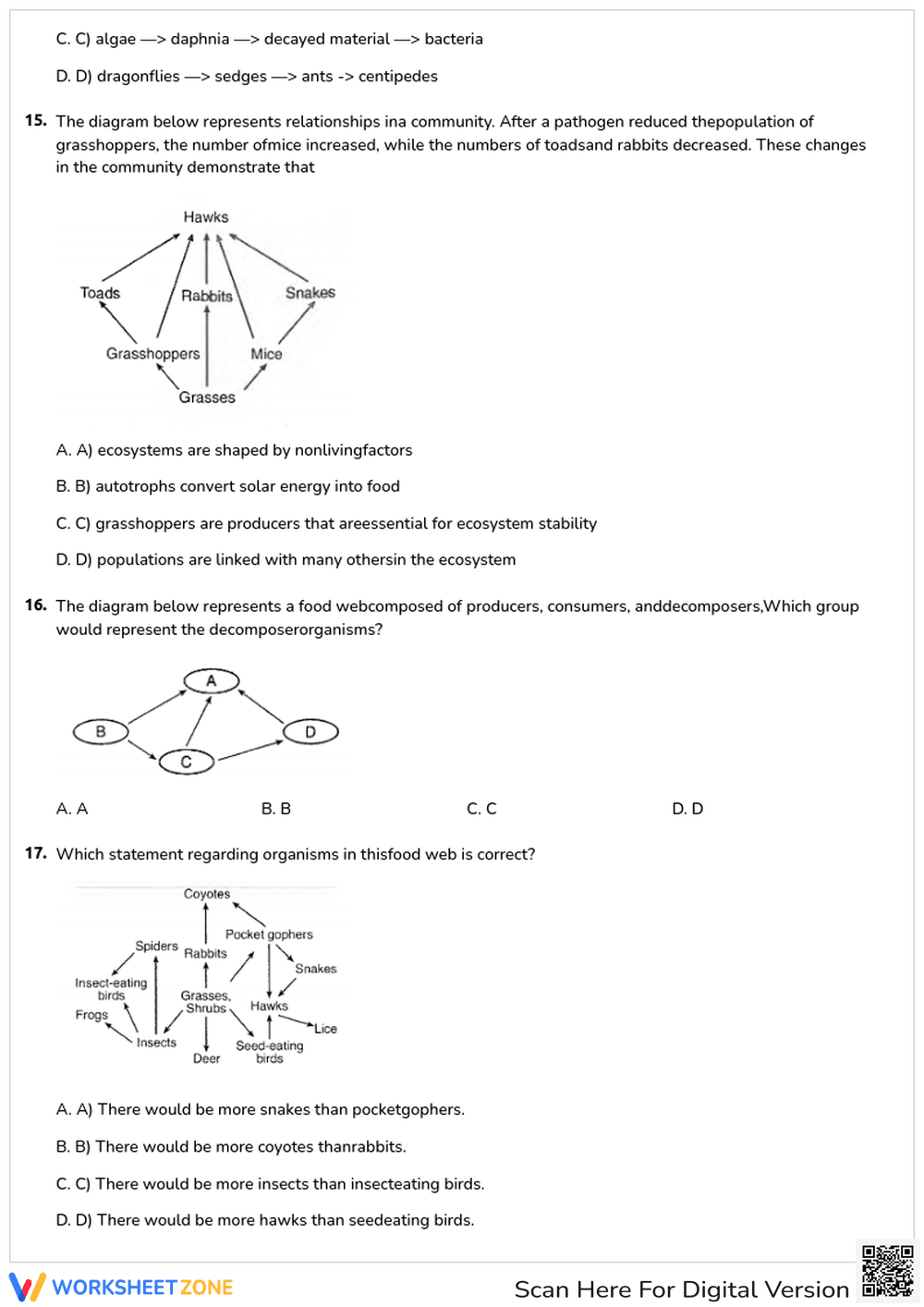
This Grade 7 science worksheet provides a comprehensive review of energy transfer within ecosystems. Students analyze 17 multiple-choice questions to identify producers, consumers, and decomposers while interpreting complex food web diagrams. It ensures learners can predict how population changes impact the stability of a biological community.
At a Glance
- Grade: 7 · Subject: Science
- Standard:
MS-LS2-3— Develop a model to describe the cycling of matter and energy flow- Skill Focus: Trophic levels and food web analysis
- Format: 4 pages · 17 problems · Answer key included · PDF
- Best For: Unit review or formative assessment
- Time: 25–35 minutes
What's Inside: The packet contains four pages of rigorous assessment items. It features five distinct ecological diagrams, including aquatic and terrestrial food webs. Students must navigate technical vocabulary such as autotroph, heterotroph, and saprophytic. The layout uses a clear multiple-choice format, making it easy to grade manually or via scanning tools.
Skill Progression
- Guided practice: The initial questions define foundational roles, asking students to identify the primary source of energy and the function of producers.
- Supported practice: Middle tasks introduce visual models where students must categorize specific organisms like fruit flies or vultures based on their nutritional relationships.
- Independent practice: The final section requires high-level analysis of population interference, asking students to predict the cascading effects of removing a specific species from a web.
This sequence follows a gradual-release model to ensure students move from recall to application.
Standards Alignment
This resource is aligned with `MS-LS2-3`: "Develop a model to describe the cycling of matter and flow of energy among living and nonliving parts of an ecosystem." It specifically addresses the flow of energy from producers to consumers. Both standard codes can be copied directly into lesson plans, IEP goals, or district curriculum mapping tools.
How to Use It
Use this as a summative review at the end of an ecology unit. Assign it after direct instruction on trophic levels to gauge student understanding of energy pyramids. During the activity, circulate to observe if students can correctly identify the direction of energy flow indicated by arrows in the diagrams. Completion typically takes 30 minutes.
Who It's For
This is designed for middle school life science students, particularly those in Grade 7 or 8. It provides excellent support for visual learners through its heavy use of diagrams. Pair this with an interactive food web building activity or a digital simulation for a complete instructional cycle.
According to the RAND AIRS 2024 report, high-quality science materials must integrate visual models with rigorous vocabulary to bridge the gap between conceptual knowledge and practical application. This worksheet fulfills that requirement by requiring students to interpret MS-LS2-3 through complex diagrams rather than simple rote memorization. By challenging students to predict ecosystem outcomes based on population shifts, the resource aligns with modern pedagogical shifts toward systems thinking in life science. Research from Fisher & Frey (2014) emphasizes that multiple-choice assessments, when paired with complex visual stimuli, serve as effective formative tools for identifying specific misconceptions in energy transfer logic. This 17-question set provides the necessary data points for teachers to adjust instruction before high-stakes testing, ensuring that 100% of the core trophic concepts are addressed through evidence-based questioning strategies.


