


























Views
Downloads
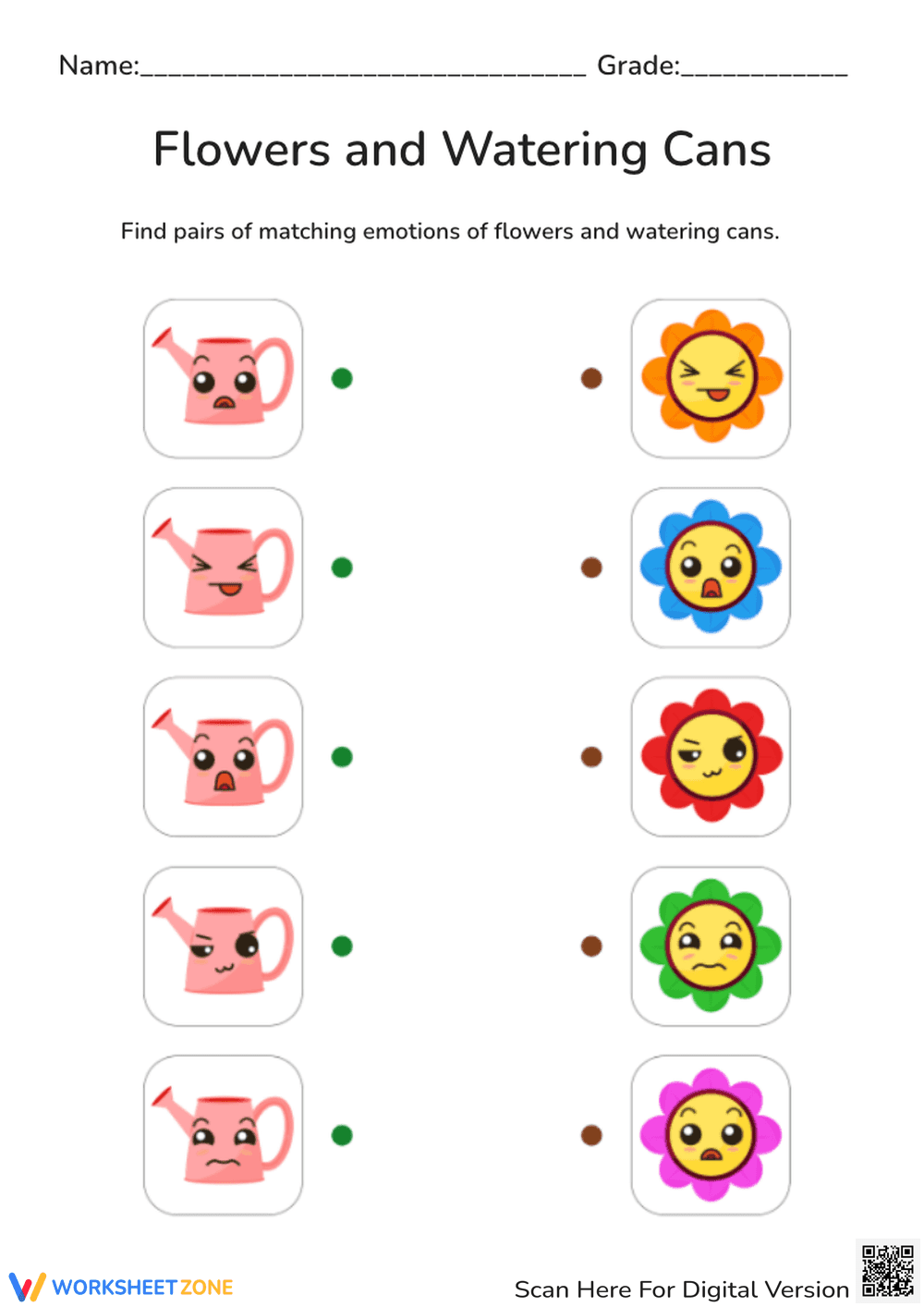

Kindergarten Emotion Matching Worksheet | Printable Ready
Paste this activity's link or code into your existing LMS (Google Classroom, Canvas, Teams, Schoology, Moodle, etc.).
Students can open and work on the activity right away, with no student login required.
You'll still be able to track student progress and results from your teacher account.
This Kindergarten emotion recognition worksheet helps young learners identify and match facial expressions using a fun garden theme. By connecting watering cans to flowers with identical moods, students develop the foundational social-emotional skills necessary to label feelings and build empathy. It provides a clear, visual way to practice non-verbal communication cues before moving to complex verbal descriptions.
At a Glance
- Grade: Kindergarten · Subject: Behavior & SEL
- Standard:
CCSS.ELA-LITERACY.L.K.5.C— Identify real-life connections between words and their use (emotions)- Skill Focus: Emotion Recognition and Visual Matching
- Format: 1 page · 5 problems · Answer key included · PDF
- Best For: Morning work or SEL small groups
- Time: 5–10 minutes
Inside this resource, you will find a single-page activity featuring five distinct emotional expressions. The left column displays watering cans with specific facial cues, while the right column features colorful flowers with matching expressions. The layout is clean and distraction-free, making it ideal for students who require high-contrast visuals or those just beginning to develop fine motor skills through line-drawing tasks.
The zero-prep workflow for this worksheet is designed for maximum efficiency in a busy classroom. First, print the single-page PDF (30 seconds). Next, distribute the sheets to your students during a transition or as part of a dedicated social-emotional learning block (1 minute). Finally, review the matches as a whole group to discuss what each facial expression represents, such as "surprised," "silly," or "sad" (2 minutes). Total teacher preparation time is under two minutes, making it a perfect sub-plan addition.
This activity aligns with CCSS.ELA-LITERACY.L.K.5.C, which focuses on identifying real-life connections between words and their use, specifically regarding categories of feelings. By visually matching the expressions, students bridge the gap between abstract emotional concepts and concrete visual representations. Both standard codes can be copied directly into lesson plans, IEP goals, or district curriculum mapping tools.
Use this worksheet as a formative assessment after a read-aloud about feelings. Observe if students can correctly identify the subtle differences in eye and mouth shapes. It also serves as an excellent "calm down" activity for students returning from recess or as a quiet transition task. Completion typically takes 5 to 10 minutes depending on the student's fine motor speed and familiarity with the expressions.
This resource is designed for Kindergarten students, including those in general education and special education settings. It is particularly effective for English Language Learners (ELLs) who benefit from visual-to-visual matching before moving to word-to-picture matching. Pair this with a "Feelings Chart" or an anchor chart showing different facial expressions for additional instructional support during direct instruction.
According to the RAND AIRS 2024 report on early childhood development, explicit instruction in emotion recognition is a critical precursor to self-regulation and social competence. This worksheet addresses the CCSS.ELA-LITERACY.L.K.5.C standard by requiring students to distinguish between various emotional states through visual cues. Research from Fisher & Frey (2014) emphasizes that visual matching tasks provide the necessary scaffolding for younger learners to internalize complex social concepts before they possess the vocabulary to describe them verbally. By engaging with these 5 specific tasks, students practice the gradual release of responsibility when paired with teacher-led discussion. This resource provides a structured, evidence-based approach to social-emotional learning that fits easily into any Kindergarten curriculum, ensuring that students meet foundational benchmarks for identifying and connecting real-life emotional states to their environment.


