


























Views
Downloads

Flower Pot Dot to Dot | Printable Grade K Math
Paste this activity's link or code into your existing LMS (Google Classroom, Canvas, Teams, Schoology, Moodle, etc.).
Students can open and work on the activity right away, with no student login required.
You'll still be able to track student progress and results from your teacher account.
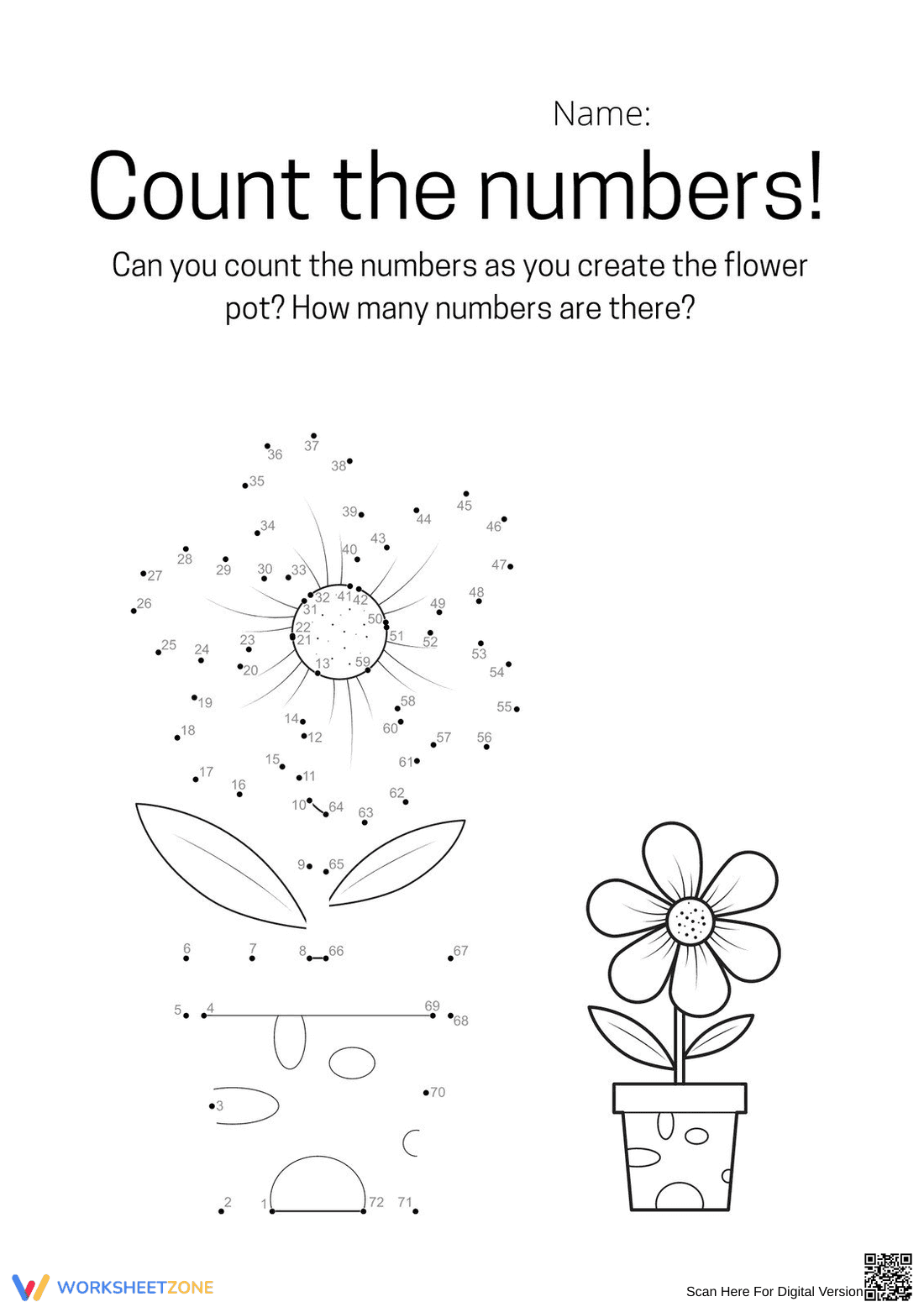
This engaging flower pot dot-to-dot worksheet gives students a fun, hands-on way to practice their number sequencing skills. By connecting the dots from 1 to 72, young learners reinforce their rote counting abilities while revealing a cheerful picture, building both math confidence and fine motor control.
At a Glance
- Grade: K · Subject: Math
- Standard:
CCSS.MATH.CONTENT.K.CC.A.1— Count to 100 by ones- Skill Focus: Number sequencing 1-72
- Format: 1 page · 1 puzzle · No answer key needed · PDF
- Best For: Independent practice
- Time: 10–15 minutes
Inside this single-page resource, educators will find a comprehensive 72-dot puzzle that forms a large flower and pot. The numbers are clearly printed and spaced appropriately for early elementary students. The visual nature of the activity means the completed picture serves as its own self-checking mechanism, eliminating the need for a separate answer key.
This resource is designed for a completely zero-prep workflow, making it ideal for busy mornings or unexpected schedule changes.
- Print (1 minute): Simply download the PDF and print a class set. No special paper or color ink is required.
- Distribute (1 minute): Hand out the sheets along with pencils or markers. The instructions are self-explanatory.
- Review (0 minutes): Students self-correct as they work; if the picture looks wrong, they know they missed a number.
Total teacher prep time is under two minutes, making this an excellent addition to any emergency sub plan.
This activity is directly aligned to CCSS.MATH.CONTENT.K.CC.A.1, which requires students to count to 100 by ones and by tens. By practicing the sequence up to 72, children solidify their understanding of base-ten counting patterns and number order. Both standard codes can be copied directly into lesson plans, IEP goals, or district curriculum mapping tools.
This worksheet is highly versatile in the early childhood classroom. Use it as a quiet morning work activity to settle students before direct instruction begins, or place it in a math center for independent reinforcement. As a formative assessment tip, observe students while they work: watch for hesitations around transition numbers (like 19 to 20 or 29 to 30) to identify who might need targeted counting intervention. Expected completion time ranges from 10 to 15 minutes depending on the child's fine motor speed.
This resource is primarily designed for Kindergarten students mastering their counting sequences, but it also serves as a great beginning-of-year review for first graders. For differentiation, you can highlight the decade numbers (10, 20, 30) with a marker beforehand to give struggling learners visual checkpoints. It pairs perfectly with a whole-class rote counting warm-up or a lesson using a hundreds chart.
Mastering the counting sequence is a foundational mathematical skill that predicts future arithmetic fluency. This activity targets CCSS.MATH.CONTENT.K.CC.A.1, requiring students to count to 100 by ones. According to EdReports 2024, integrating visual-spatial tasks like dot-to-dot puzzles with rote counting exercises significantly improves number sense retention in early childhood education. When children physically connect sequential numbers, they engage multiple cognitive pathways, reinforcing the mental number line more effectively than verbal counting alone. This multisensory approach ensures that abstract numerical concepts are grounded in concrete, observable actions. By completing the 72-number sequence required to form the flower pot, students demonstrate mastery of standard counting principles while simultaneously developing the fine motor control necessary for subsequent handwriting tasks. This dual-benefit design maximizes instructional efficiency in the primary classroom.


