




























Views
Downloads

Essential Grade 4 Electrical Circuits & Switches Worksheet

Paste this activity's link or code into your existing LMS (Google Classroom, Canvas, Teams, Schoology, Moodle, etc.).
Students can open and work on the activity right away, with no student login required.
You'll still be able to track student progress and results from your teacher account.
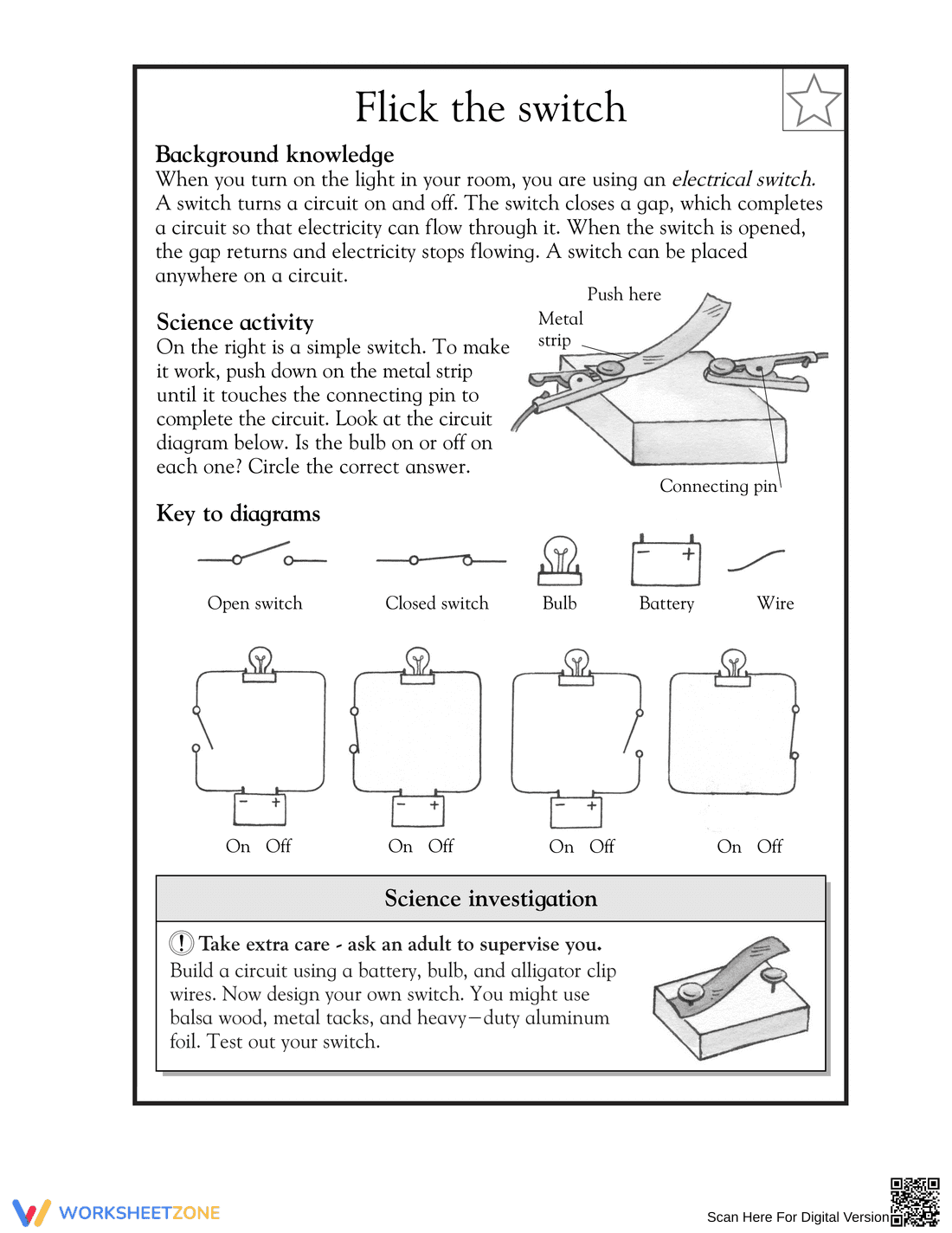
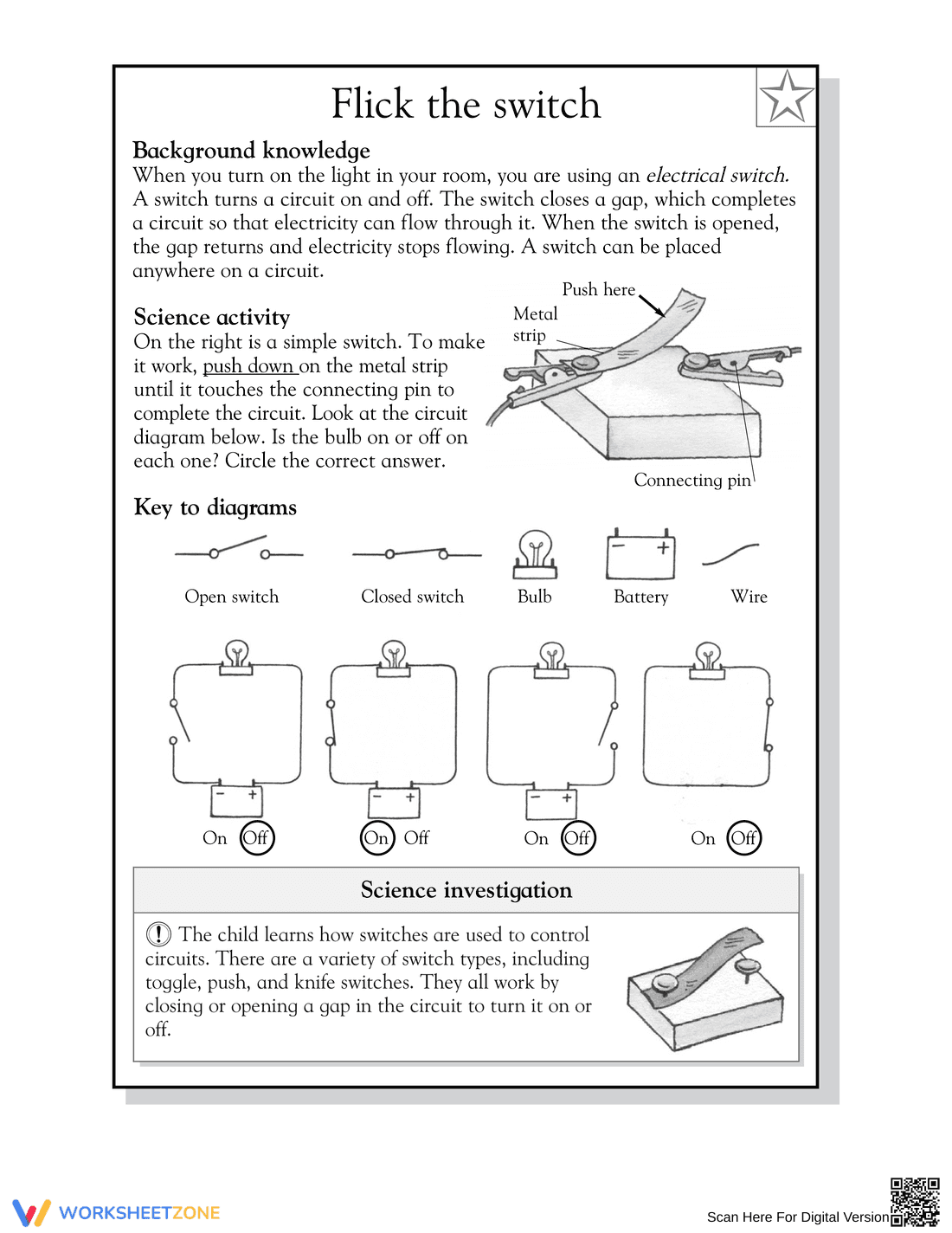
Students master the fundamentals of electrical energy transfer by identifying how switches control the flow of current in a simple circuit. This activity transforms abstract physics concepts into observable facts, allowing learners to predict whether a bulb will illuminate based on diagrammatic evidence. By bridging the gap between theory and hands-on investigation, students develop a functional understanding of electrical systems.
At a Glance
- Grade: 4 · Subject: Physical Science
- Standard:
4-PS3-2— Observe and provide evidence that energy can be transferred by electric currents- Skill Focus: Circuit diagram analysis and switch mechanics
- Format: 1 page · 5 tasks · Answer key included · PDF
- Best For: Introduction to electricity and simple machines
- Time: 15–25 minutes
The worksheet includes a concise background knowledge section that defines the role of an electrical switch in completing or breaking a circuit. Inside, students find a visual key to standard circuit symbols, including batteries, bulbs, and wires. The core activity features four distinct circuit diagrams where learners must determine the light bulb's status. A final science investigation section prompts students to design and test their own physical switch using everyday classroom materials.
This resource follows a high-efficiency zero-prep workflow designed for busy educators. Teachers can print the single-page PDF in less than one minute and distribute it immediately as a standalone lesson or a transition activity. The structured layout allows students to work independently with minimal guidance, requiring roughly two minutes of total teacher preparation time. It is an ideal resource for emergency sub plans or as a quick check for understanding during a larger unit on energy forms.
Aligned strictly to 4-PS3-2, this activity requires students to make observations to provide evidence that energy can be transferred from place to place by electric currents. The inclusion of an open-ended design task also supports 4-PS3-4 by asking students to refine a device that converts energy. Both standard codes can be copied directly into lesson plans, IEP goals, or district curriculum mapping tools to ensure instructional compliance.
Use this worksheet as a formative assessment during the direct instruction phase of an electricity unit. After teaching the symbols, have students complete the four diagrams and observe if they can distinguish between open and closed loops. For a more intensive experience, use the investigation prompt as a Friday science lab where students build the circuits they just analyzed. This allows teachers to observe student troubleshooting skills in real-time as they manipulate alligator clips and foil.
This resource is specifically designed for Grade 4 students but is highly effective for Grade 3 learners who are beginning their exploration of physical science. The clear visuals provide necessary scaffolding for English Language Learners and students with processing needs. It pairs naturally with a hands-on circuit kit or a digital simulation that allows for virtual testing of the diagrams presented on the page.
According to the RAND AIRS 2024 report on science literacy, the use of representational circuit diagrams is a critical precursor to higher-order engineering design. By requiring students to translate a 2D symbol into a predicted physical outcome, this worksheet builds the mental models necessary for complex systems thinking. The 4-PS3-2 standard emphasizes that energy transfer must be supported by evidence, and identifying the physical gap in a circuit provides the concrete proof young scientists need. Research indicates that connecting diagrammatic literacy with a hands-on design challenge significantly increases long-term retention of electrical concepts. This dual-modal approach ensures students understand the underlying mechanics of energy movement. Educators can rely on this structured practice to bridge the gap between simple observation and active scientific inquiry in the elementary classroom.


