


























Views
Downloads

Advanced Vocabulary Worksheet | College ELA Essential
Paste this activity's link or code into your existing LMS (Google Classroom, Canvas, Teams, Schoology, Moodle, etc.).
Students can open and work on the activity right away, with no student login required.
You'll still be able to track student progress and results from your teacher account.
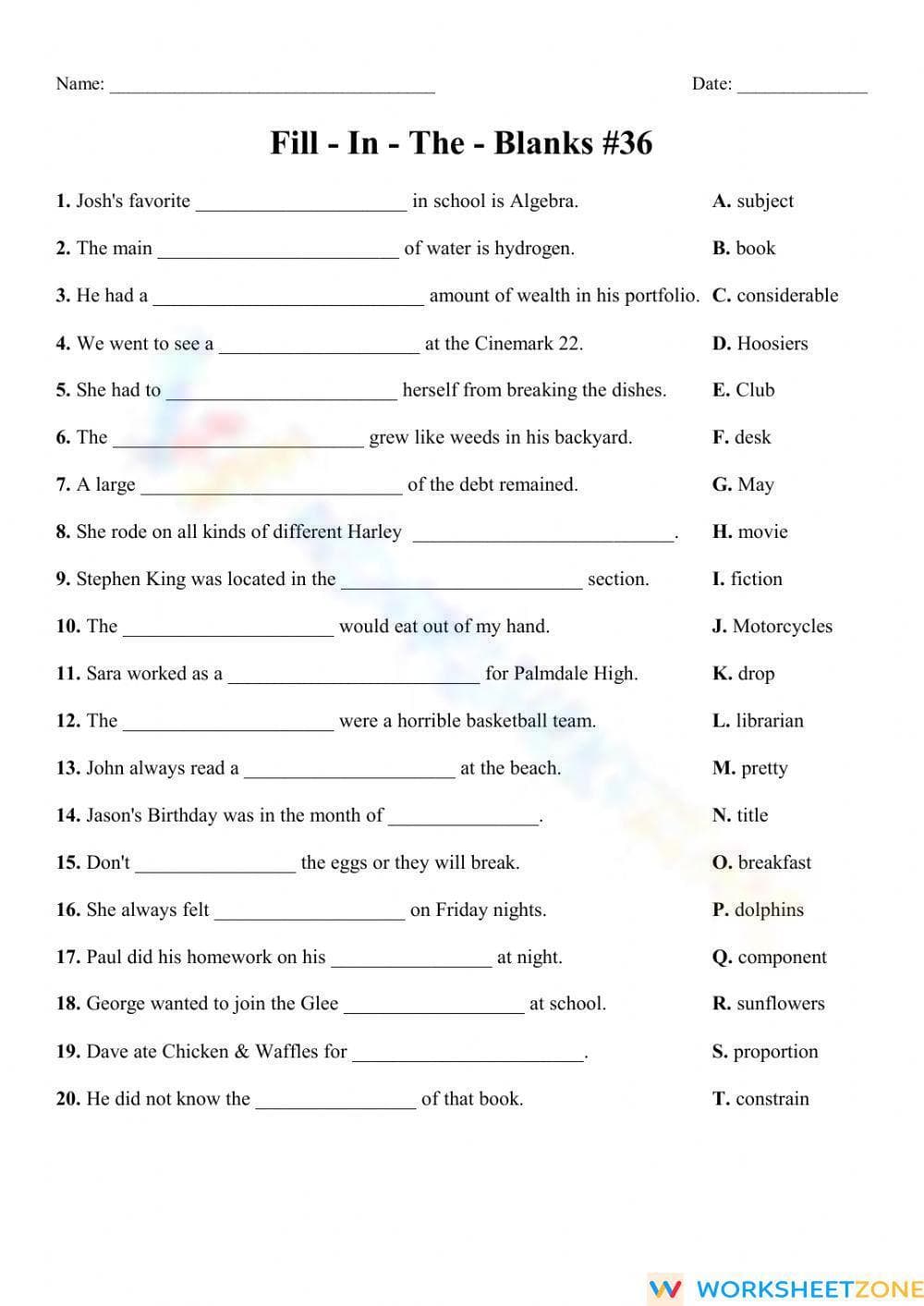
This advanced English Language Arts worksheet focuses on sophisticated vocabulary acquisition through contextual application. By completing sentence-level fill-in-the-blank exercises, students strengthen their understanding of precise word choice and semantic nuances. The resource is designed to bridge the gap between basic recognition and fluid academic application in college-level writing and reading.
At a Glance
- Grade: College · Subject: English Language Arts
- Standard:
CCSS.ELA-LITERACY.L.11-12.4— Determine the meaning of unknown and multiple-meaning words and phrases- Skill Focus: Contextual Vocabulary Application
- Format: 1 page · 20 problems · Answer key included · PDF
- Best For: Advanced vocabulary reinforcement and academic writing prep
- Time: 15–20 minutes
What's Inside
This single-page resource contains 20 unique sentence completion tasks paired with a word bank of 20 high-level academic terms. Students must analyze the syntactic and semantic requirements of each sentence to select the most appropriate noun, verb, or adjective. The worksheet is delivered in a clean, distraction-free PDF format, including a full answer key for efficient self-correction or grading.
Skill Progression
- Guided practice: The initial tasks provide clear contextual clues pointing toward specific grammatical categories like identifying a "favorite subject" or common nouns.
- Supported practice: Middle-tier sentences require students to distinguish between abstract concepts like "proportion" and "considerable" within financial and academic contexts.
- Independent practice: The final challenges require the synthesis of complex vocabulary such as "constrain" and "component," ensuring students can apply these terms in academic discourse.
This approach follows the gradual-release model, moving from concrete associations to abstract academic mastery.
Standards Alignment
Aligned with CCSS.ELA-LITERACY.L.11-12.4, students determine the meaning of unknown words using context clues. It specifically addresses using sentence-level meaning as a clue to word interpretation. This standard code can be copied directly into lesson plans, IEP goals, or district curriculum mapping tools.
How to Use It
Use this as a warm-up in composition courses to highlight the importance of precise word choice. It also serves as a formative assessment for academic register. Observe student struggles with abstract nouns like "constrain" to guide future morphological study. Expected completion time is 15-20 minutes.
Who It's For
Tailored for college-bound seniors and first-year university students refining their academic lexicon. It benefits advanced ELL students practicing academic collocations. Pair this with a scholarly reading passage to see these terms applied in a professional environment.
Research indicates that contextualized vocabulary instruction is significantly more effective than isolated rote memorization for long-term retention in higher education. This resource aligns with the findings of Fisher & Frey (2014) regarding the importance of "word-rich environments" and the gradual release of responsibility in literacy instruction. By focusing on CCSS.ELA-LITERACY.L.11-12.4, the worksheet ensures that students develop the ability to interpret advanced terminology such as "proportion" and "constrain" within authentic academic frameworks. The 20-task structure provides sufficient repetition to move these terms from receptive to productive vocabularies. This systematic approach supports the NAEP framework for vocabulary assessment, emphasizing the role of word meaning in overall reading comprehension and academic success. Such evidence-based practice is essential for college-level ELA curricula aiming to improve student outcomes in writing and analytical thinking.


