


























Views
Downloads

Sight Words Write & Learn — Printable Kindergarten
Paste this activity's link or code into your existing LMS (Google Classroom, Canvas, Teams, Schoology, Moodle, etc.).
Students can open and work on the activity right away, with no student login required.
You'll still be able to track student progress and results from your teacher account.
This Kindergarten sight word worksheet builds high-frequency word recognition through guided writing practice, giving students repeated exposure to essential words they will encounter in early reading texts. One focused page, zero prep, immediate classroom use.
At a Glance
- Grade: Kindergarten · Subject: English Language Arts — Sight Words
- Standard:
CCSS.ELA-LITERACY.RF.K.3.C— Read common high-frequency words by sight from a standard list- Skill Focus: High-frequency sight word recognition and written reproduction
- Format: 1 page · 10 problems · Answer key included · PDF
- Best For: Independent morning work or literacy centers
- Time: 10–15 minutes
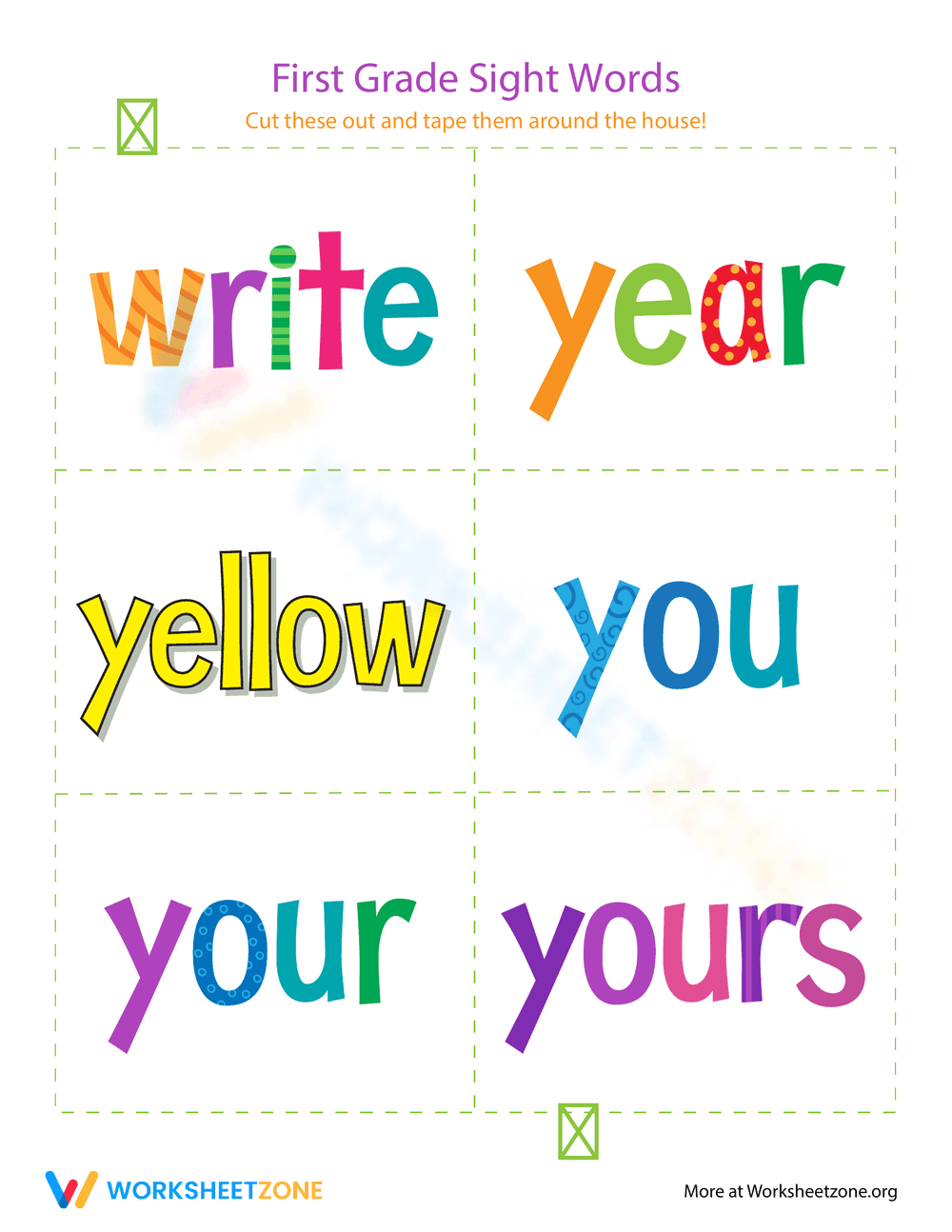
Inside: one structured page featuring first-grade sight words presented in a write-and-trace format. Each word appears with a model, a tracing line, and an independent writing box. No word bank required — words are self-contained. Print single-sided; no cutting, folding, or laminating needed before use.
Zero-Prep Workflow
- Print — Send file to printer; single page prints in under 30 seconds. Total teacher prep: under 2 minutes.
- Distribute — Hand to students at the start of a literacy block, morning meeting, or center rotation. No verbal instructions required; task format is self-explanatory.
- Review — Collect and scan for letter formation errors or skipped words. Use as a quick formative check before moving to decodable text reading.
Sub-plan ready: any adult can supervise this activity without prior lesson knowledge.
Standards Alignment
Primary standard: CCSS.ELA-LITERACY.RF.K.3.C — Read common high-frequency words by sight (e.g., the, of, to, you, she, my, is, are, do, does). Supporting standard: CCSS.ELA-LITERACY.L.K.1 — Print many upper- and lowercase letters. Both standard codes can be copied directly into lesson plans, IEP goals, or district curriculum mapping tools.
How to Use It
Use before direct instruction as a diagnostic: gaps in letter formation or word recall signal which words need explicit teaching that day. Use after instruction as a fluency check — students who complete all 10 words correctly within 12 minutes demonstrate solid automaticity. Formative tip: watch for students who copy letter-by-letter rather than writing the whole word from memory; that behavior signals the word is not yet automatic and needs additional repetition cycles.
Who It's For
Kindergarten and early first-grade students building a core sight-word bank. Works for on-grade learners in whole-class settings and for below-grade readers who benefit from repeated motor encoding of high-frequency words. Pairs naturally with a decodable reader featuring the same target words or a classroom word wall anchor chart.
Sight word automaticity is foundational to reading fluency. NAEP data show that students who recognize high-frequency words automatically by end of Kindergarten demonstrate significantly stronger passage comprehension scores by Grade 3. This worksheet targets CCSS.ELA-LITERACY.RF.K.3.C — reading common high-frequency words by sight — through a write-and-trace format that encodes words via motor memory as well as visual recognition. Fisher & Frey (2014) identify repeated low-stakes retrieval practice as a key mechanism for moving words from effortful decoding to automatic recognition. One focused page, 10 target words, and a clear write-trace-write sequence give students exactly that retrieval loop. Teachers can use completion rate and letter-formation quality as direct evidence of RF.K.3.C progress, suitable for literacy portfolios or IEP documentation.


