


























Views
Downloads

Essential First Day Sequencing Worksheet for Grades 1-2
Paste this activity's link or code into your existing LMS (Google Classroom, Canvas, Teams, Schoology, Moodle, etc.).
Students can open and work on the activity right away, with no student login required.
You'll still be able to track student progress and results from your teacher account.
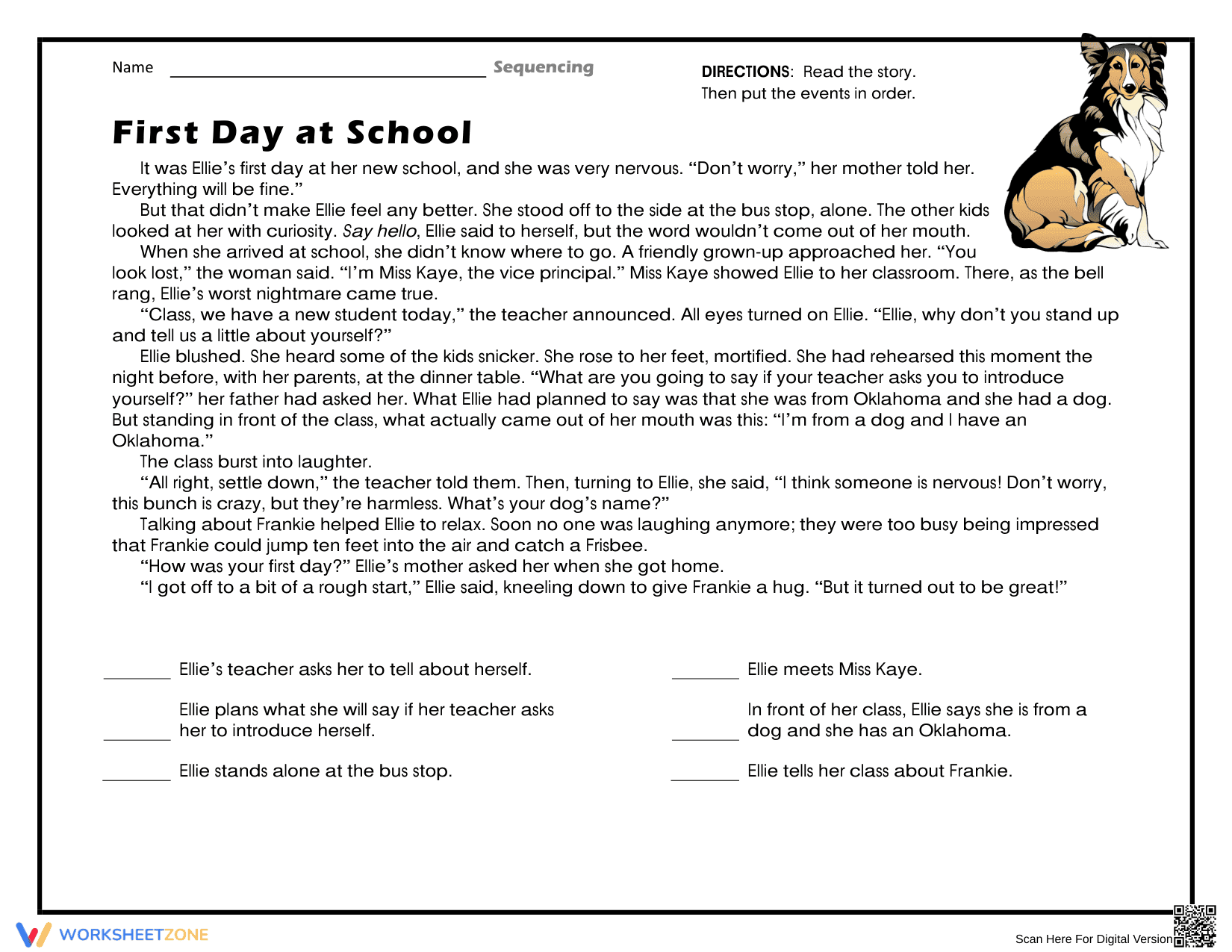
This story sequencing worksheet helps Grade 1 and 2 students master chronological order and reading comprehension. By analyzing Ellie's relatable first-day experience, learners identify key plot points and organize them logically. This exercise strengthens narrative understanding and foundational ELA skills, providing a clear path for students to demonstrate their ability to retell a story accurately.
At a Glance
- Grade: 1-2 · Subject: ELA
- Standard:
CCSS.ELA-LITERACY.RL.1.2— Retell stories, including key details, and demonstrate understanding of their central message- Skill Focus: Chronological story sequencing
- Format: 1 page · 6 problems · Answer key included · PDF
- Best For: Independent practice or sub plans
- Time: 15–20 minutes
The worksheet features a high-interest narrative about a student overcoming first-day jitters. Below the text, students find six specific events from the plot, each with a designated line for numbering. The layout is clean and focused, including a decorative illustration of a dog to engage younger readers. A comprehensive answer key is provided to ensure quick and accurate grading for teachers or parents.
This resource is designed for a seamless, zero-prep classroom workflow. 1. Print the single-page PDF in less than 30 seconds. 2. Distribute the worksheet to students for 15 minutes of independent reading and sequencing practice. 3. Review the numbered events using the included answer key in under 2 minutes. This efficient structure makes it an ideal choice for morning work, literacy centers, or emergency sub plans.
This activity is primarily aligned to CCSS.ELA-LITERACY.RL.1.2, which requires students to retell stories and demonstrate understanding of key details. It also supports CCSS.ELA-LITERACY.RL.2.1 by encouraging students to answer implicit "when" questions through sequencing. Both standard codes can be copied directly into lesson plans, IEP goals, or district curriculum mapping tools.
Use this worksheet during the "independent practice" phase of a lesson on story structure or chronological order. It serves as an excellent formative assessment tool; observe if students refer back to the text to verify the sequence or rely on memory alone. The estimated completion time of 15 to 20 minutes allows for easy integration into a standard literacy block or as a transition activity.
This resource is tailored for first and second-grade students developing their reading fluency and structural analysis skills. It is particularly effective for English Language Learners (ELLs) who benefit from the clear, sequential logic of the tasks. Pair this worksheet with a short passage or an anchor chart about transition words like "first," "next," and "finally" for a complete instructional experience.
Masterful story sequencing is a critical milestone in early literacy, serving as a bridge between basic decoding and complex comprehension. According to Fisher & Frey (2014), the ability to reconstruct a narrative sequence demonstrates a deep structural understanding of the text, which is a prerequisite for more advanced summarization tasks. This worksheet addresses CCSS.ELA-LITERACY.RL.1.2 by requiring students to identify and order six key details from a narrative text, reinforcing the logic of plot progression. Research highlighted in the NAEP reports suggests that students who engage in regular sequencing exercises show improved performance in logical reasoning and textual evidence retrieval. By providing a relatable first-day-of-school context, the material ensures high student engagement while maintaining rigorous standards alignment. Educators can rely on this tool to provide high-quality, evidence-based practice that supports long-term reading success and aligns with modern ELA pedagogical frameworks.


