


























Views
Downloads

Finding the Area Worksheet | Grade 3 Printable Essential
Paste this activity's link or code into your existing LMS (Google Classroom, Canvas, Teams, Schoology, Moodle, etc.).
Students can open and work on the activity right away, with no student login required.
You'll still be able to track student progress and results from your teacher account.
This finding the area worksheet provides comprehensive practice for Grade 3 and Grade 4 students. By moving from counting unit squares to applying the standard area formula, students build a deep conceptual understanding of spatial measurement. This essential resource ensures mastery of calculating surface coverage for both regular and irregular figures.
At a Glance
- Grade: 3 · Subject: Math
- Standard:
CCSS.MATH.CONTENT.3.MD.C.6— Measure areas by counting unit squares such as square cm or square m- Skill Focus: Calculating Area
- Format: 5 pages · 7 problems · Answer key included · PDF
- Best For: Independent practice and conceptual skill building
- Time: 25–35 minutes
What's Inside
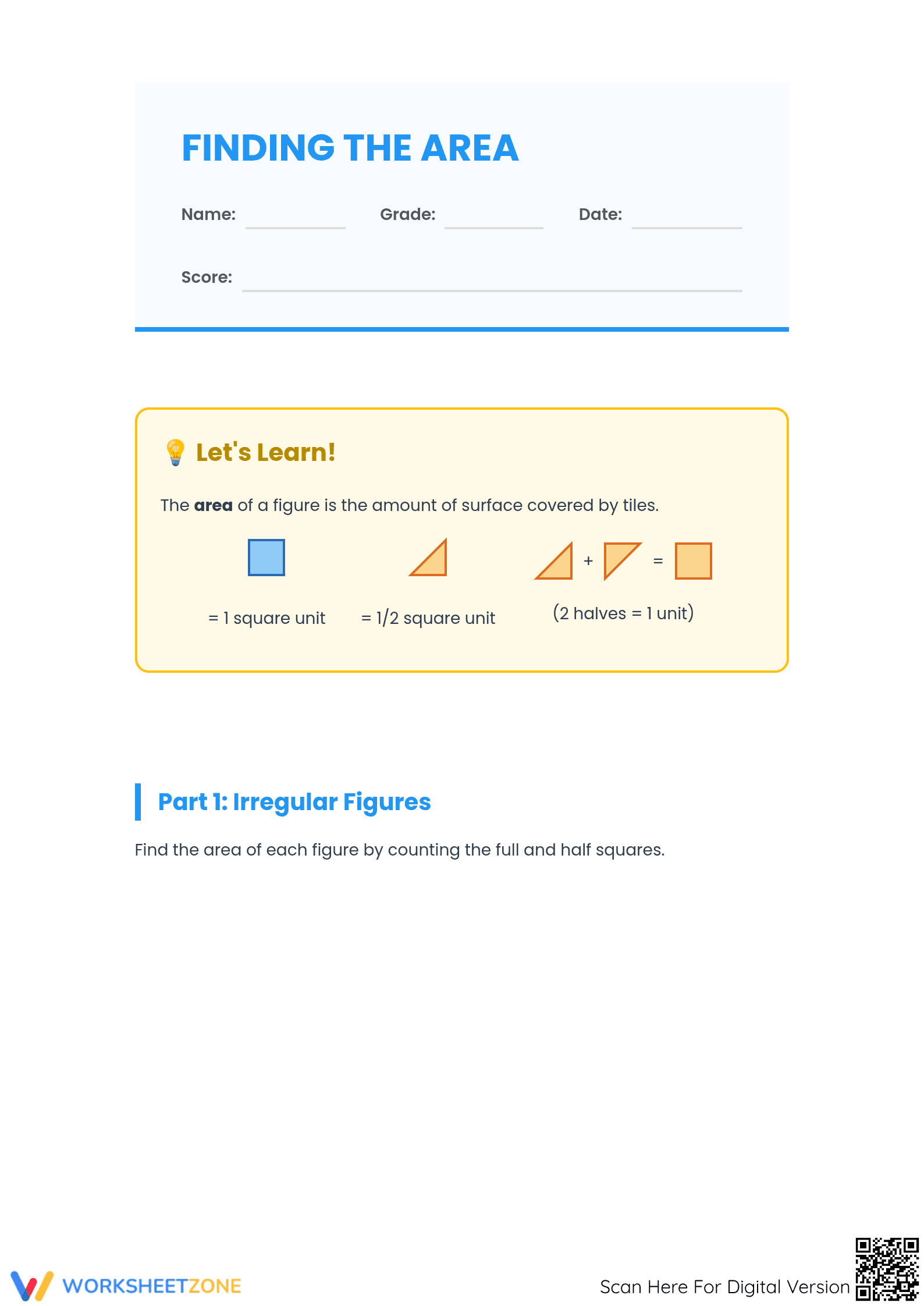
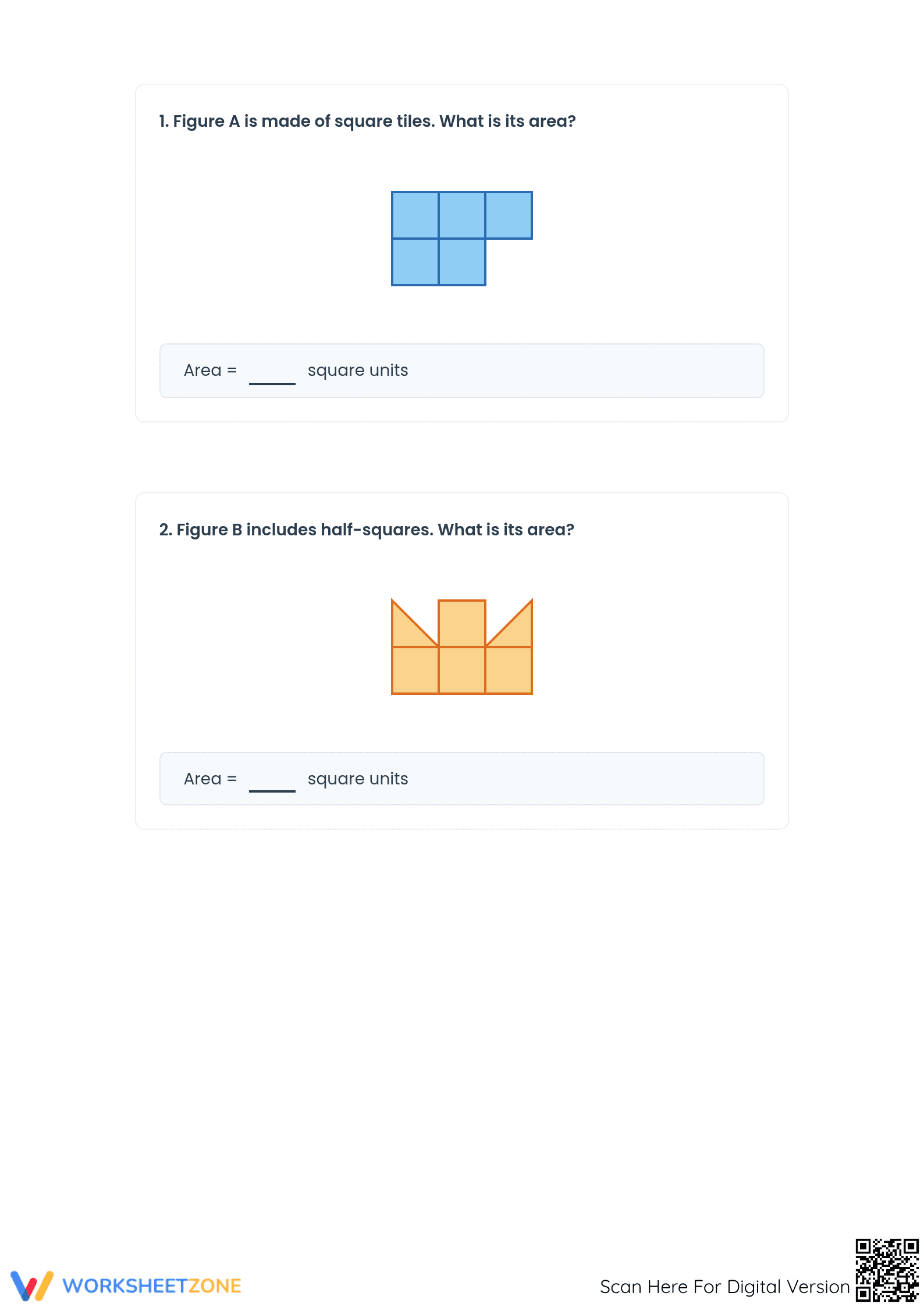
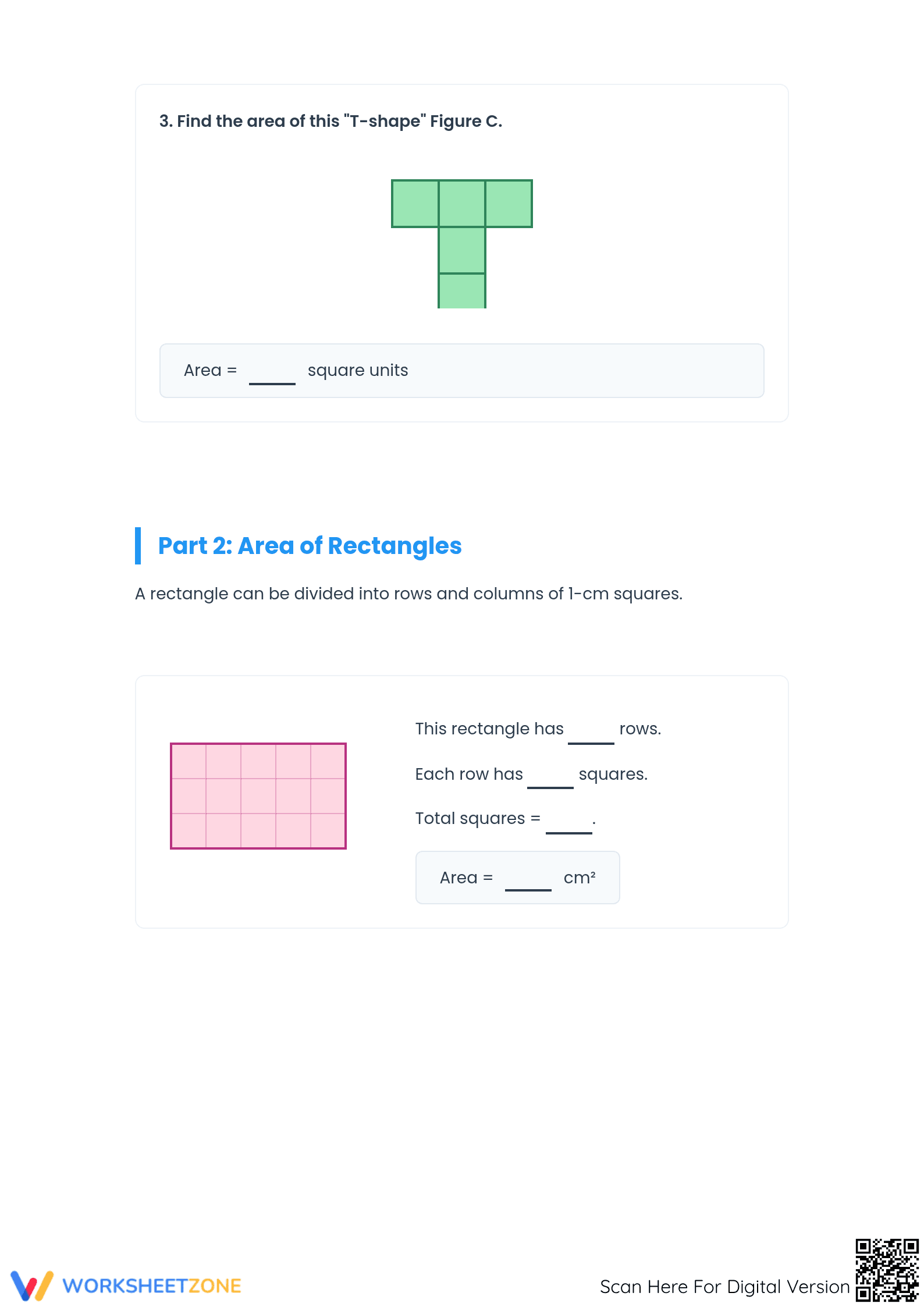
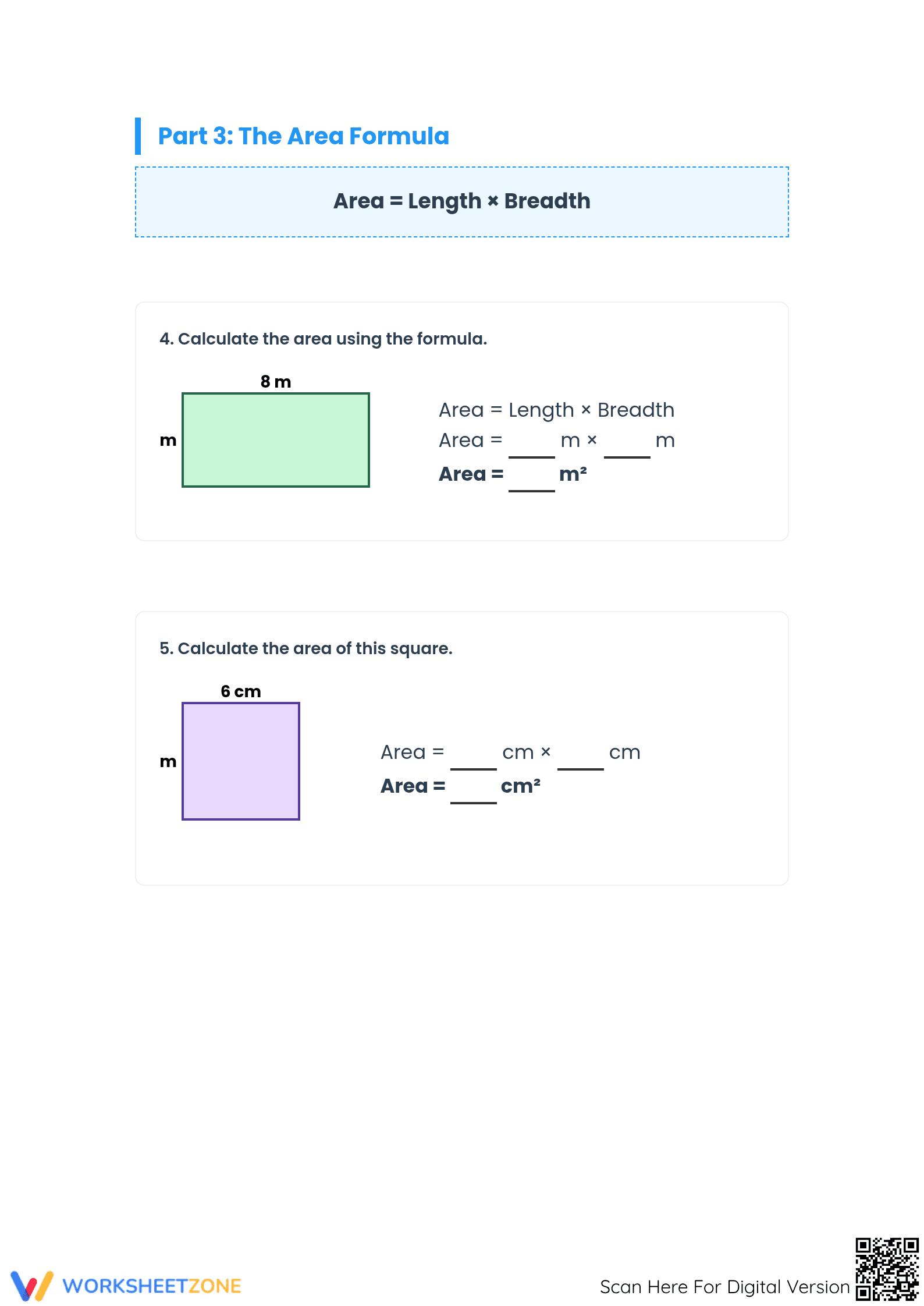
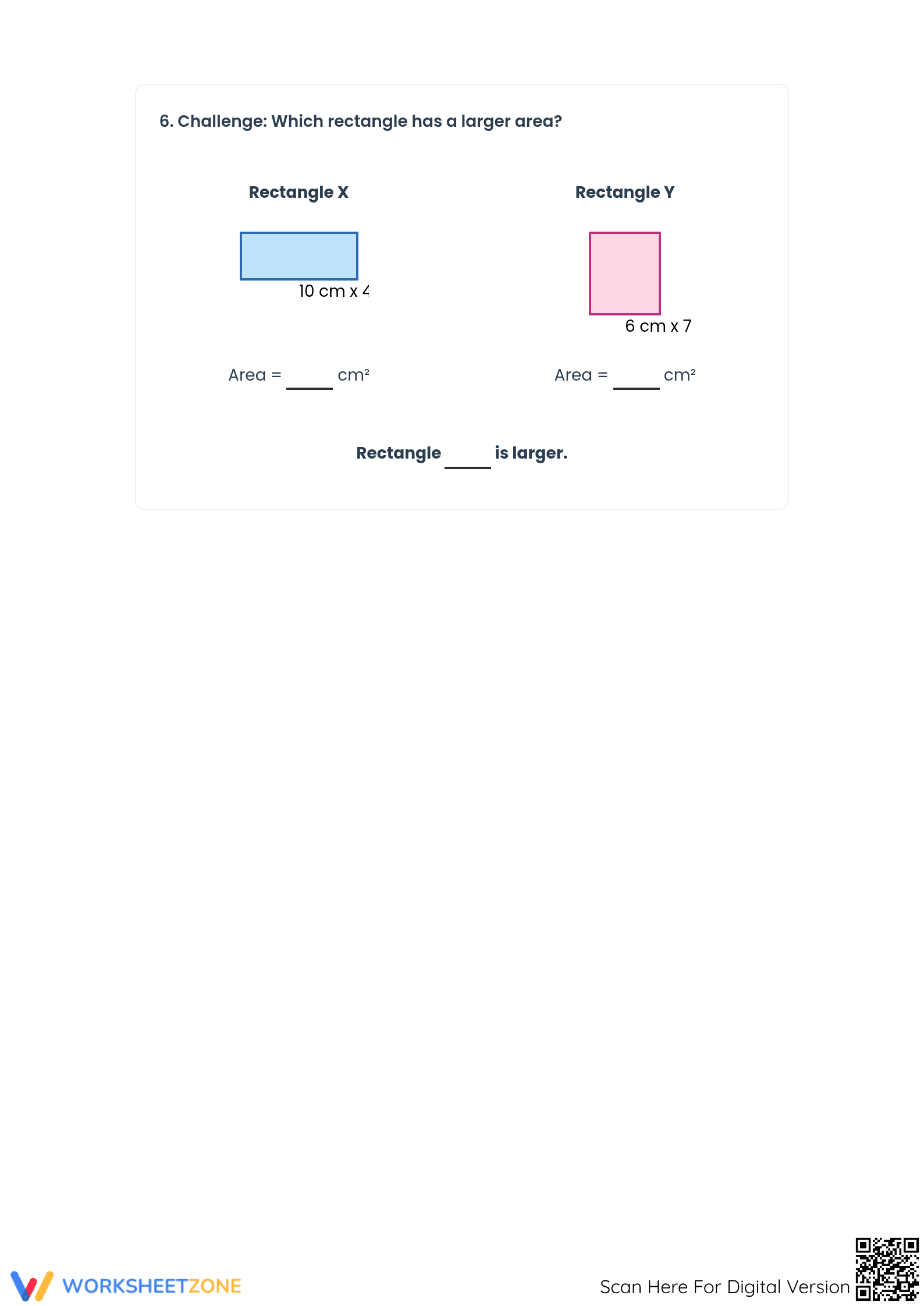
The 5-page packet contains three distinct sections. Part 1 focuses on irregular figures where students count full and half squares. Part 2 introduces the area of rectangles using grid systems to visualize rows and columns. Part 3 presents the formal area formula (Length x Breadth) and includes a challenge problem comparing two different rectangles. A full answer key is provided for immediate feedback and quick grading.
Skill Progression
- Guided Practice: The "Let's Learn" section provides visual anchors for full and half square units, followed by three introductory problems on irregular shapes that require careful unit counting.
- Supported Practice: Part 2 scaffolds the transition to multiplication by having students identify specific rows and columns before calculating the total square units in a tiled rectangle.
- Independent Practice: Students apply the formal area formula to rectangles and squares in three final tasks, concluding with a comparative reasoning challenge that tests higher-order thinking.
This gradual-release model moves students from concrete counting to abstract calculation, following the proven I Do, We Do, You Do instructional framework.
Standards Alignment
Primary alignment is CCSS.MATH.CONTENT.3.MD.C.6, which requires students to measure area by counting unit squares. It also supports CCSS.MATH.CONTENT.3.MD.C.7.A, finding the area of a rectangle with whole-number side lengths by tiling it and showing that the area is the same as would be found by multiplying the side lengths. Both standard codes can be copied directly into lesson plans, IEP goals, or district curriculum mapping tools.
How to Use It
Use this during the independent practice phase of a lesson on measurement. For a formative assessment observation, check students during Part 1 to see if they correctly combine two half-squares into single whole units. The expected completion time range is 30 minutes, making it ideal for a main lesson activity, a comprehensive homework assignment, or a robust sub-plan resource.
Who It's For
This resource is designed for third and fourth-grade students mastering geometry basics. It serves as an excellent differentiation tool for learners needing a visual bridge between concrete counting and abstract multiplication. Pair this with a physical set of unit tiles or an anchor chart to reinforce the spatial relationship between dimensions and surface area.
This math resource aligns with the CCSS.MATH.CONTENT.3.MD.C.6 standard, focusing on the fundamental skill of measuring area through unit square quantification. According to EdReports 2024 analysis, providing students with multiple representations—including irregular grids, tiled rectangles, and formula-based calculations—is critical for preventing procedural gaps in geometric reasoning. The inclusion of half-unit squares specifically addresses common misconceptions regarding non-standard shapes, a strategy supported by Fisher & Frey (2014). By integrating counting methods with the standard multiplication formula, the worksheet ensures that students develop both conceptual depth and computational fluency. Educators can reliably use this 5-page packet as a primary tool for evidence-based instruction, ensuring that learners meet the rigorous demands of state and national standards for spatial measurement.


