


























Views
Downloads

Printable Place Value Worksheet | Grade 4-5 Math
Paste this activity's link or code into your existing LMS (Google Classroom, Canvas, Teams, Schoology, Moodle, etc.).
Students can open and work on the activity right away, with no student login required.
You'll still be able to track student progress and results from your teacher account.
This comprehensive place value worksheet helps students master the relationship between digits and their values in multi-digit whole numbers. Students will practice converting between standard form, expanded form, and word form while identifying missing components. This resource ensures learners build a solid foundation for complex arithmetic and advanced number sense.
At a Glance
- Grade: 4–5 · Subject: Math / Number & Operations
- Standard:
CCSS.MATH.CONTENT.4.NBT.A.2— Read and write multi-digit whole numbers using base-ten numerals, number names, and expanded form- Skill Focus: Place Value, Standard Form, and Expanded Notation mastery
- Format: 4 comprehensive pages · 20 rigorous problems · Full answer key included · PDF
- Best For: Independent classroom practice, homework reinforcement, or quick formative assessment
- Time: 25–35 minutes of focused student work time
What's Inside
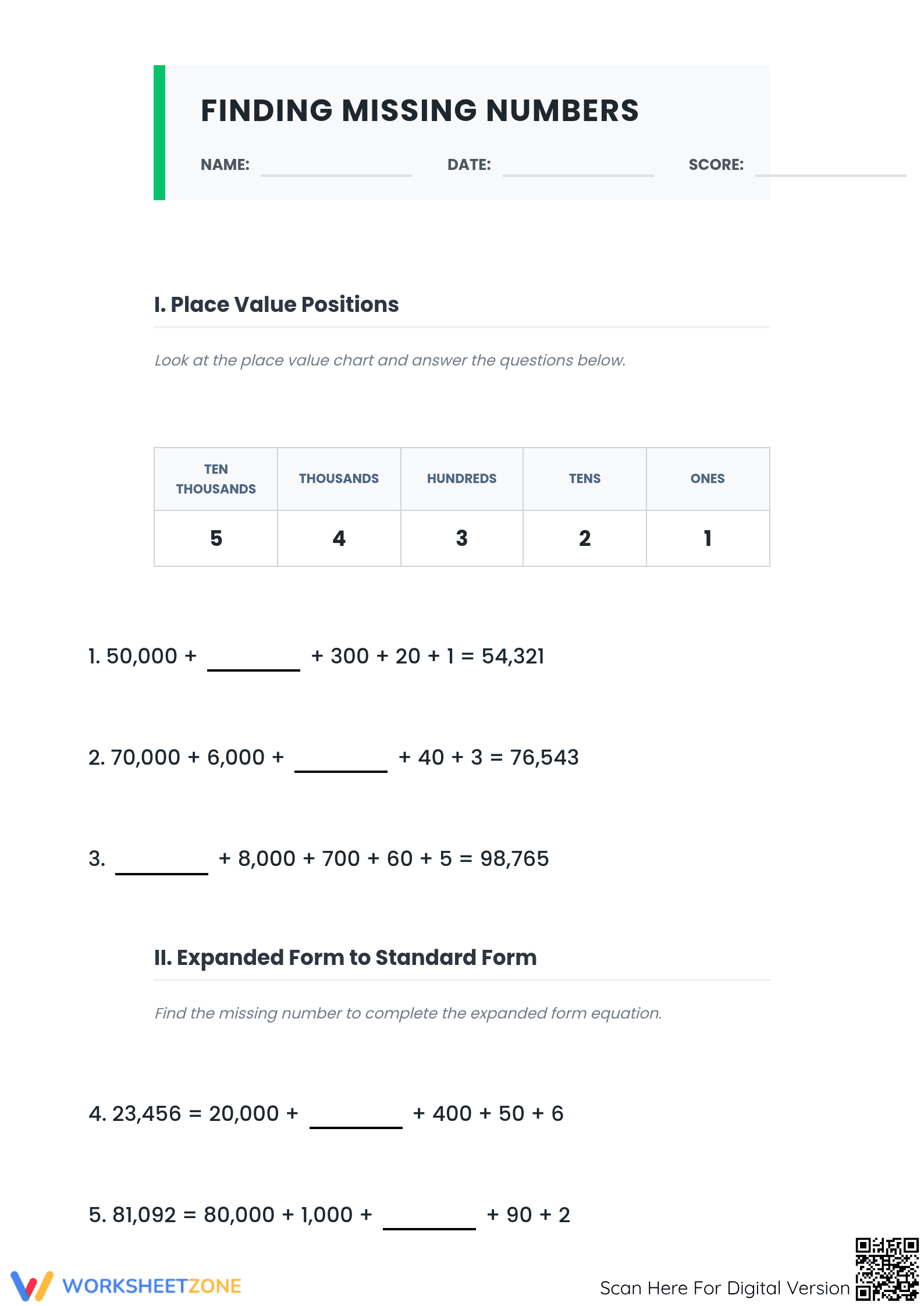
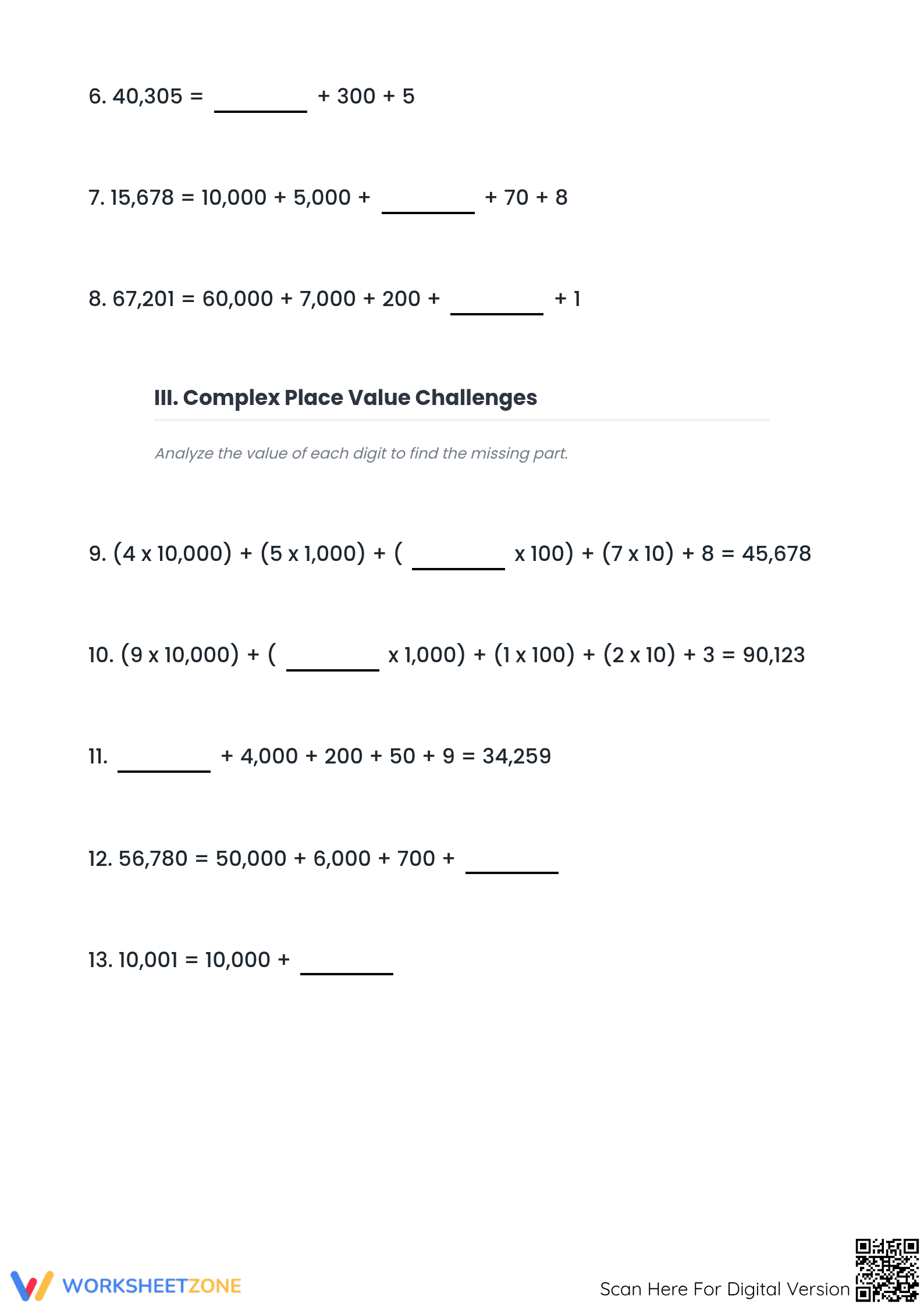
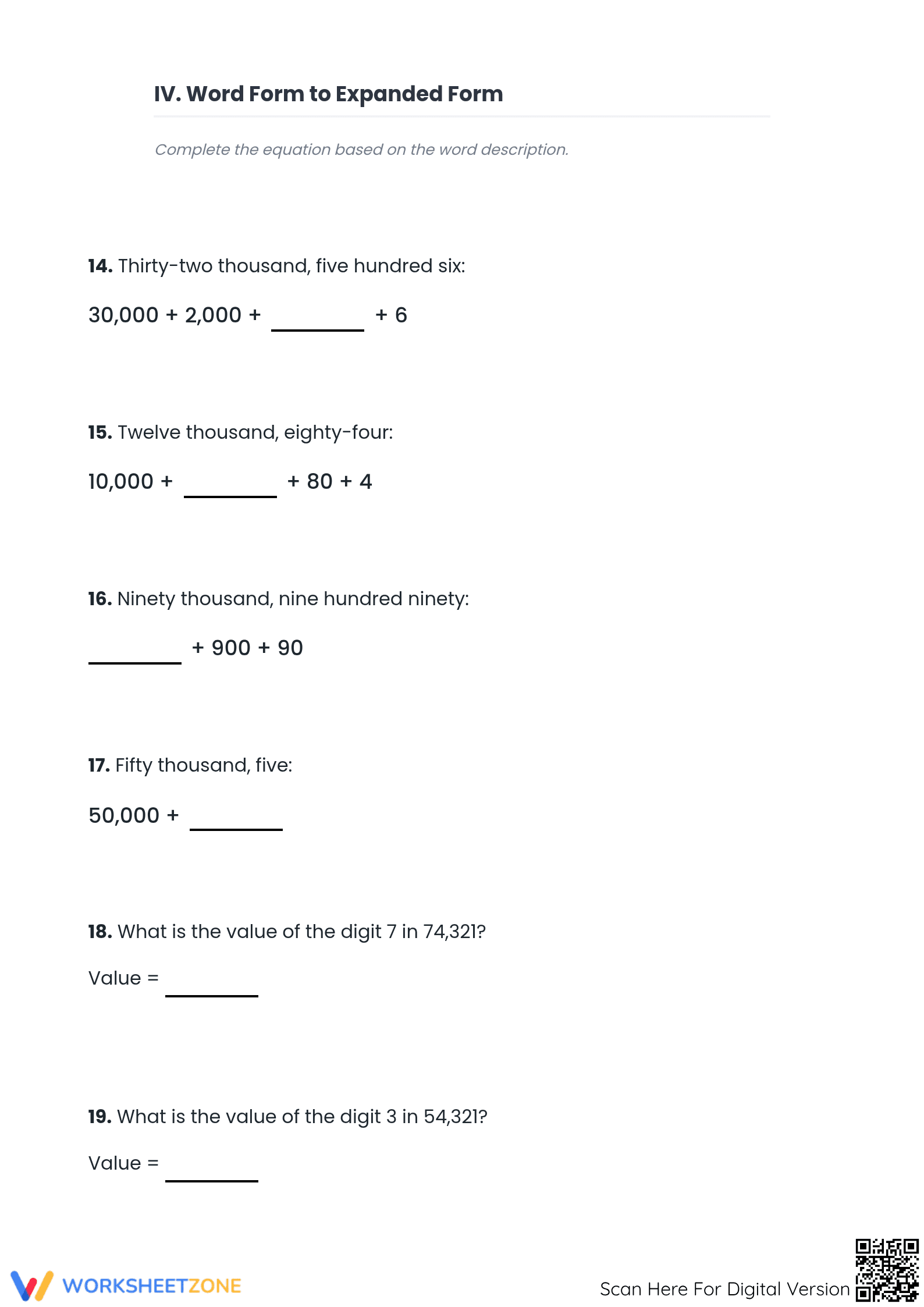
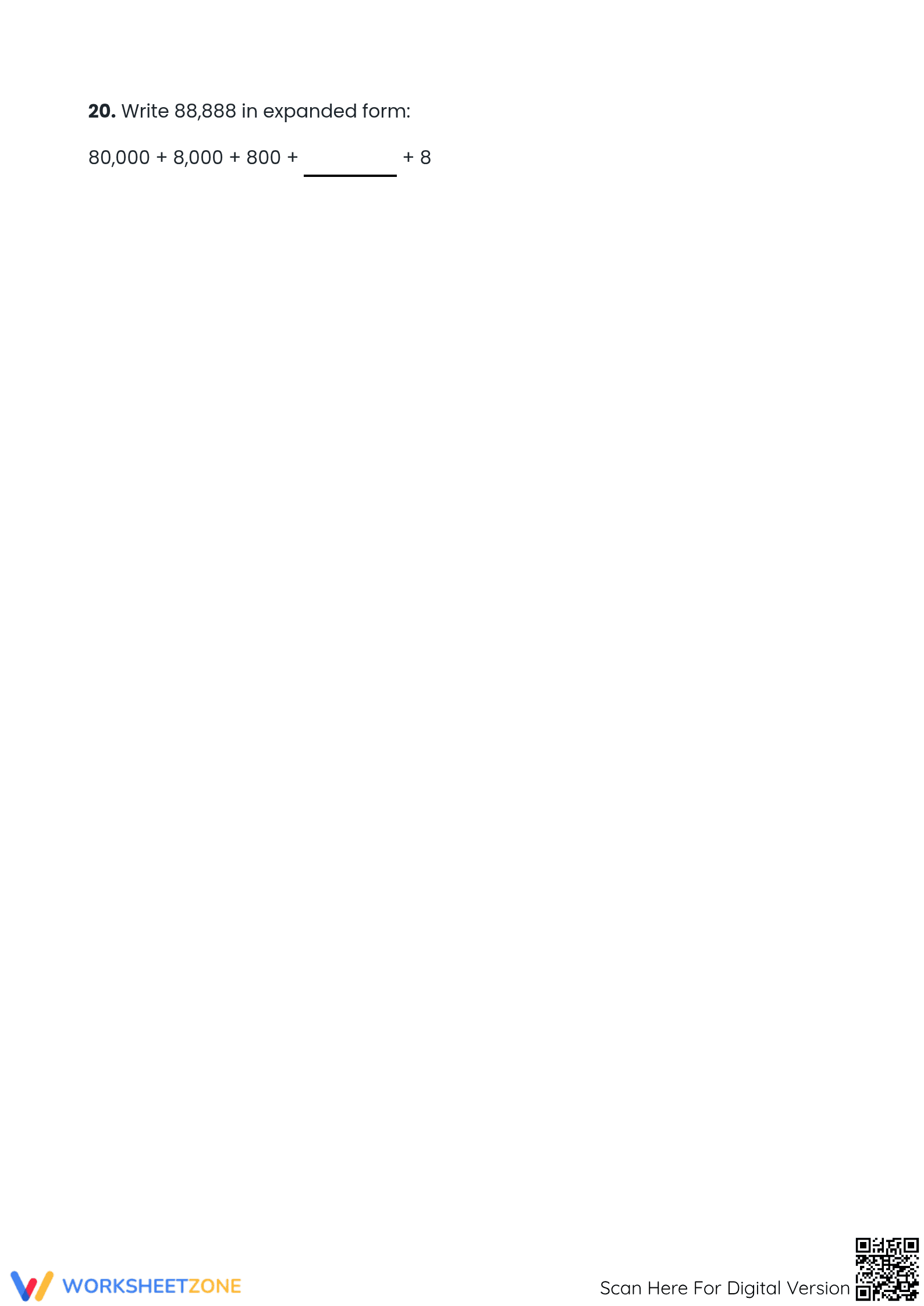
This four-page PDF features 20 problems across four sections. It includes place value charts, missing number equations, complex notation involving multiplication, and word-to-expanded form conversions. A complete answer key is provided to facilitate quick grading and student self-correction during the learning process.
Skill Progression
- Guided Practice: The first section uses place value charts to help students visualize digit positions (Ten Thousands to Ones) before completing expanded form equations with visual scaffolds.
- Supported Practice: Sections two and three increase complexity by requiring students to identify missing addends and navigate notation involving multiplication by powers of ten.
- Independent Practice: The final pages challenge students to translate word form descriptions into expanded form and determine precise digit values without visual aids.
This follows a gradual-release model, moving from concrete supports to abstract reasoning, ensuring mastery of base-ten concepts.
Standards Alignment
Aligned to `CCSS.MATH.CONTENT.4.NBT.A.2`, requiring students to write numbers in expanded form. It also supports `CCSS.MATH.CONTENT.5.NBT.A.1` regarding digit value relationships. These standard codes can be copied directly into lesson plans, IEP goals, or district curriculum mapping tools.
How to Use It
Assign this worksheet during the independent practice phase of a lesson or as homework to reinforce classroom instruction. Teachers can use the digit-value questions as a formative assessment to verify if students understand the difference between a digit's position and its actual numerical value.
Who It's For
Ideal for Grade 4 students learning large number notation or Grade 5 students requiring a review of base-ten concepts. It is particularly helpful for students who struggle with zero placeholders. Pair this with a place value anchor chart or physical blocks for additional support.
Research indicates that proficiency in place value is a significant predictor of later mathematical achievement (NAEP). This worksheet aligns with the CRA instructional framework advocated by Fisher & Frey (2014), bridging the gap between place value charts and abstract notation. By requiring students to identify missing components in expanded form (e.g., `CCSS.MATH.CONTENT.4.NBT.A.2`), this resource builds the algebraic thinking necessary for multi-digit multiplication. Systematic practice helps internalize the base-ten system, a core requirement for upper elementary mathematics. According to RAND AIRS 2024 data, high-quality supplemental materials that target specific standard sub-skills lead to improved student performance on standardized assessments. This resource provides the focused practice necessary for mastery of multi-digit whole number systems. The inclusion of word-form-to-expanded-form translation ensures students develop the linguistic and mathematical fluency required for complex word problems and high-stakes testing environments.


