


























Views
Downloads




Finding Area Worksheet | Grade 4 & 5 Essential Math Ready
Paste this activity's link or code into your existing LMS (Google Classroom, Canvas, Teams, Schoology, Moodle, etc.).
Students can open and work on the activity right away, with no student login required.
You'll still be able to track student progress and results from your teacher account.
This comprehensive area calculation worksheet empowers Grade 4 and 5 students to master the geometry of rectangles and squares. By progressing from basic visual models to complex word problems and algebraic "missing side" challenges, learners build a concrete understanding of spatial measurement and formulaic application in real-world contexts.
At a Glance
- Grade: 4–5 · Subject: Math
- Standard:
4.MD.A.3— Apply area and perimeter formulas for rectangles in mathematical and real-world problems- Skill Focus: Area of Rectangles and Squares
- Format: 5 pages · 14 problems · Answer key included · PDF
- Best For: Independent practice and formative assessment
- Time: 30–45 minutes
What's Inside
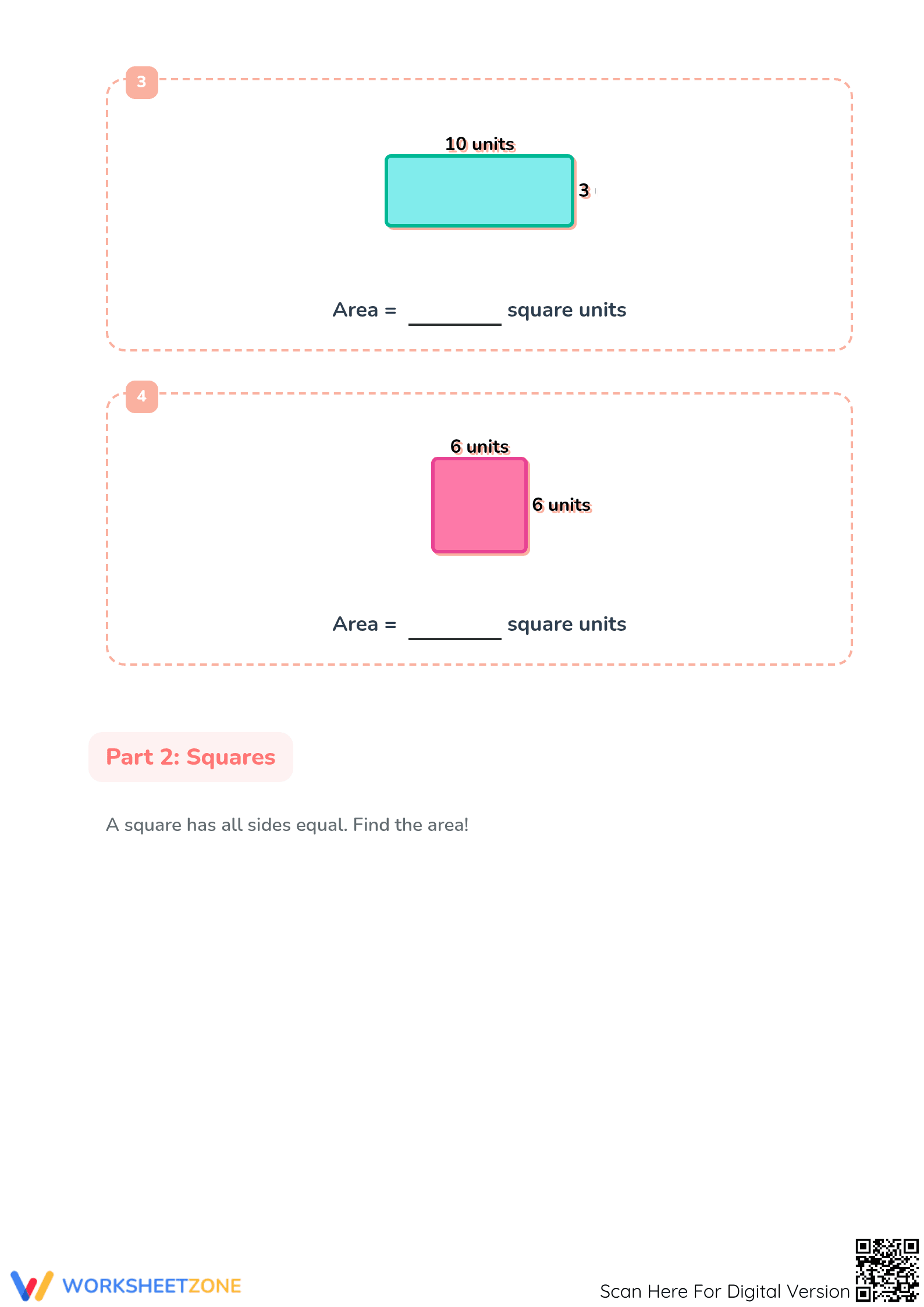
This five-page instructional packet is divided into four distinct sections designed for scaffolding. It begins with visual rectangles where length and width are provided, moves into square properties, transitions to four rigorous word problems involving classroom rugs and chocolate bars, and concludes with a "Challenge Mode" requiring students to solve for missing dimensions. A full answer key ensures immediate feedback.
Zero-Prep Workflow
Teachers can implement this resource in under two minutes with a simple three-step workflow. First, print the single PDF file (30 seconds). Second, distribute the packets to students for independent or small-group work (60 seconds). Finally, use the provided answer key for rapid grading or peer-review (variable). This zero-prep structure makes it an ideal choice for emergency substitute plans or sudden instructional shifts.
Standards Alignment
The primary alignment is 4.MD.A.3, which requires students to apply the area formula (Area = length × width) to solve problems. The worksheet also supports Grade 5 foundational skills for geometric measurement and the transition to volume. Both standard codes can be copied directly into lesson plans, IEP goals, or district curriculum mapping tools.
How to Use It
Use this worksheet as a summative assessment at the end of a geometry unit or as a "Station Rotation" activity. For a formative check, observe students during Part 3 (Word Problems) to see if they can identify the necessary dimensions from text-heavy prompts. Expected completion time ranges from 30 minutes for accelerated learners to 45 minutes for those needing extra support.
Who It's For
This resource is designed for Grade 4 and 5 students, including those in Tier 2 intervention groups who need more practice with the transition from counting units to using formulas. It pairs naturally with a "Finding Area" anchor chart or a hands-on measurement lesson using square tiles.
Alignment with 4.MD.A.3 ensures that students move beyond simple counting to the multiplicative reasoning required for higher-level geometry. Research from the NAEP highlights that proficiency in calculating area through formulas is a critical gatekeeper skill for understanding volume and surface area in middle school. By integrating word problems and "challenge mode" tasks where students must work backward from a known area to find a missing side, this resource promotes the deep conceptual mastery emphasized in the RAND AIRS 2024 framework. These varied task types help bridge the gap between procedural fluency and mathematical problem-solving. Educators can confidently assign this packet as part of a standards-based curriculum, knowing that the structural progression from visual scaffolding to abstract reasoning aligns with evidence-based practices for geometric instruction and cognitive development in upper elementary learners.


