


























0
Views
0
Downloads

0.0
0
Save
0 Likes
Identifying Adverbs: Grammar Practice Tips
0 Views
0 Downloads
Paste this activity's link or code into your existing LMS (Google Classroom, Canvas, Teams, Schoology, Moodle, etc.).
Students can open and work on the activity right away, with no student login required.
You'll still be able to track student progress and results from your teacher account.
Information
Description
What It Is:
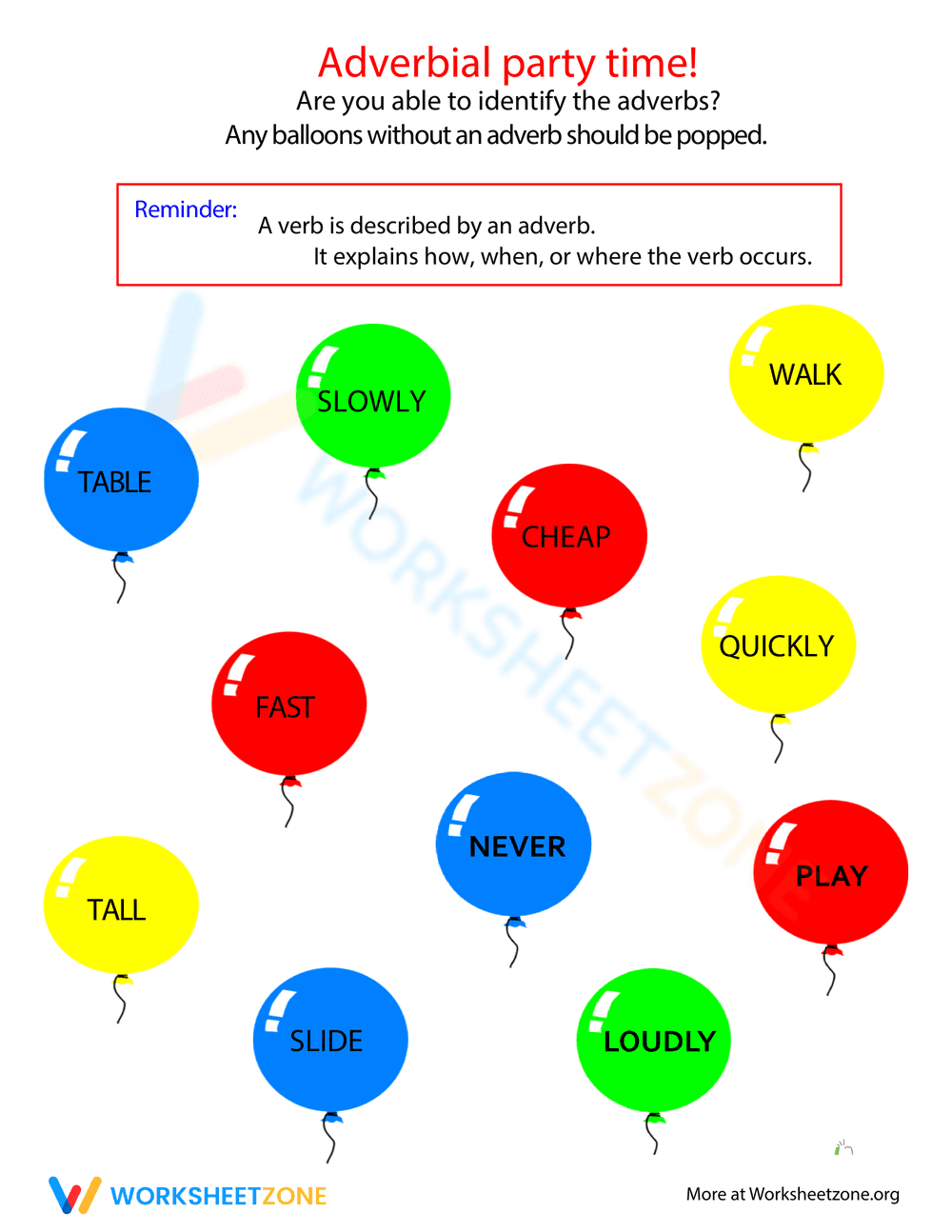
This is an educational worksheet designed to help students identify adverbs. The worksheet features a title 'Adverbial party time!' and the instruction 'Are you able to identify the adverbs? Any balloons without an adverb should be popped.' There is a reminder box explaining that adverbs describe verbs, indicating how, when, or where the verb occurs. The worksheet contains illustrations of balloons, each containing a word. Some of the words are adverbs (e.g., 'Slowly,' 'Quickly,' 'Fast,' 'Never,' 'Loudly') and some are not (e.g., 'Table,' 'Walk,' 'Cheap,' 'Play,' 'Tall,' 'Slide').
Grade Level Suitability:
This worksheet is suitable for grades 2-4. The concept of adverbs is typically introduced in these grades. The vocabulary used is relatively simple and appropriate for this age range. The activity of identifying adverbs among a list of words is also a suitable task for this grade level.
Why Use It:
This worksheet provides a fun and engaging way for students to practice identifying adverbs. The balloon theme makes the activity more visually appealing and can help to maintain student interest. It reinforces the definition of an adverb and provides practice in distinguishing adverbs from other parts of speech.
How to Use It:
Students should read each word inside the balloons. If the word is an adverb, they can leave the balloon as is. If the word is not an adverb (e.g., a noun or a verb), they should 'pop' the balloon, perhaps by crossing it out or coloring it differently. This allows them to visually separate the adverbs from the other words.
Target Users:
The target users are elementary school students, specifically those in grades 2-4, who are learning about adverbs. It's also suitable for students who need additional practice in identifying parts of speech.
This is an educational worksheet designed to help students identify adverbs. The worksheet features a title 'Adverbial party time!' and the instruction 'Are you able to identify the adverbs? Any balloons without an adverb should be popped.' There is a reminder box explaining that adverbs describe verbs, indicating how, when, or where the verb occurs. The worksheet contains illustrations of balloons, each containing a word. Some of the words are adverbs (e.g., 'Slowly,' 'Quickly,' 'Fast,' 'Never,' 'Loudly') and some are not (e.g., 'Table,' 'Walk,' 'Cheap,' 'Play,' 'Tall,' 'Slide').
Grade Level Suitability:
This worksheet is suitable for grades 2-4. The concept of adverbs is typically introduced in these grades. The vocabulary used is relatively simple and appropriate for this age range. The activity of identifying adverbs among a list of words is also a suitable task for this grade level.
Why Use It:
This worksheet provides a fun and engaging way for students to practice identifying adverbs. The balloon theme makes the activity more visually appealing and can help to maintain student interest. It reinforces the definition of an adverb and provides practice in distinguishing adverbs from other parts of speech.
How to Use It:
Students should read each word inside the balloons. If the word is an adverb, they can leave the balloon as is. If the word is not an adverb (e.g., a noun or a verb), they should 'pop' the balloon, perhaps by crossing it out or coloring it differently. This allows them to visually separate the adverbs from the other words.
Target Users:
The target users are elementary school students, specifically those in grades 2-4, who are learning about adverbs. It's also suitable for students who need additional practice in identifying parts of speech.


