


























Views
Downloads
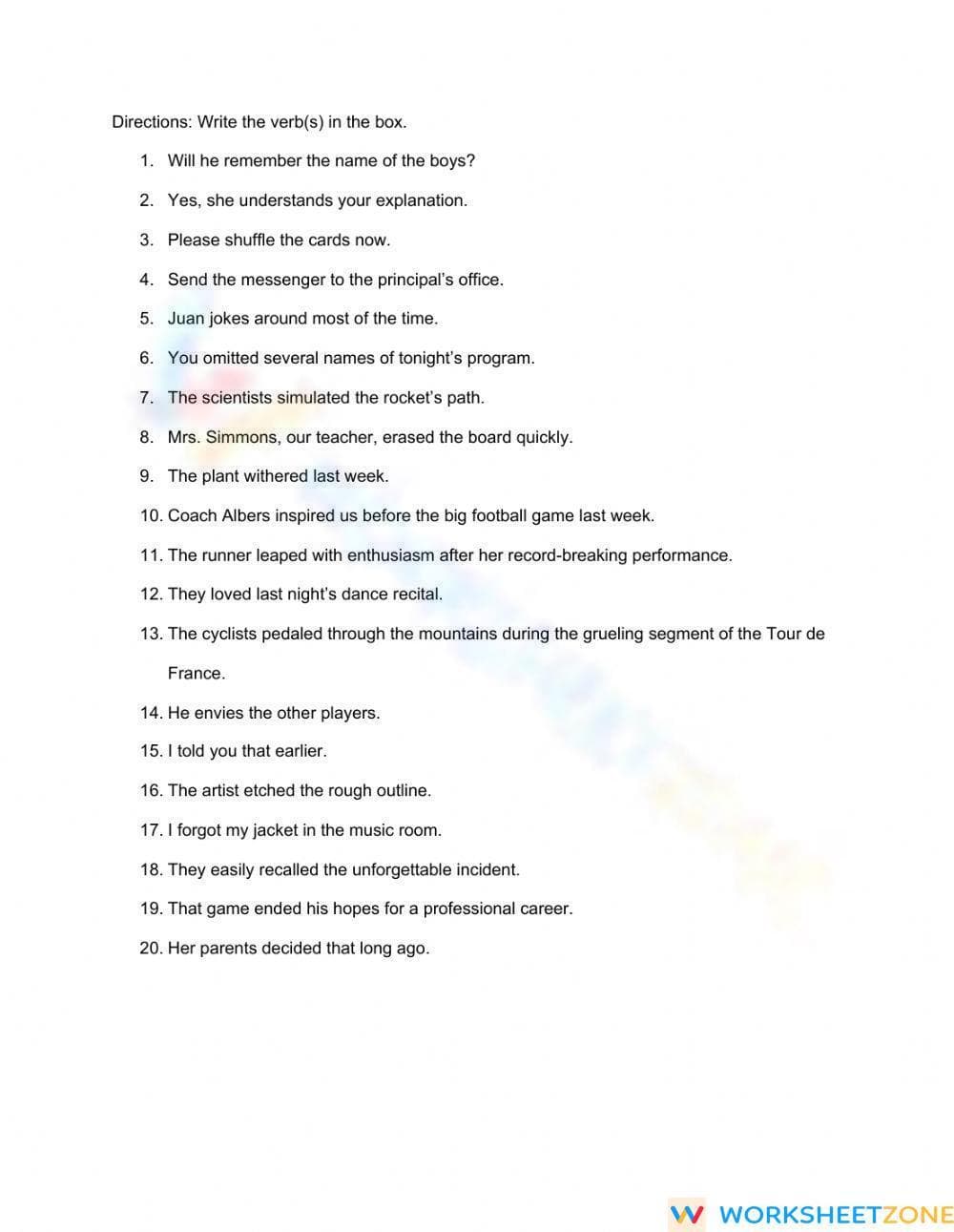

Printable Identifying Verbs Worksheet | Grade 5-8 ELA
Paste this activity's link or code into your existing LMS (Google Classroom, Canvas, Teams, Schoology, Moodle, etc.).
Students can open and work on the activity right away, with no student login required.
You'll still be able to track student progress and results from your teacher account.
Mastering verb identification is a fundamental pillar of grammatical fluency and sophisticated writing. This comprehensive identifying verbs worksheet challenges students to isolate the core action or state of being within twenty distinct sentences. By accurately locating lexical verbs, learners strengthen their ability to analyze sentence structure and improve their overall reading comprehension across multiple grade levels.
At a Glance
- Grade: 5-8 · Subject: English Language Arts
- Standard:
CCSS.ELA-LITERACY.L.5.1— Identify and use verbs correctly in various sentence structures- Skill Focus: Lexical Verb Identification
- Format: 1 page · 20 problems · Answer key included · PDF
- Best For: Middle school grammar reinforcement and assessment
- Time: 15–20 minutes
What's Inside
This single-page resource features twenty curated sentences that range in complexity, providing robust practice for middle schoolers. Tasks require students to isolate the specific verb responsible for the action or condition. The layout is clean and focused, ensuring engagement with the linguistic analysis. A comprehensive answer key is provided for rapid grading and immediate classroom feedback.
Skill Progression
- Guided practice begins with simple subject-verb constructions, building confidence in identifying clear action words in familiar contexts.
- Supported practice introduces sentences with descriptive phrases, requiring students to distinguish the main verb from other words.
- Independent practice culminates in complex sentences with technical vocabulary, challenging students to isolate the core predicate.
This gradual-release approach ensures students move from basic recognition to nuanced analysis through a structured I Do, We Do, You Do framework.
Standards Alignment
The primary focus of this worksheet is CCSS.ELA-LITERACY.L.5.1, which requires students to demonstrate command of the conventions of standard English grammar and usage when writing or speaking. Specifically, it targets the foundational skill of identifying word classes, a prerequisite for mastering more advanced standards. Both standard codes can be copied directly into lesson plans, IEP goals, or district curriculum mapping tools.
How to Use It
Use this worksheet as a formative assessment during a unit on parts of speech to gauge student readiness for more complex syntax. Teachers should observe whether students struggle with specific verb types to inform future instruction. This activity is also ideal for a quick homework assignment to reinforce direct instruction. Expect completion within a fifteen to twenty-minute window.
Who It's For
This resource is designed for students in grades 5 through 8 refining their understanding of word classes. It serves general education classrooms, English Language Learners requiring support, and students with IEPs focusing on literacy. The worksheet pairs naturally with an anchor chart detailing verb functions within a sentence and its role in conveying action.
Identifying lexical verbs is a critical gateway skill for syntactic maturity, as noted in the EdReports 2024 analysis of high-quality ELA curriculum. Research by Fisher & Frey (2014) emphasizes that isolated grammar practice is most effective when it bridges the gap between basic recognition and applied writing. This worksheet aligns with the CCSS.ELA-LITERACY.L.5.1 standard by providing the high-repetition practice necessary for students to achieve automaticity in word class identification. By engaging with twenty varied sentence structures, students develop a more sophisticated "grammatical eye" that directly informs their ability to construct complex, well-formed sentences. The structured nature of this practice provides teachers with clear data points for tracking progress toward grade-level proficiency in English Language Arts. This resource ensures that students are not merely memorizing definitions but are actively applying linguistic rules to authentic text, a proven strategy for long-term retention of grammatical concepts.


