




























Views
Downloads


Kindergarten Sight Words Worksheet | Printable Ready

Paste this activity's link or code into your existing LMS (Google Classroom, Canvas, Teams, Schoology, Moodle, etc.).
Students can open and work on the activity right away, with no student login required.
You'll still be able to track student progress and results from your teacher account.
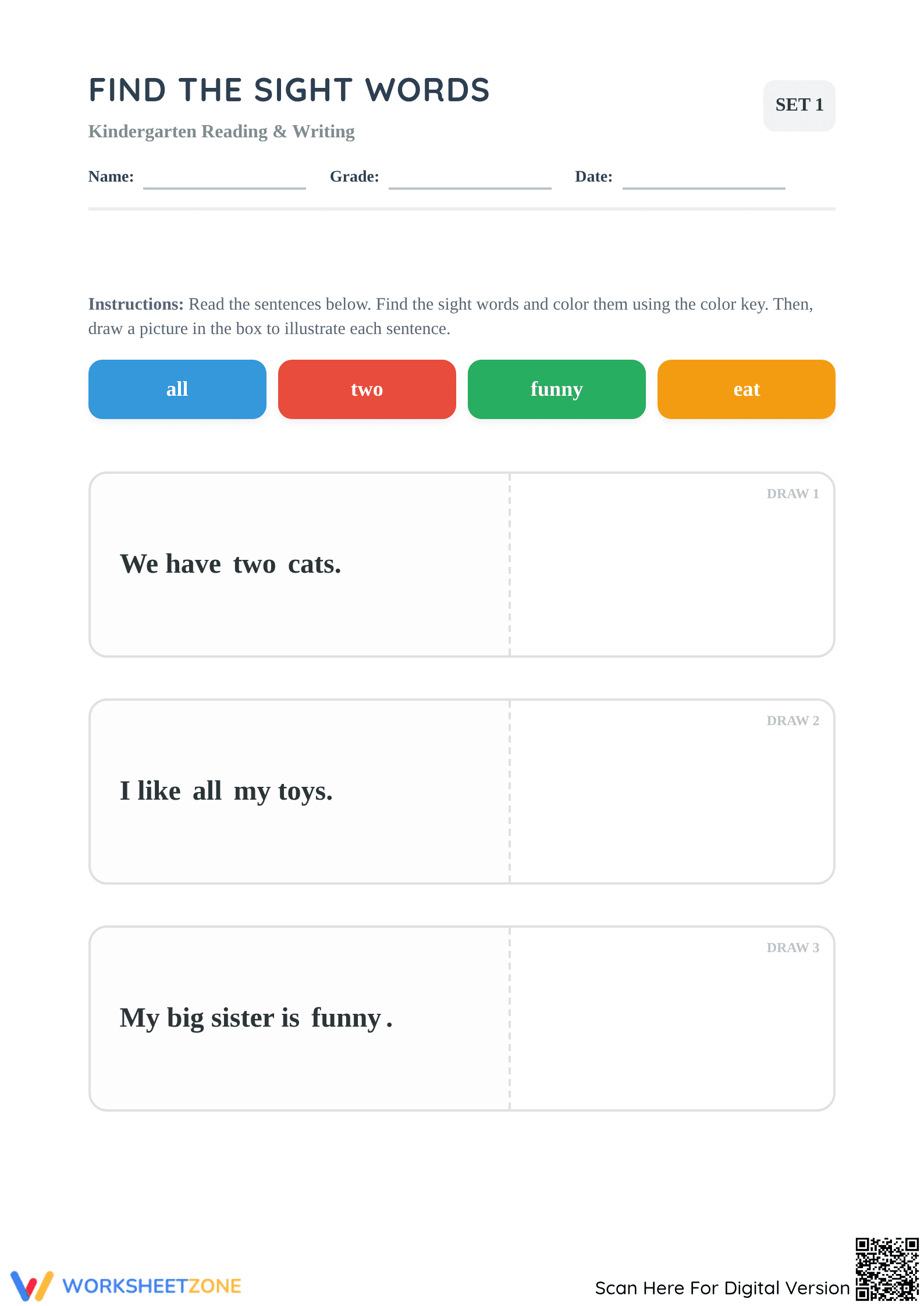
This Kindergarten sight word worksheet helps early readers build fluency by identifying and visualizing high-frequency words within simple sentence structures. By combining word recognition with creative illustration, students move beyond rote memorization to demonstrate true reading comprehension. This resource ensures students can recognize common words instantly to improve overall reading speed and confidence.
At a Glance
- Grade: Kindergarten · Subject: ELA
- Standard:
CCSS.ELA-LITERACY.RF.K.3.C— Read common high-frequency words by sight- Skill Focus: Sight word identification and visualization
- Format: 3 pages · 8 problems · Answer key included · PDF
- Best For: Independent literacy centers and morning work
- Time: 15–20 minutes
Inside this 3-page PDF, you will find eight distinct practice blocks. Each block features a high-frequency sentence containing target words such as "all," "two," "funny," "eat," "like," "see," "big," and "play." Students are prompted to find the specific word using a color-coded key and then use the adjacent "Draw" box to illustrate the sentence's meaning. A full answer key is provided to allow for quick grading or student self-correction.
Zero-Prep Workflow
- Print (1 minute): Select the three student pages and the answer key. The clean, black-and-white design is optimized for high-volume school copiers.
- Distribute (30 seconds): Provide students with the worksheet and a small set of crayons or colored pencils to match the color key.
- Review (30 seconds): Use the included answer key to verify word identification. The drawing component serves as an immediate formative assessment of comprehension.
This streamlined layout makes the resource an ideal choice for emergency sub plans or quiet transition periods between core lessons.
Standards Alignment
This resource aligns primarily with `CCSS.ELA-LITERACY.RF.K.3.C`: Read common high-frequency words by sight (e.g., the, of, to, you, she, my, is, are, do, does). It also supports foundational writing skills by requiring students to process sentence-level syntax. Both standard codes can be copied directly into lesson plans, IEP goals, or district curriculum mapping tools.
How to Use It
Assign this worksheet during your daily literacy block after introducing a new set of sight words. It works exceptionally well as a "Must-Do" activity in a station-based classroom. For a formative assessment tip, observe whether students can read the sentence aloud to you before they begin drawing; this confirms they are not just matching the visual shape of the word but understanding the context. Expect completion within 20 minutes.
Who It's For
This worksheet is designed for Kindergarten students and advanced Preschoolers ready for sentence-level reading. It is also a valuable tool for ESL/ELL students who benefit from the visual reinforcement of drawing to confirm vocabulary meaning. Pair this with a sight word anchor chart or a shared reading passage to reinforce the target vocabulary in multiple contexts.
Research from the RAND AIRS 2024 report emphasizes that multisensory approaches to literacy, such as combining visual identification with motor-based drawing tasks, significantly improve long-term retention of high-frequency words in early childhood settings. By engaging both the linguistic and spatial centers of the brain, this worksheet addresses the diverse needs of emerging readers. The inclusion of 8 specific tasks across 3 pages provides enough repetition to build mastery without causing cognitive fatigue. According to recent NAEP data, students who master sight word recognition by the end of Kindergarten are significantly more likely to reach reading proficiency benchmarks in third grade. This resource provides the structured, repeatable practice necessary to reach those critical milestones while maintaining student engagement through creative expression and clear, achievable goals.


