




























Views
Downloads
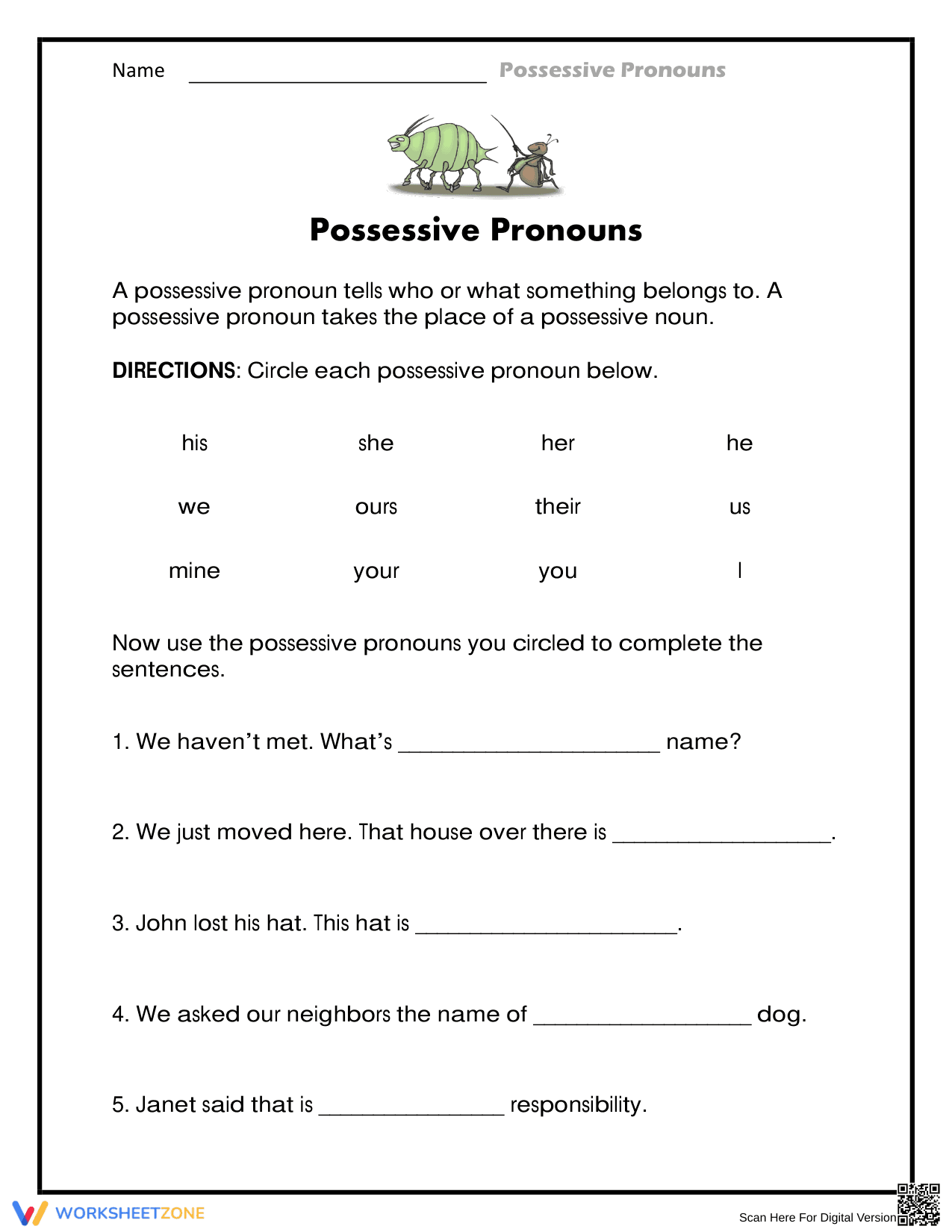

Essential Possessive Pronouns Worksheet | Grade 3 English

Paste this activity's link or code into your existing LMS (Google Classroom, Canvas, Teams, Schoology, Moodle, etc.).
Students can open and work on the activity right away, with no student login required.
You'll still be able to track student progress and results from your teacher account.
This Grade 3 worksheet helps students master possessive pronouns through targeted identification and sentence-level application. Learners first isolate specific ownership terms from a mixed list before completing context-rich sentences to demonstrate mastery. This dual-layer approach ensures students can recognize and apply these grammar tools accurately, leading to improved clarity and sophistication in student writing.
At a Glance
- Grade: 3 · Subject: English Language Arts
- Standard:
CCSS.ELA-LITERACY.L.3.1— Use possessive pronouns to show ownership and ensure pronoun-antecedent agreement- Skill Focus: Identifying and using possessive pronouns
- Format: 1 page · 17 problems · Answer key included · PDF
- Best For: Grammar centers and independent practice
- Time: 15–20 minutes
What's Inside
The worksheet features a streamlined design focused on grammatical mastery. It begins with a word bank of 12 pronouns where students circle only the possessive forms. Five targeted fill-in-the-blank sentences provide immediate application opportunities, helping students bridge the gap between abstract recognition and concrete usage. This single-page PDF includes a full answer key for efficient grading and student self-review.
Zero-Prep Workflow
This resource allows for immediate classroom implementation with minimal effort. Educators can follow this simple three-step process:
- Print: Download and print the single-page PDF for your group.
- Distribute: Use as a warm-up, bell-ringer, or independent task.
- Review: Use the included answer key for quick checks or self-correction.
Standards Alignment
This resource aligns with CCSS.ELA-LITERACY.L.3.1, focusing on the command of standard English grammar conventions. It specifically addresses using possessive pronouns to indicate ownership and maintain clarity. By distinguishing between possessive and personal pronouns, students build the foundational skills necessary for complex sentence construction. This code can be copied directly into lesson plans or IEP goals.
How to Use It
Use this worksheet as a formative assessment during grammar units. After direct instruction, assign the identification section to check for word recognition. Use the sentence completion phase to observe if students can accurately apply pronouns to implied antecedents. Completion typically takes 15 to 20 minutes, providing a clear snapshot of student mastery for progress monitoring.
Who It's For
Designed for Grade 2 through Grade 4 students, this resource is especially effective for ELL learners who benefit from structured grammar practice and visual circling tasks. Pair it with an anchor chart to reinforce ownership concepts. It works equally well for RTI small groups, morning work, or as part of a literacy center rotation.
Explicit grammar instruction requires a balance of identification and application, a strategy supported by Fisher & Frey (2014) regarding the gradual release of responsibility. This Grade 3 worksheet adheres to those principles by guiding students from recognition of possessive pronouns to active usage in structured sentences. Aligned to CCSS.ELA-LITERACY.L.3.1, the resource focuses on identifying and applying ownership markers to improve sentence-level clarity. Research from NAEP indicates that students who master these foundational conventions early demonstrate higher proficiency in complex writing tasks later in their academic careers. The "Find It, Use It!" structure provides the necessary scaffolding for learners to move from lower-order identification to higher-order application. Educators can utilize the 17 distinct tasks to gather formative data on student mastery. This standalone summary serves as a citation-ready overview for curriculum directors and instructional coaches seeking standards-aligned materials that bridge the gap between grammar theory and student practice.


