


























Views
Downloads
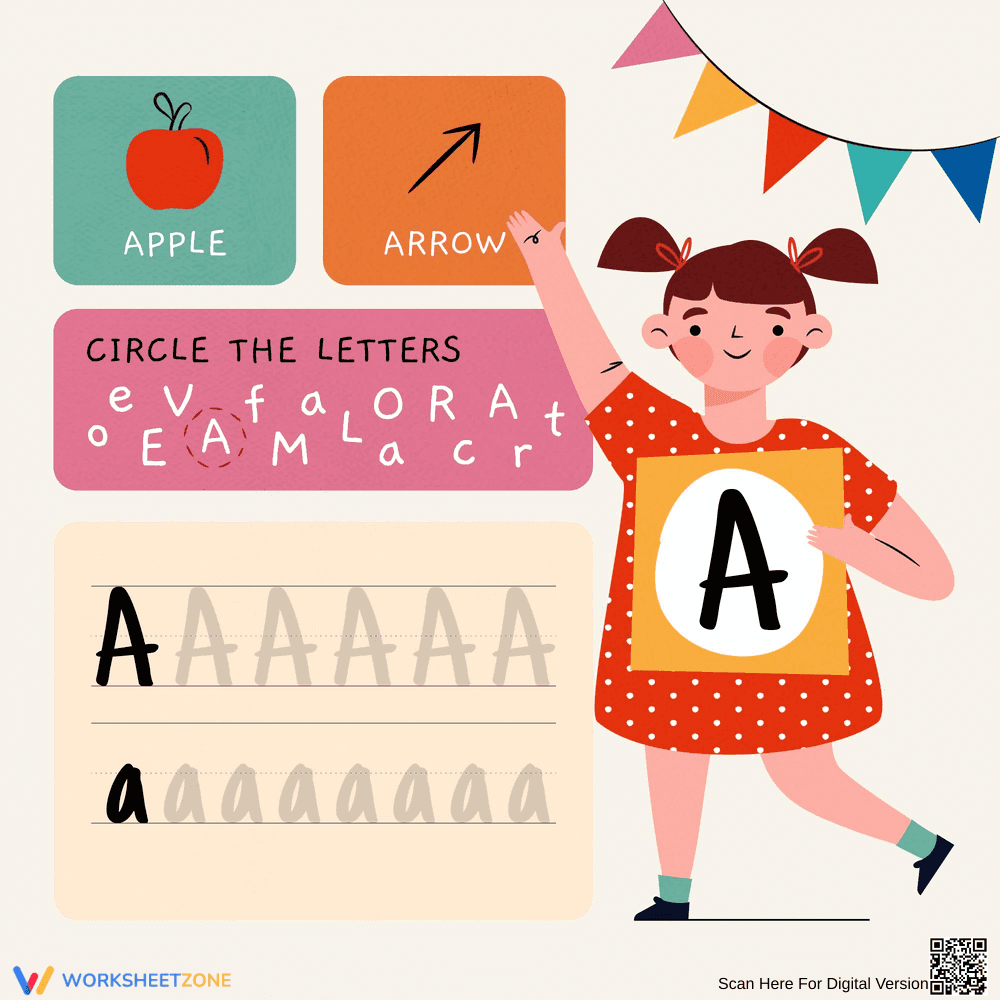

Find and Trace Letter A | Printable Kindergarten Worksheet
Paste this activity's link or code into your existing LMS (Google Classroom, Canvas, Teams, Schoology, Moodle, etc.).
Students can open and work on the activity right away, with no student login required.
You'll still be able to track student progress and results from your teacher account.
This Letter A worksheet provides foundational literacy practice for early learners. Students engage in dual-modality learning by identifying the letter A within a mixed-letter field and practicing precise handwriting strokes for both uppercase and lowercase forms. It ensures students build the muscle memory and visual discrimination necessary for reading readiness and early writing success.
At a Glance
- Grade: Kindergarten · Subject: English Handwriting
- Standard:
CCSS.ELA-LITERACY.RF.K.1.D— Recognize and name all upper- and lowercase letters of the alphabet- Skill Focus: Letter A recognition and tracing
- Format: 1 page · 30 tasks · Answer key included · PDF
- Best For: Morning work or literacy centers
- Time: 10–15 minutes
What's Inside
Inside this resource, you will find a comprehensive single-page activity. It begins with a visual discrimination task where students circle the letter A among various distractors. Following this, two dedicated tracing lines provide 15 specific opportunities to practice the formation of uppercase 'A' and lowercase 'a' using guided dashed lines and starting points to ensure proper stroke order.
Zero-Prep Workflow
The zero-prep workflow is designed for busy educators. First, print the single-page PDF (30 seconds). Second, distribute the sheets to students during your phonics block (1 minute). Third, review the completed work using the included answer key to identify students needing additional intervention (30 seconds). This makes it an ideal choice for emergency sub plans or transition periods.
Standards Alignment
This activity aligns with `CCSS.ELA-LITERACY.RF.K.1.D`, which requires students to recognize and name all upper- and lowercase letters. By focusing specifically on the letter A, it supports the foundational strand of Print Concepts. Both standard codes can be copied directly into lesson plans, IEP goals, or district curriculum mapping tools to ensure compliance with state and federal requirements.
How to Use It
Use this worksheet as a formative assessment after introducing the letter A. Observe students during the "find" portion to see if they confuse 'A' with similar shapes like 'V' or 'M'. It is also effective as a quiet-time activity or a homework assignment to reinforce classroom instruction. Expected completion time ranges from 10 to 15 minutes depending on fine motor development.
Who It's For
This resource is designed for preschool and kindergarten students beginning their literacy journey. It is particularly helpful for English Language Learners (ELLs) who need explicit practice with English orthography. Pair this with an anchor chart featuring the "Apple" and "Arrow" keywords shown on the worksheet for maximum impact during small group direct instruction sessions.
According to the RAND AIRS 2024 report, early exposure to letter-name knowledge is one of the strongest predictors of later reading achievement. This worksheet targets CCSS.ELA-LITERACY.RF.K.1.D by integrating visual search tasks with fine motor handwriting practice. Research by Fisher & Frey (2014) emphasizes that the gradual release of responsibility begins with clear, scaffolded models like the tracing lines provided here. By isolating the letter A, students reduce cognitive load, allowing them to focus entirely on the unique features of the grapheme. This 1-page resource provides 30 distinct opportunities for student response, meeting the high-frequency practice requirements suggested by EdReports 2024 for foundational skills. Educators can use the results to track progress toward alphabet mastery, ensuring that every child develops the prerequisite skills for phonics instruction and eventual decoding fluency in later primary grades.


