


























Views
Downloads
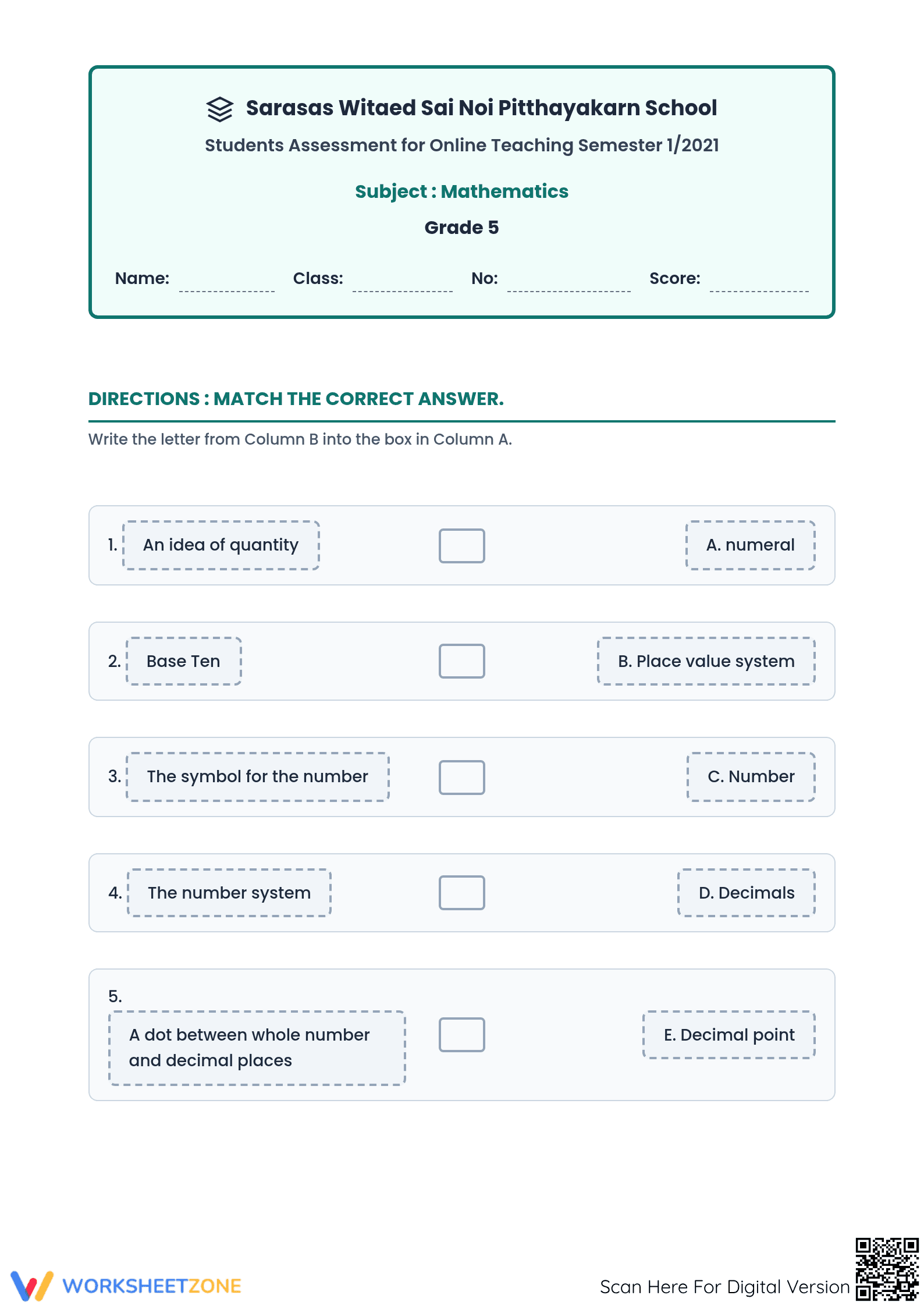
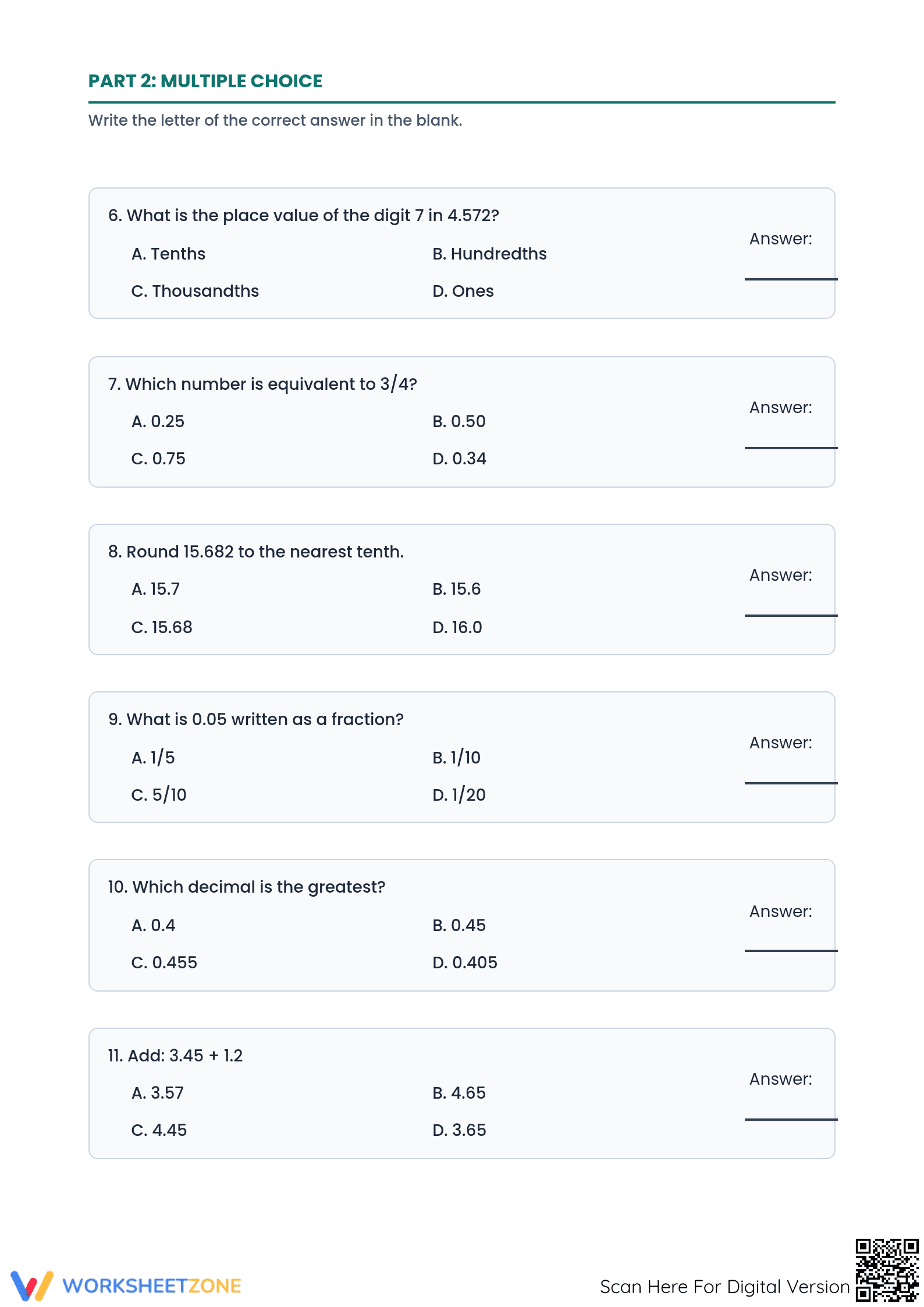
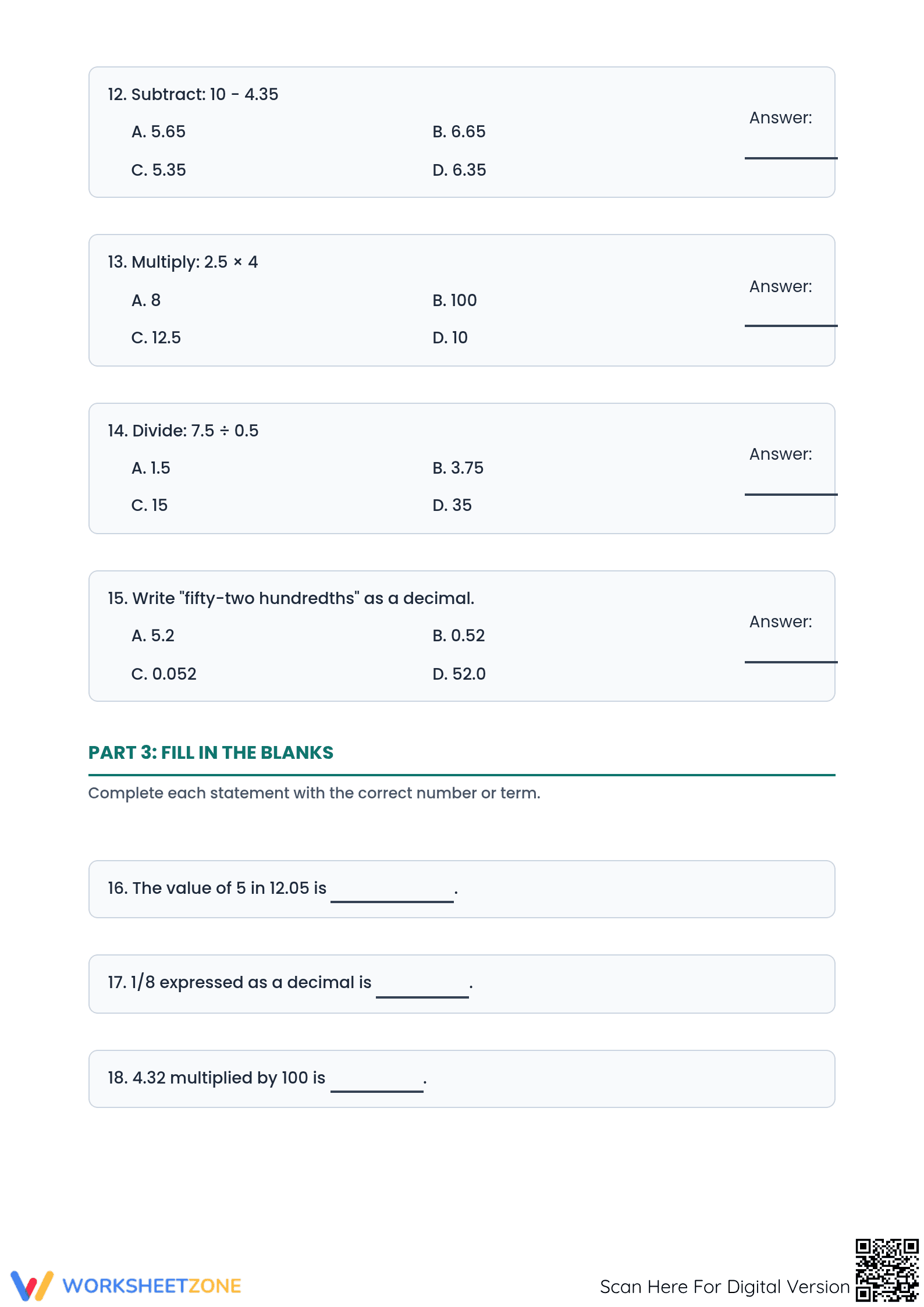
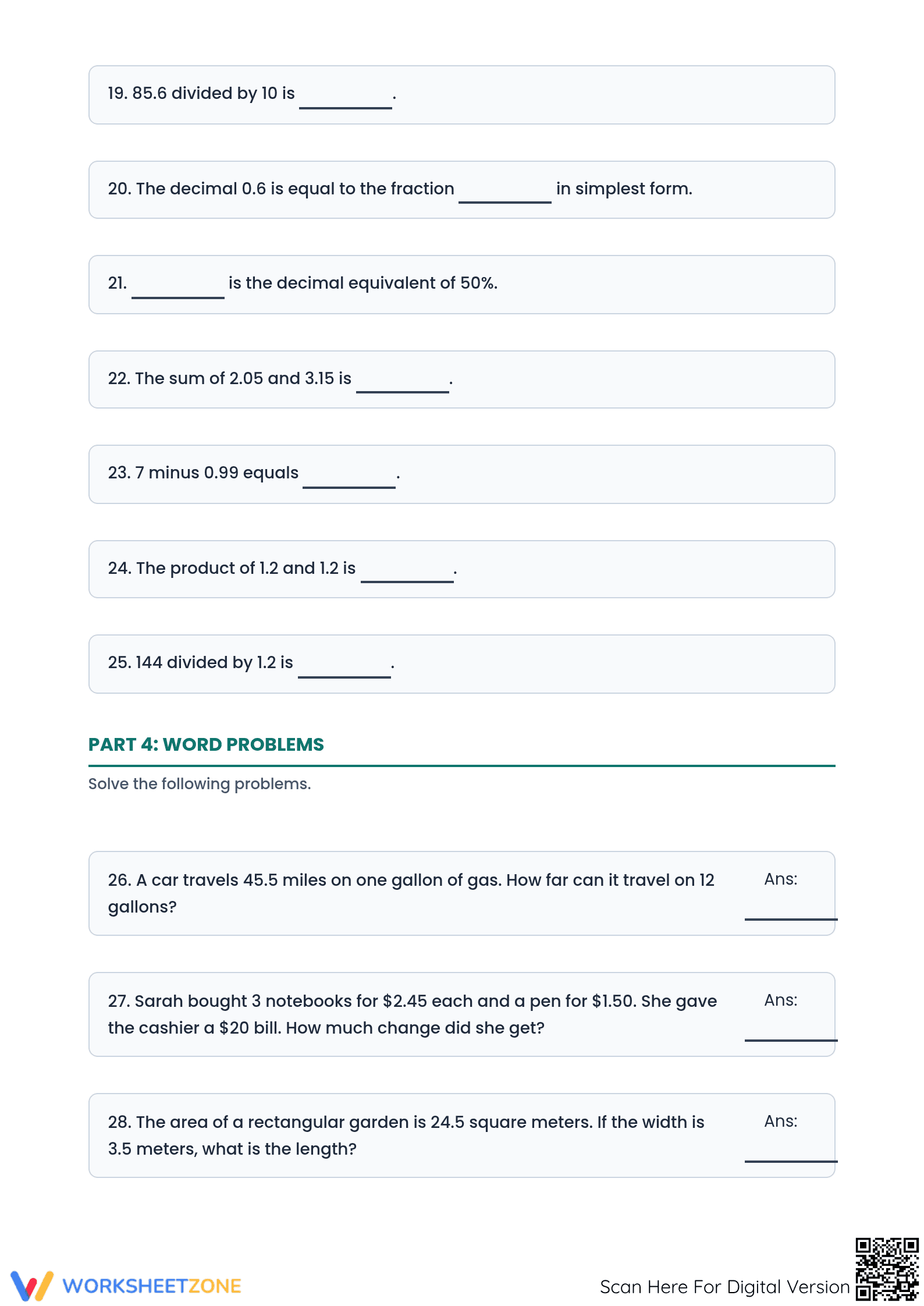

5.NBT.B.7 Worksheet: Decimal Operations — Grade 5 Aligned
Paste this activity's link or code into your existing LMS (Google Classroom, Canvas, Teams, Schoology, Moodle, etc.).
Students can open and work on the activity right away, with no student login required.
You'll still be able to track student progress and results from your teacher account.
This comprehensive Grade 5 decimal operations assessment provides a rigorous evaluation of student proficiency in place value, arithmetic, and word problems. By integrating diverse task types, the worksheet ensures students can demonstrate deep conceptual understanding and procedural fluency. It serves as a complete summative tool for concluding decimal units or preparing for standardized testing.
At a Glance
- Grade: 5 · Subject: Math
- Standard:
CCSS.MATH.CONTENT.5.NBT.B.7— Add, subtract, multiply, and divide decimals to hundredths- Skill Focus: Decimal Operations & Place Value
- Format: 5 pages · 40 problems · Answer key included · PDF
- Best For: End-of-unit summative assessment and mastery tracking
- Time: 45–60 minutes
What's Inside
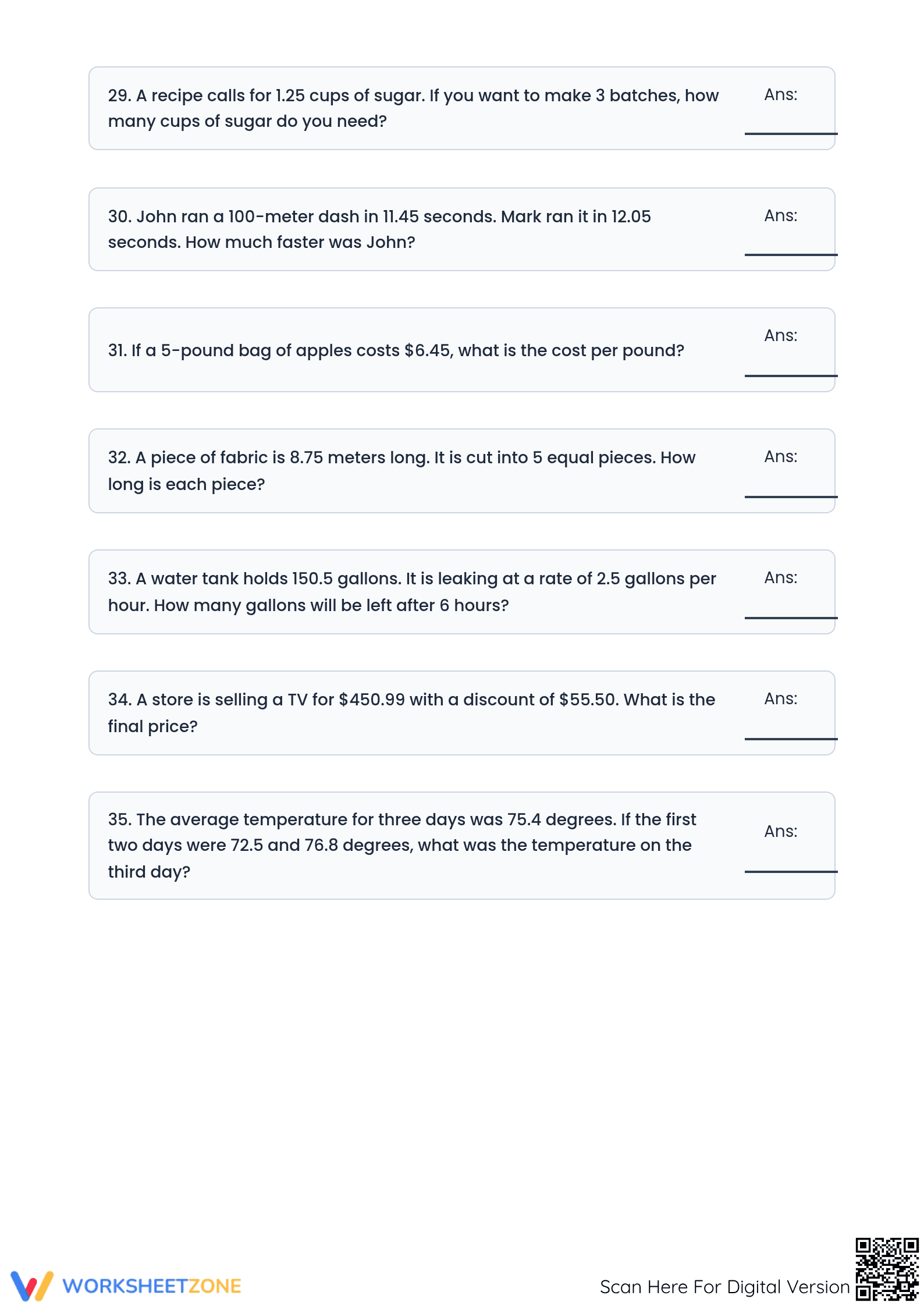
The assessment is structured into five distinct sections across five pages, ensuring a thorough review of the curriculum. It includes multiple-choice questions for conceptual checks, computational blocks for arithmetic fluency, and multi-step word problems that require application in real-world contexts. A comprehensive answer key is provided to facilitate rapid grading and immediate feedback.
Mastery Evidence
This worksheet is designed to provide clear evidence of mastery across the 5.NBT standard cluster. Tasks are mapped to specific sub-skills, allowing educators to identify whether students are Approaching, Meeting, or Exceeding grade-level expectations. The structured layout supports data-driven instruction by making it easy to enter scores directly into gradebooks or IEP progress notes for specialized support.
Standards Alignment
The primary focus is CCSS.MATH.CONTENT.5.NBT.B.7: "Add, subtract, multiply, and divide decimals to hundredths, using concrete models or drawings and strategies based on place value, properties of operations, and/or the relationship between addition and subtraction." Supporting standards include 5.NBT.A.3 for reading and comparing decimals. Both standard codes can be copied directly into lesson plans, IEP goals, or district curriculum mapping tools.
How to Use It
Utilize this resource as a formal summative assessment after completing a unit on decimal arithmetic to gauge individual student progress. During administration, observe student strategies for aligning decimal points in addition and subtraction tasks as a formative checkpoint. The expected completion time is 45 to 60 minutes, making it suitable for a single focused instructional block.
Who It's For
This resource is tailored for Grade 5 students, though it provides excellent review for Grade 6 or extension for Grade 4 learners. It is particularly effective for general education classrooms and resource rooms. Pair this assessment with a decimal place value anchor chart or a prior multi-digit multiplication lesson to ensure students have the necessary scaffolds for success.
Mathematical proficiency in decimal operations is a critical milestone for middle school readiness, as it bridges the gap between whole number arithmetic and rational number theory. According to Fisher & Frey (2014), the use of scaffolded assessments allows teachers to pinpoint specific misconceptions in decimal place value before they hinder future progress in algebra. This Grade 5 worksheet aligns with the CCSS.MATH.CONTENT.5.NBT.B.7 framework by requiring students to navigate 40 distinct tasks that range from simple recognition to complex application. Research indicates that frequent, standards-aligned practice in decimal division and multiplication reduces cognitive load during subsequent higher-order problem solving. By providing 5 pages of structured practice, this resource supports the gradual release of responsibility model, ensuring that students can independently perform calculations with precision. Educators can rely on this document as a valid measure of student achievement within the decimal domain.


