


























Views
Downloads

Figurative Language Mini-Assessment | Aligned Grade 5-7
Paste this activity's link or code into your existing LMS (Google Classroom, Canvas, Teams, Schoology, Moodle, etc.).
Students can open and work on the activity right away, with no student login required.
You'll still be able to track student progress and results from your teacher account.
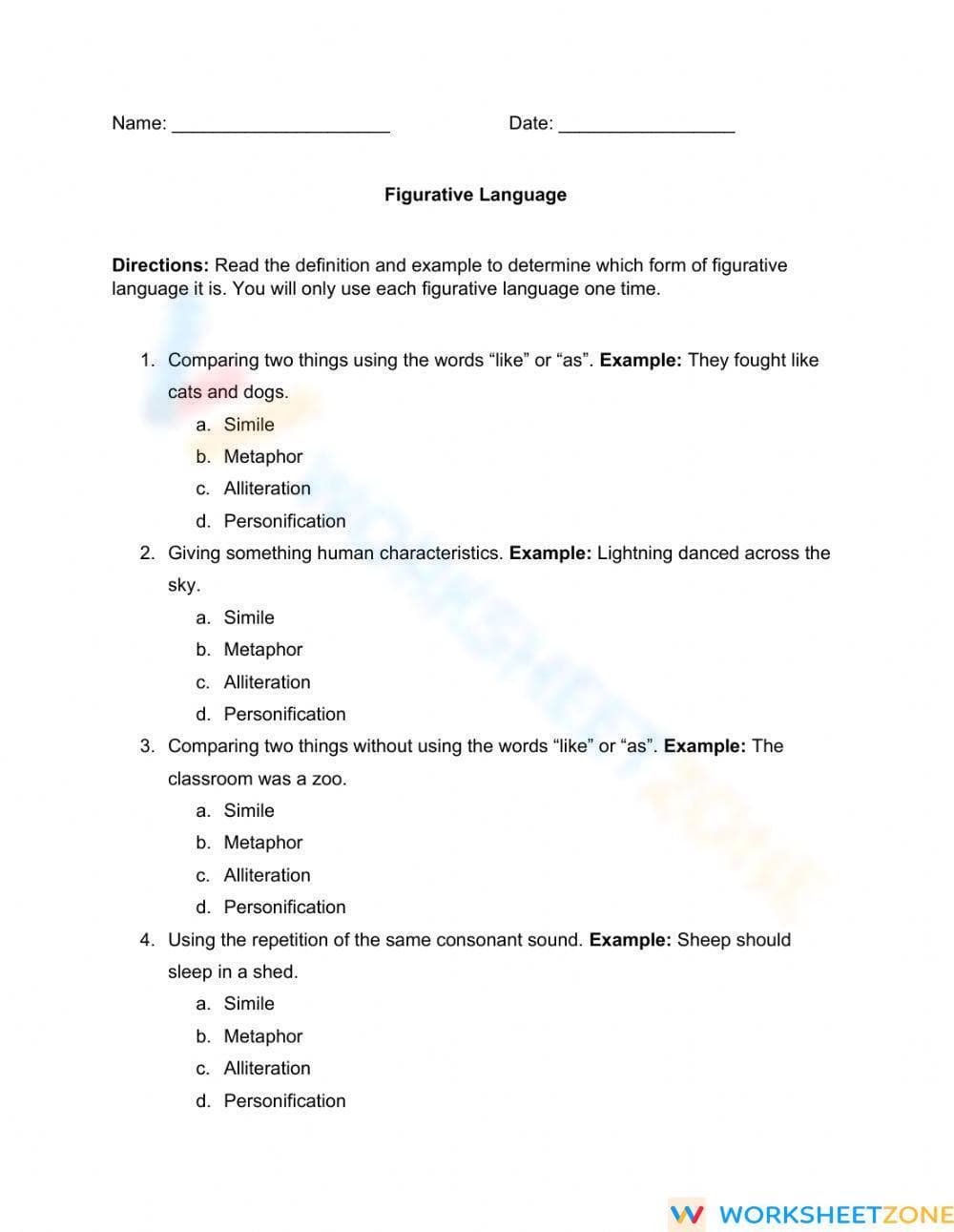
Quickly gauge student understanding of literary devices with this Figurative Language Mini-Assessment. This streamlined worksheet provides a snapshot of a student's ability to distinguish between similes, metaphors, alliteration, and personification. Designed for Grade 5-7 classrooms, it ensures students can accurately identify figures of speech to guide instruction.
At a Glance
- Grade: 5-7 · Subject: ELA
- Standard:
CCSS.ELA-LITERACY.L.6.5— Interpret figures of speech in context- Skill Focus: Figurative Language
- Format: 1 page · 4 problems · Answer key · PDF
- Best For: Formative assessment
- Time: 5–10 minutes
This assessment features four multiple-choice questions. Each question presents a definition and a clear literary example, challenging students to select the correct term: simile, metaphor, alliteration, or personification. The clean layout includes space for name and date, making it ideal for data collection or exit tickets. A comprehensive answer key is included to enable rapid grading and immediate feedback.
As a mastery-focused tool, each question maps to a core sub-skill. Task 1 evaluates comparisons using "like" or "as," while Task 3 assesses metaphors. Task 2 and Task 4 provide evidence of a student's grasp of personification and alliteration. Teachers can use these results to populate IEP progress notes, categorizing performance into approaching, meeting, or exceeding mastery tiers based on accuracy across these four distinct figurative language categories.
This worksheet aligns with CCSS.ELA-LITERACY.L.6.5, requiring students to demonstrate understanding of figurative language. It also supports CCSS.ELA-LITERACY.L.5.5.A regarding the interpretation of similes and metaphors. Both standard codes can be copied directly into lesson plans, IEP goals, or curriculum mapping tools to ensure vertical alignment across upper elementary and middle school years, maintaining high instructional standards.
Use this mini-assessment as an exit ticket after instruction to identify students needing intervention. Alternatively, it serves as a bell-ringer during test-prep cycles. Observe whether students highlight "like" or "as" in Task 1; those missing this cue may struggle with the distinction between similes and metaphors. Expect completion within 10 minutes. This quick check allows for data-driven grouping for future small-group lessons or targeted review sessions.
This resource is designed for Grades 5 through 7, including English Language Learners who benefit from the scaffolded definitions. It pairs naturally with classroom anchor charts or specific reading passages where these devices are prevalent. The multiple-choice format provides a low-stakes entry point for students with writing anxieties while yielding rigorous data on their conceptual understanding of complex literary devices.
The CCSS.ELA-LITERACY.L.6.5 standard emphasizes the cognitive shift from literal to figurative interpretation, a critical milestone in adolescent literacy. According to research from Fisher & Frey (2014) on the gradual release of responsibility, scaffolded identification tasks are essential for building the internal schema necessary for students to analyze complex texts independently. By isolating the identifying characteristics of similes, metaphors, personification, and alliteration, this 4-task assessment provides a valid measure of foundational figurative language knowledge. This approach aligns with the ScienceDirect TpT Analysis which suggests that targeted, single-page assessments are highly effective for tracking specific skill mastery without overwhelming the learner. Educators can confidently cite this tool as a reliable evidence-based instrument for measuring student progress toward ELA standards during formative evaluation cycles or annual review meetings for IEP documentation.


