


























Views
Downloads

Identifying Feelings Worksheet | Grade 1 Essential
Paste this activity's link or code into your existing LMS (Google Classroom, Canvas, Teams, Schoology, Moodle, etc.).
Students can open and work on the activity right away, with no student login required.
You'll still be able to track student progress and results from your teacher account.
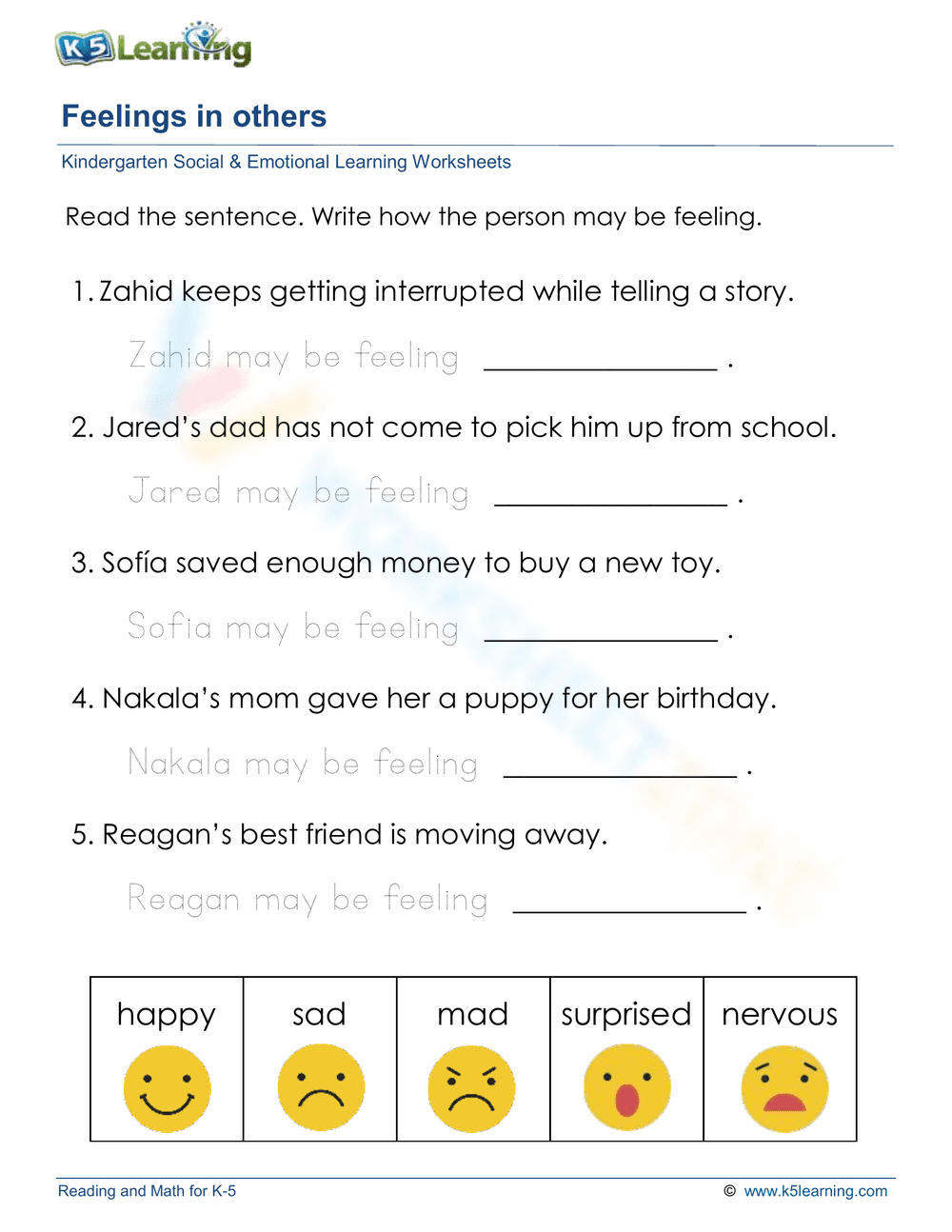
This Grade 1 social-emotional learning worksheet helps young learners identify and describe feelings in others through relatable scenarios. By analyzing short sentences, students develop empathy and social awareness while practicing foundational reading comprehension. It provides a structured way for children to connect actions with emotional outcomes in a classroom or home setting.
At a Glance
- Grade: 1 · Subject: Social Skills
- Standard:
CCSS.ELA-LITERACY.RL.1.3— Describe characters and their feelings using key details from short scenarios- Skill Focus: Identifying emotions in others
- Format: 1 page · 5 problems · Answer key included · PDF
- Best For: Social-emotional learning and morning work
- Time: 10–15 minutes
The worksheet features five distinct social scenarios, such as receiving a puppy or a friend moving away. Each task includes a sentence-starter trace to support early writers. A visual word bank at the bottom provides five core emotions—happy, sad, mad, surprised, and nervous—paired with expressive emojis to assist non-readers and English Language Learners as they navigate the text.
This resource is designed for immediate classroom implementation with a total teacher prep time of under 2 minutes. Simply print the single-page PDF, distribute it to students during a social skills block, and review the answers together to spark a class discussion. Its self-contained word bank makes it an ideal choice for emergency sub plans or independent morning work.
This activity aligns with `CCSS.ELA-LITERACY.RL.1.3`, which requires students to describe characters and major events in a text using key details. By inferring a character's internal state from external events, students practice high-level comprehension skills. Both standard codes can be copied directly into lesson plans, IEP goals, or district curriculum mapping tools.
Use this worksheet during a direct instruction lesson on empathy to model how we read social cues. It also serves as an effective formative-assessment tool; observe if students can justify their choice of "nervous" or "sad" based on the text. Expect most first graders to complete the five tasks within a 15-minute window during their independent practice time.
This resource is tailored for Kindergarten and Grade 1 students, particularly those developing social-emotional literacy or participating in speech-language therapy. It pairs naturally with a classroom anchor chart about feelings or a read-aloud book focused on diverse emotions and interpersonal relationships. The visual aids ensure accessibility for students with varying reading levels.
According to Fisher & Frey (2014), the ability to infer character emotions is a critical bridge between basic decoding and deep reading comprehension. This worksheet targets CCSS.ELA-LITERACY.RL.1.3 by providing five specific social contexts that require students to synthesize situational evidence with emotional vocabulary. Research from the NAEP suggests that early exposure to social-emotional vocabulary significantly improves a child's ability to navigate complex texts in later grades. By using the provided word bank and sentence frames, the resource scaffolds the cognitive load, allowing students to focus on the social inference task. This alignment ensures that students are not just identifying words but are actively practicing the perspective-taking skills necessary for both academic success and social competence in a collaborative classroom environment.


