


























Views
Downloads

Essential CCSS RH.11-12.9: Federalists vs Anti-Federalists
Paste this activity's link or code into your existing LMS (Google Classroom, Canvas, Teams, Schoology, Moodle, etc.).
Students can open and work on the activity right away, with no student login required.
You'll still be able to track student progress and results from your teacher account.
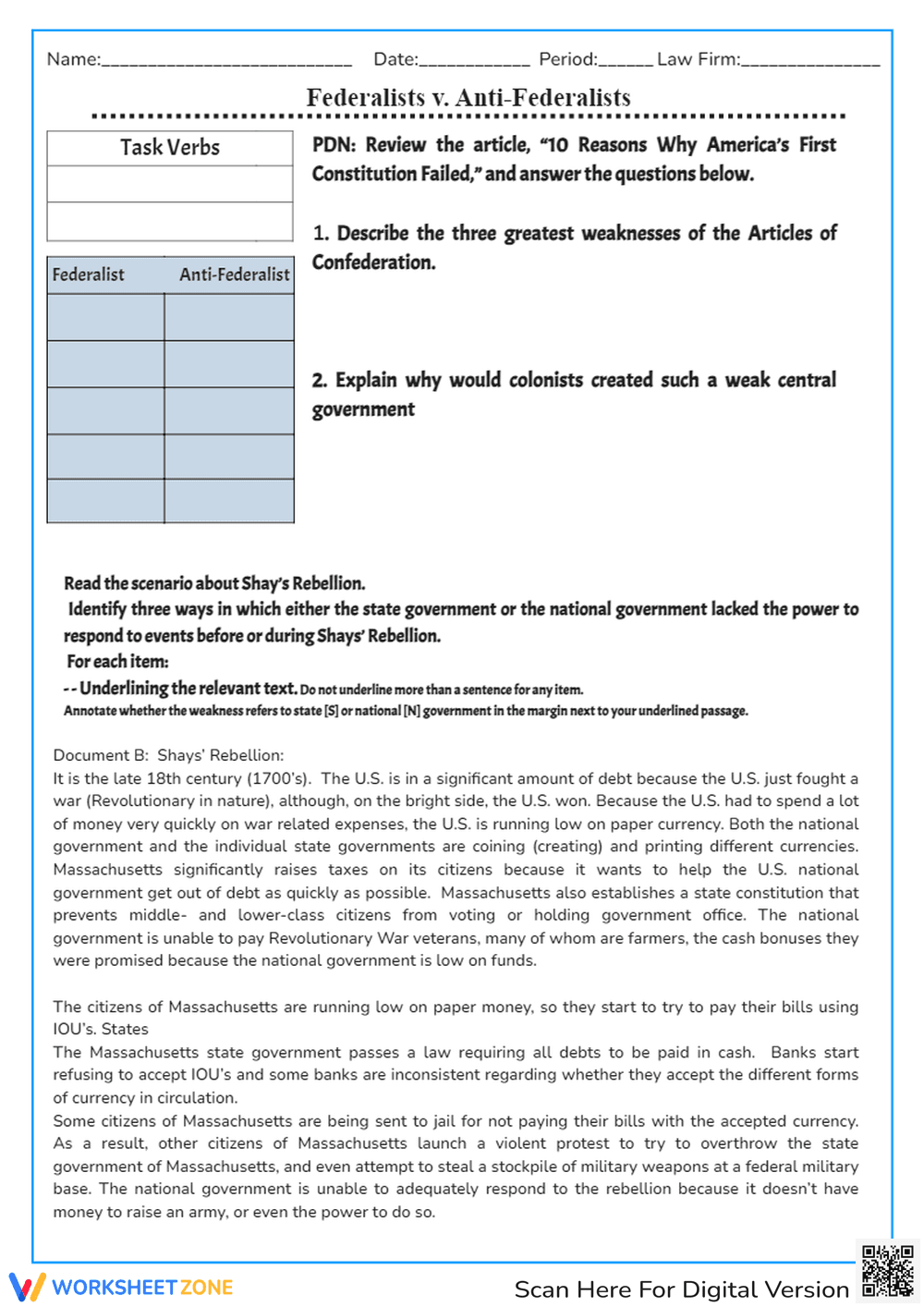
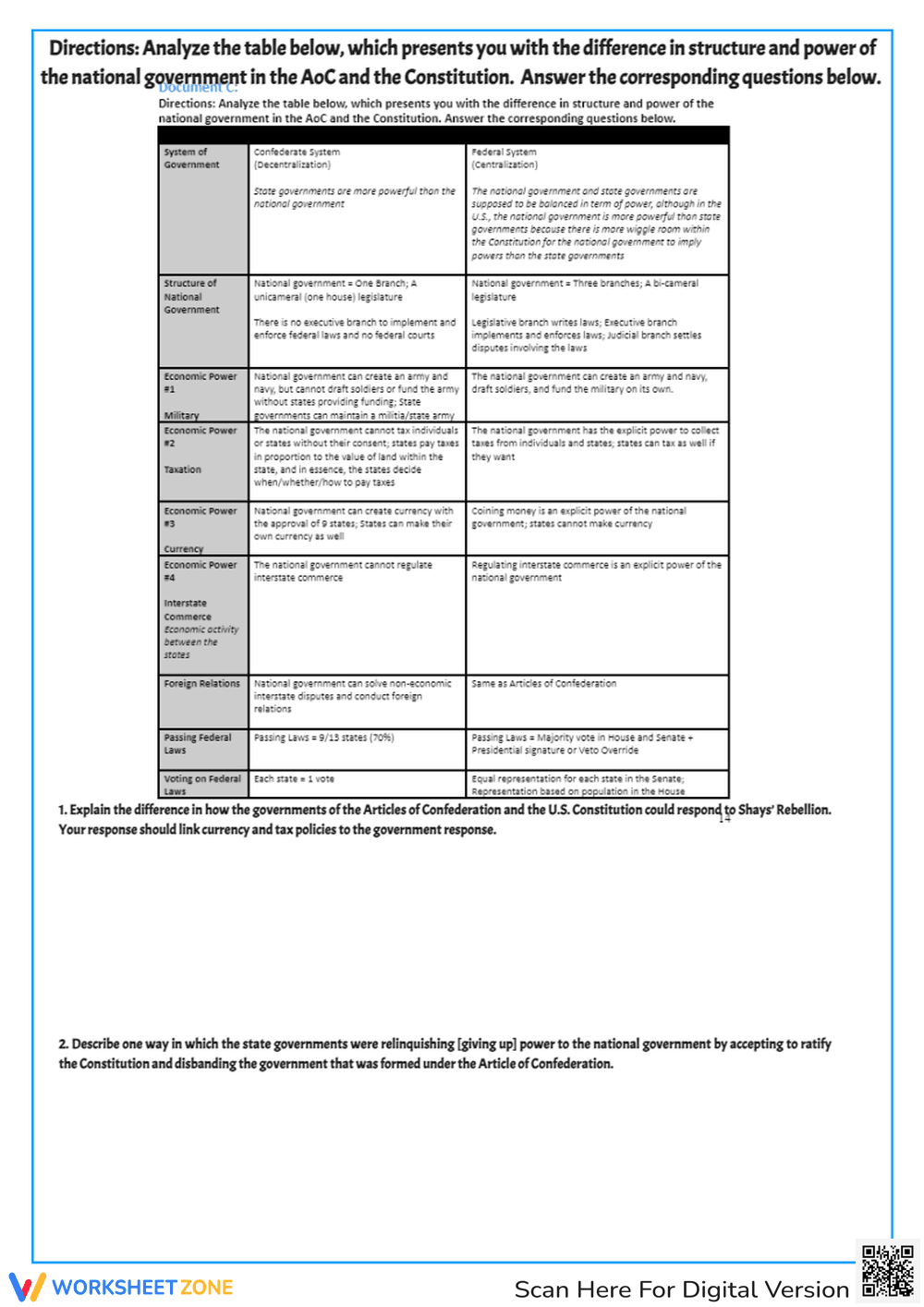
This Grade 12 Social Studies worksheet facilitates a rigorous examination of the structural differences between the Articles of Confederation and the U.S. Constitution. Students analyze Shays' Rebellion and economic policies to evaluate why the early American government shifted toward federalism. It provides a structured framework for evidence-based historical argumentation and critical thinking.
At a Glance
- Grade: 12 · Subject: Social Studies
- Standard:
CCSS.ELA-LITERACY.RH.11-12.9— Integrate and evaluate multiple sources of information to address a question or solve a problem- Skill Focus: Comparative Government Analysis
- Format: 2 pages · 6 problems · Answer key included · PDF
- Best For: High school Civics and U.S. History units
- Time: 45–50 minutes
What's Inside
The resource contains a two-page structured analysis. Page one features a "Prior Day's Notice" (PDN) review of the Articles of Confederation's weaknesses and a primary-source-style scenario regarding Shays' Rebellion for text annotation. Page two provides a comprehensive comparison table detailing economic, military, and legislative differences between the Confederate and Federal systems, followed by high-level synthesis questions that require students to connect historical events to policy changes.
Mastery Evidence
The worksheet is designed to provide clear evidence of student mastery across three tiers. The initial identification of weaknesses serves as the "Approaching" level, while the annotation of the Shays' Rebellion text demonstrates "Meeting" the standard for evidence citation. The final synthesis questions, requiring students to link currency and tax policies to government response, represent the "Exceeding" tier. Scores can be entered directly into gradebooks or used for IEP progress monitoring in literacy and historical analysis.
Standards Alignment
The primary standard addressed is `CCSS.ELA-LITERACY.RH.11-12.9`, which requires students to integrate and evaluate multiple sources of information presented in diverse formats. Additionally, it supports `CCSS.ELA-LITERACY.RH.11-12.1` by mandating specific textual evidence to support analysis of primary and secondary sources. Both standard codes can be copied directly into lesson plans, IEP goals, or district curriculum mapping tools.
How to Use It
Assign this worksheet during the transition between the Revolutionary War and the Constitutional Convention units. It works best as a mid-lesson formative assessment after students have read about the failures of the first constitution. Teachers should observe student annotations during the Shays' Rebellion section to ensure they are correctly identifying the tension between state and national authority. Completion typically takes 45 to 50 minutes.
Who It's For
This resource is tailored for Grade 12 students in U.S. Government, Civics, or AP U.S. History courses. It is particularly effective for learners who require structured graphic organizers to process complex political theory. Pair this with a primary source reading of Federalist No. 10 or an anchor chart detailing the Great Compromise for a complete instructional cycle.
According to the RAND AIRS 2024 report, high school social studies instruction that emphasizes the integration of diverse informational formats—such as the comparison tables and scenario-based annotations found here—significantly improves student retention of complex civic concepts. By aligning with CCSS.ELA-LITERACY.RH.11-12.9, this worksheet ensures that Grade 12 students are actively evaluating the functional differences between decentralized and centralized government structures. The inclusion of economic variables like currency and taxation provides a multidisciplinary approach that mirrors the rigor expected in college-level political science courses. This resource serves as a reliable tool for measuring a student's ability to synthesize historical data and construct evidence-based arguments regarding the evolution of American federalism, meeting the high-utility benchmarks established for secondary social studies curriculum materials.


