


























Views
Downloads


1.OA.C.6 Worksheet: Math Assessment — Grade 1 Aligned
Paste this activity's link or code into your existing LMS (Google Classroom, Canvas, Teams, Schoology, Moodle, etc.).
Students can open and work on the activity right away, with no student login required.
You'll still be able to track student progress and results from your teacher account.
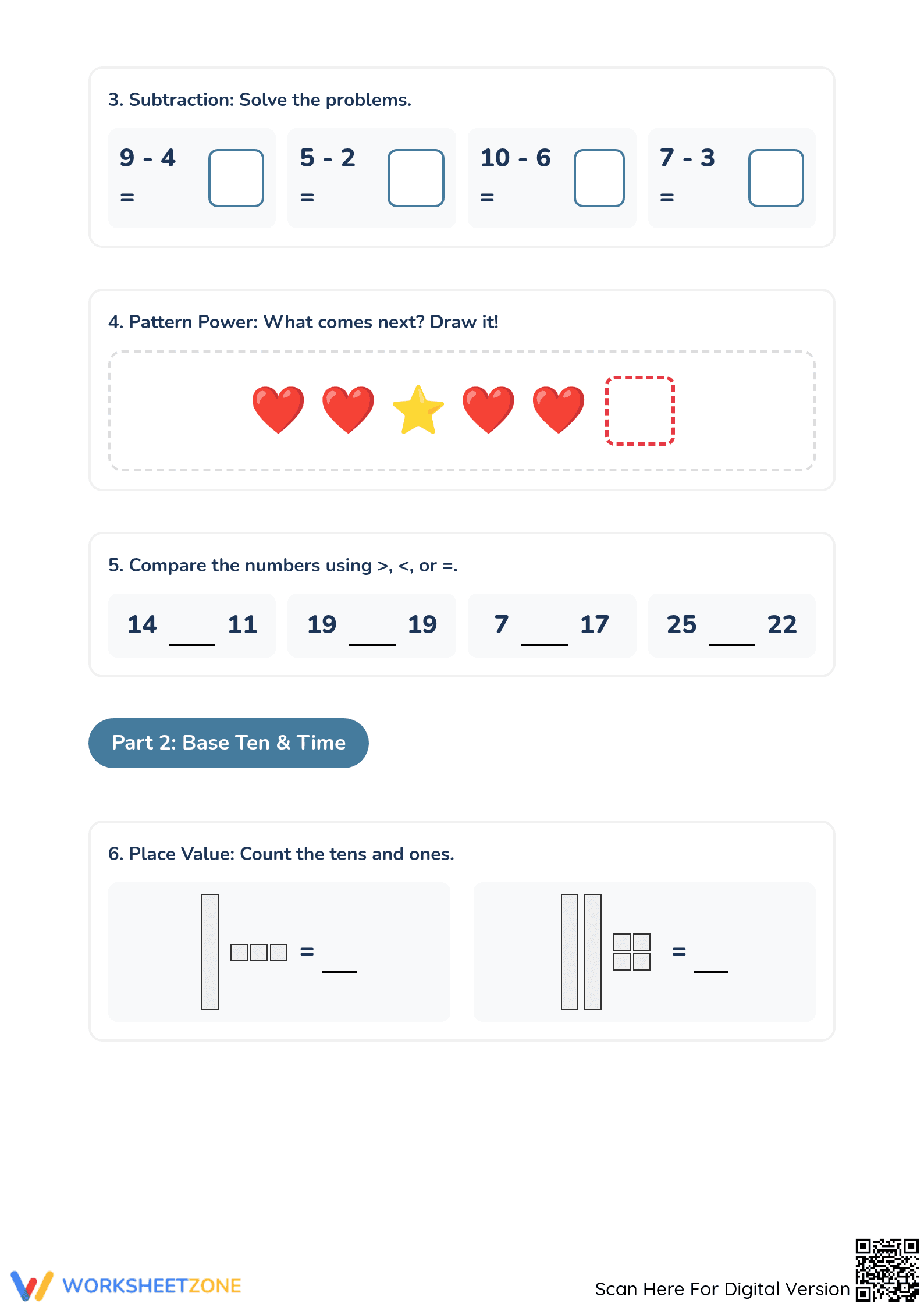
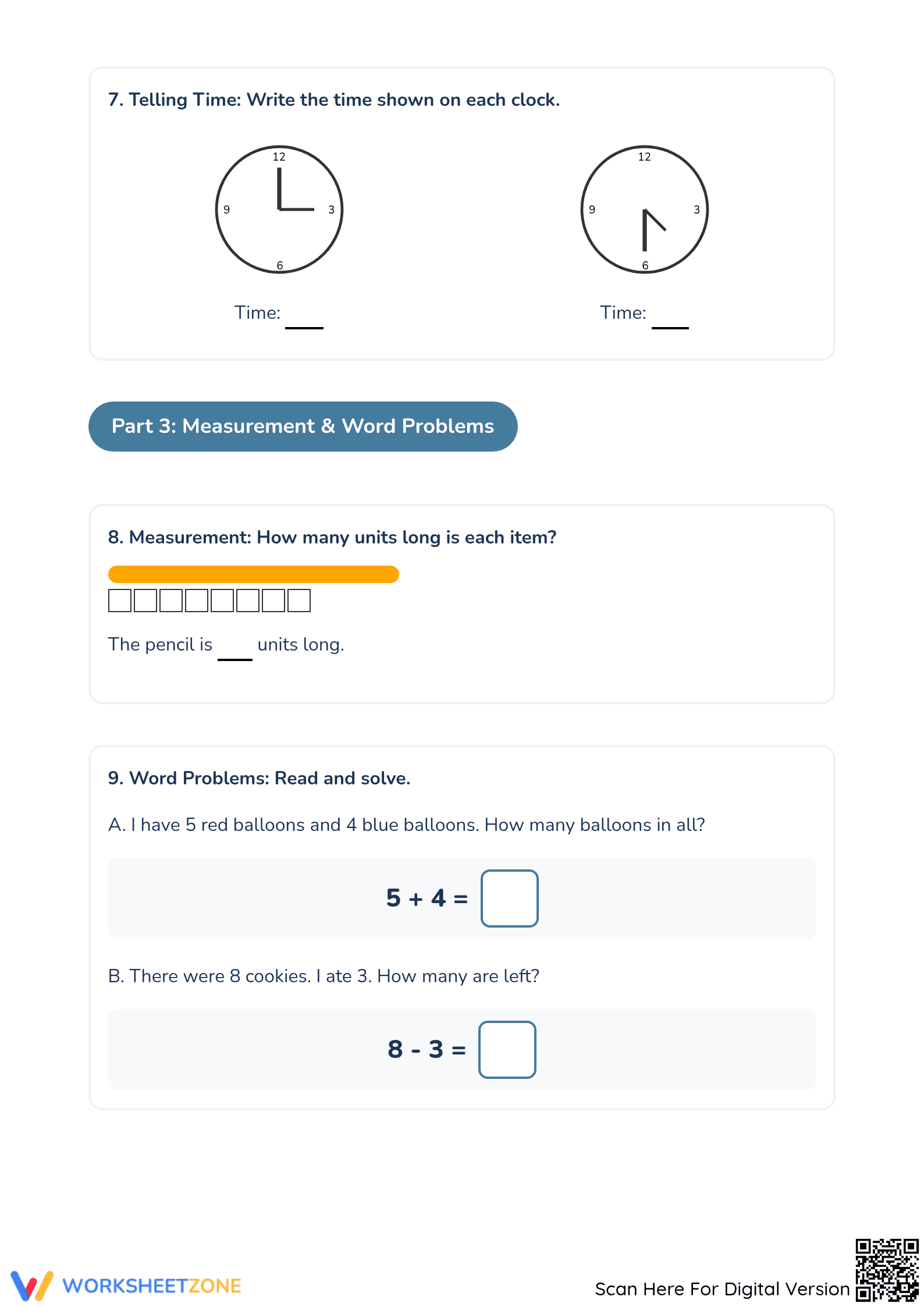
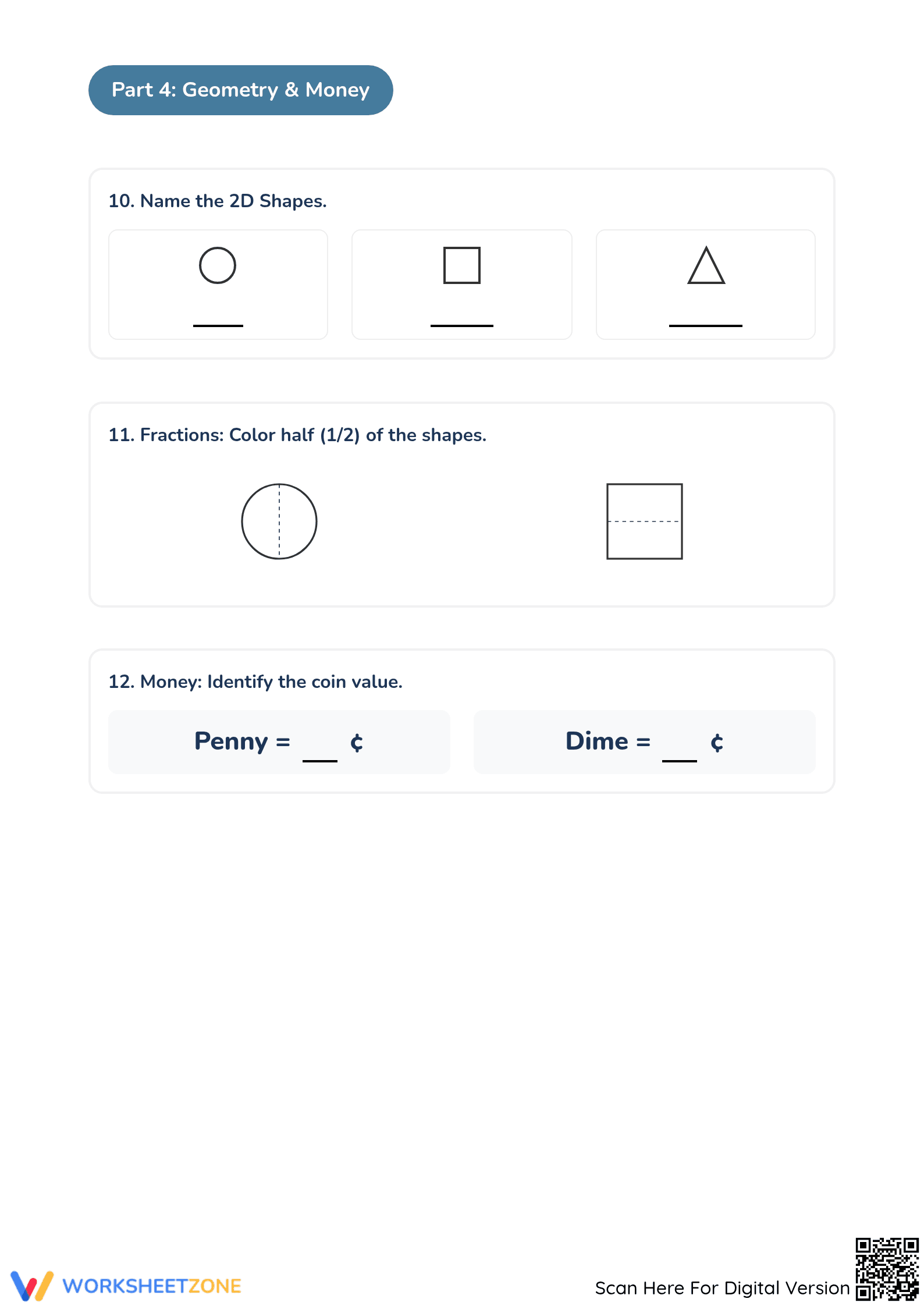
This Grade 1 math assessment provides a comprehensive evaluation of mid-year mathematical proficiency. Students demonstrate mastery across multiple domains, including operations, algebraic thinking, and base-ten numeration. By completing these structured tasks, learners show their ability to solve problems, compare values, and apply geometric concepts in a formal testing format before moving to advanced topics.
At a Glance
- Grade: 1 · Subject: Math
- Standard:
CCSS.MATH.CONTENT.1.OA.C.6— Add and subtract within 20, demonstrating fluency for addition and subtraction within 10- Skill Focus: Mixed Math Review
- Format: 4 pages · 12 tasks · Answer key included · PDF
- Best For: Mid-year summative assessment or progress monitoring
- Time: 30–45 minutes
The packet contains four high-quality pages featuring 12 distinct assessment sections. It includes visual counting exercises, vertical and horizontal operations, pattern recognition, and comparison symbols. The layout also incorporates place value blocks, analog clocks, and non-standard measurement tools. A full 4-page answer key is provided to ensure rapid and accurate grading for busy educators.
Mastery Evidence
Each of the 12 tasks maps directly to specific Grade 1 benchmarks, allowing teachers to identify precise gaps in understanding. The assessment is structured to provide evidence of mastery in three tiers: foundational counting, operational fluency, and applied problem-solving. Results can be recorded in gradebooks or used to update IEP progress notes regarding specific goals like telling time or identifying coin values.
Standards Alignment
This resource aligns with `CCSS.MATH.CONTENT.1.OA.C.6`, focusing on addition and subtraction fluency. It also supports `CCSS.MATH.CONTENT.1.NBT.B.2` through place value identification and `CCSS.MATH.CONTENT.1.MD.B.3` for telling time. Both standard codes can be copied directly into lesson plans, IEP goals, or district curriculum mapping tools to ensure compliance with state frameworks.
How to Use It
Use this as a summative assessment to gauge student retention after the winter break. It works effectively as a pre-test for upcoming units or a post-test to verify mastery of early-year concepts. During administration, observe if students use finger counting or mental strategies for the addition section to inform future small-group instruction. Expect completion within 45 minutes for most learners.
Who It's For
This assessment is designed for Grade 1 students but serves as an excellent challenge for Kindergarteners or a review for Grade 2 learners. It is particularly useful for Title I specialists and special education teachers needing documented data. Pair this with a math manipulative kit or a hundreds chart for students requiring additional visual support during the practice phase.
According to the RAND AIRS 2024 report, frequent low-stakes assessments are critical for identifying learning loss in early elementary mathematics. This worksheet addresses the core requirements of CCSS.MATH.CONTENT.1.OA.C.6 by requiring students to perform mental math and apply operational logic to word problems. Research from Fisher & Frey (2014) emphasizes that checking for understanding through mixed-skill reviews helps solidify the spiral curriculum approach, ensuring that concepts like place value and geometry are not lost as new topics are introduced. By utilizing this 12-task diagnostic tool, educators can gather actionable data on student performance across five distinct math domains. This evidence-based approach to progress monitoring supports data-driven instruction and allows for targeted intervention before high-stakes end-of-year testing. The inclusion of visual scaffolds, such as base-ten blocks and analog clocks, aligns with best practices for universal design for learning in the primary classroom.


