


























Views
Downloads

Essential Fast and Slow Motion Worksheet | Grade 1-2 Science
Paste this activity's link or code into your existing LMS (Google Classroom, Canvas, Teams, Schoology, Moodle, etc.).
Students can open and work on the activity right away, with no student login required.
You'll still be able to track student progress and results from your teacher account.
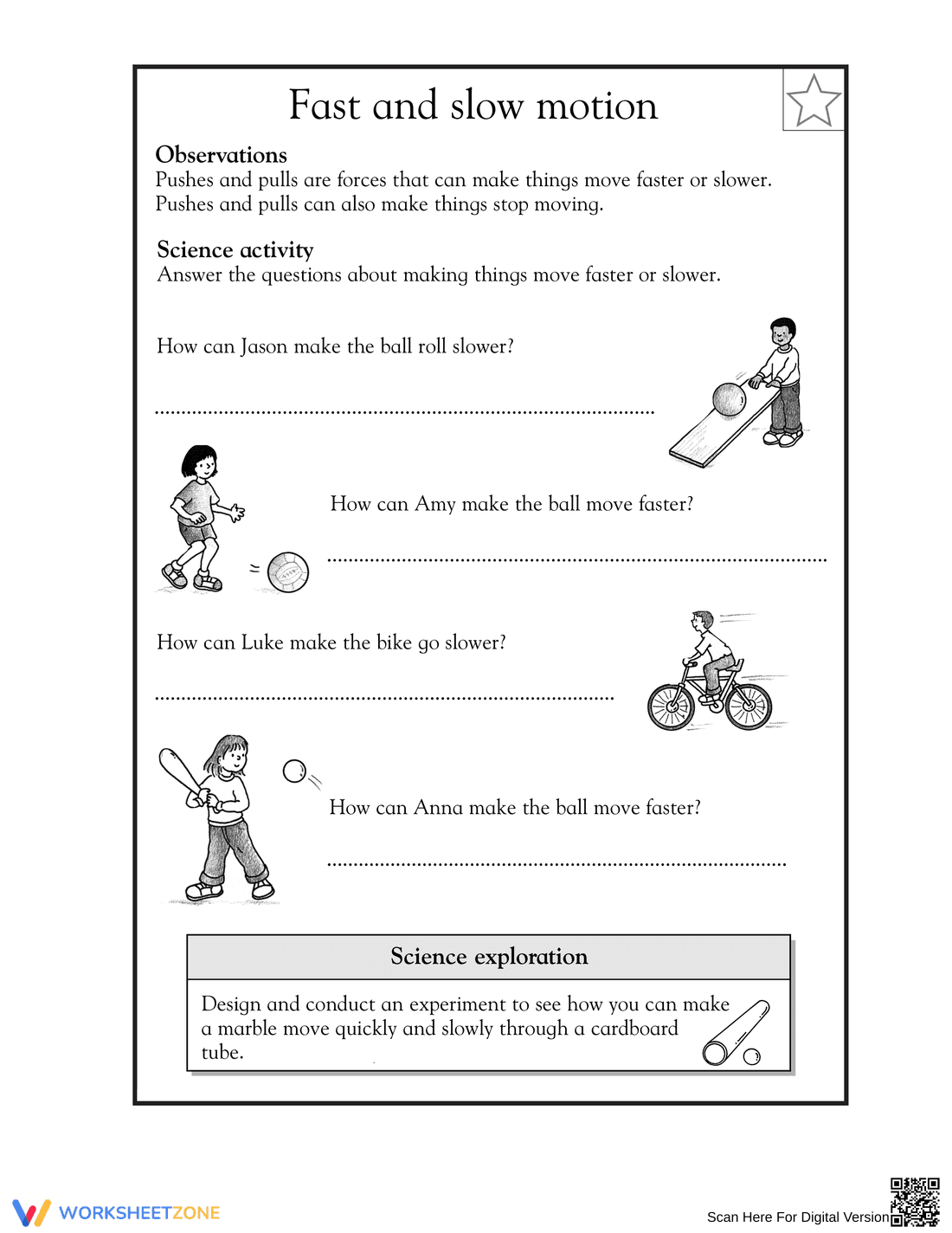
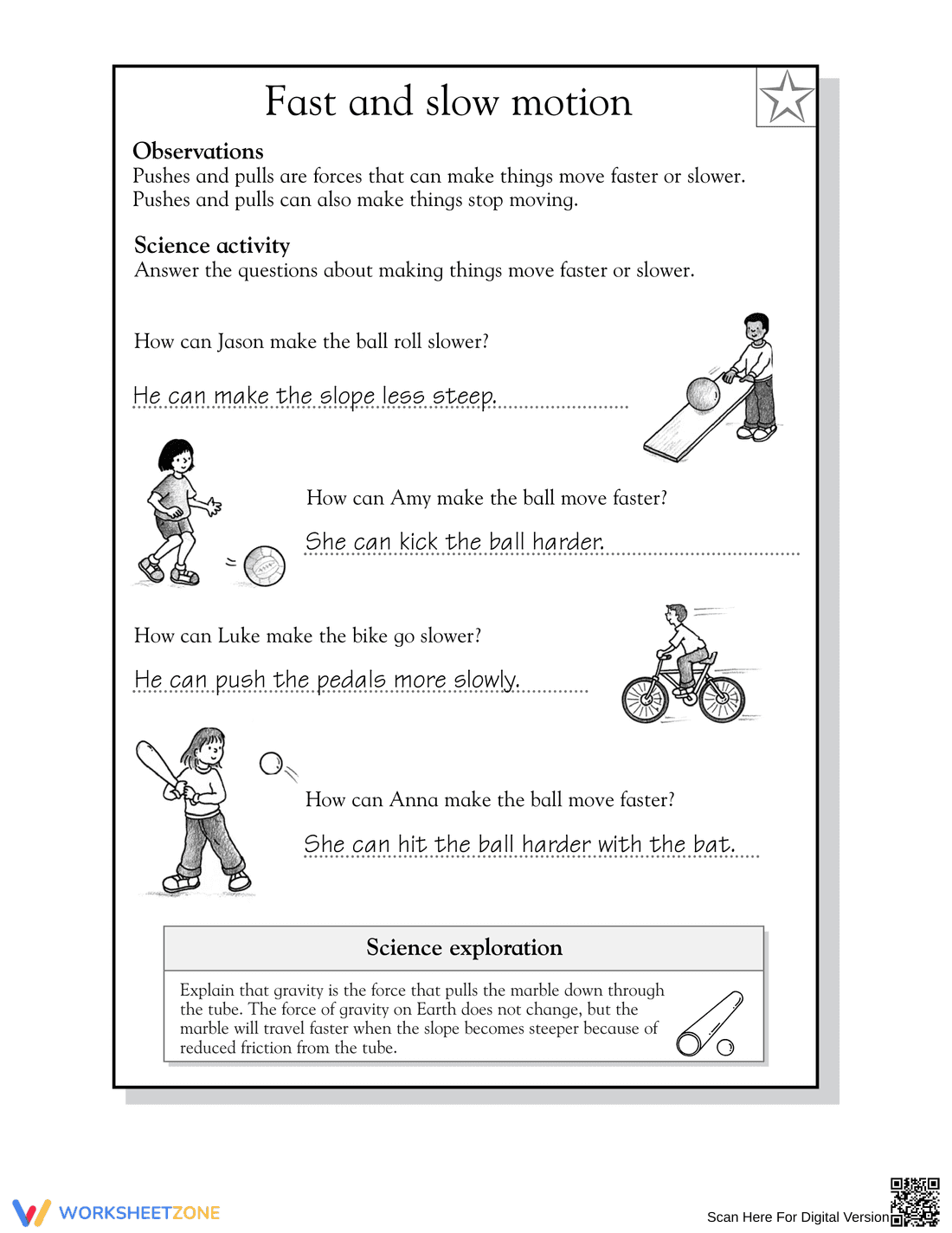
This essential Grade 1-2 science worksheet explores the fundamental relationship between forces and motion by challenging students to identify how pushes and pulls change speed. Students analyze real-world scenarios to determine how specific actions make objects move faster or slower, building a concrete understanding of physical science concepts through critical observation and reasoning.
At a Glance
- Grade: 1-2 · Subject: Science
- Standard:
K-PS2-1— Compare the effects of different strengths of pushes and pulls on motion- Skill Focus: Forces and Speed Changes
- Format: 1 page · 5 problems · Answer key included · PDF
- Best For: Introduction to forces and physical science units
- Time: 15–20 minutes
What's Inside
This resource includes a single-page activity divided into three distinct sections. The "Observations" header provides a clear instructional anchor, defining how pushes and pulls influence speed and stopping. The "Science activity" features four illustrated scenarios involving ramps, balls, and bicycles, requiring students to write short-answer explanations. Finally, the "Science exploration" box provides a hands-on experiment prompt involving marbles and cardboard tubes to reinforce learning through physical investigation.
Zero-Prep Workflow
Teachers can implement this activity with minimal effort: Print the single-page PDF, distribute to students during your science block, and facilitate the closing marble experiment as a whole-group demonstration or small-group center. This streamlined workflow requires zero prior setup, making it an ideal choice for emergency sub plans or quick formative assessments during physical science rotations.
Standards Alignment
This worksheet is directly aligned to K-PS2-1, which requires students to plan and conduct an investigation to compare the effects of different strengths or directions of pushes and pulls on the motion of an object. It also supports 2nd-grade physical science explorations into how objects move and change. Both standard codes can be copied directly into lesson plans, IEP goals, or district curriculum mapping tools.
How to Use It
Use this worksheet as a mid-lesson check for understanding after introducing the vocabulary of "push" and "pull." It serves as an excellent bridge between direct instruction and independent lab work. During the activity, observe if students can differentiate between increasing force to gain speed versus applying opposing force to slow down. The expected completion time for the written portion is approximately 15 minutes, followed by the hands-on extension.
Who It's For
This resource is designed for first and second-grade students beginning their study of physics. The clear illustrations and sentence-based tasks provide support for early writers while the open-ended exploration section allows for natural differentiation for advanced learners. It pairs perfectly with physical science anchor charts or a hands-on "Forces Scavenger Hunt" around the classroom or playground.
Research from RAND AIRS 2024 emphasizes that early exposure to physical science through illustrated, scenario-based inquiry significantly improves long-term retention of force and motion concepts. By connecting abstract principles like K-PS2-1 to familiar activities—such as riding a bike or playing with a ball—this worksheet helps students internalize the mechanics of pushes and pulls. Fisher & Frey (2014) note that incorporating a hands-on exploration immediately following conceptual practice ensures that students move beyond rote memorization into active scientific inquiry. This integrated approach aligns with NAEP standards for science literacy, providing a robust foundation for more complex mechanics in later grades. The use of specific, everyday examples allows students to build mental models of force strength and directionality that are essential for mastering elementary science curriculum goals. This ensures that young learners develop the critical thinking skills necessary for future success in STEM fields while meeting immediate academic requirements.


