




























Views
Downloads

Famous Space Women Worksheet | Grade 5-8 Essential

Paste this activity's link or code into your existing LMS (Google Classroom, Canvas, Teams, Schoology, Moodle, etc.).
Students can open and work on the activity right away, with no student login required.
You'll still be able to track student progress and results from your teacher account.
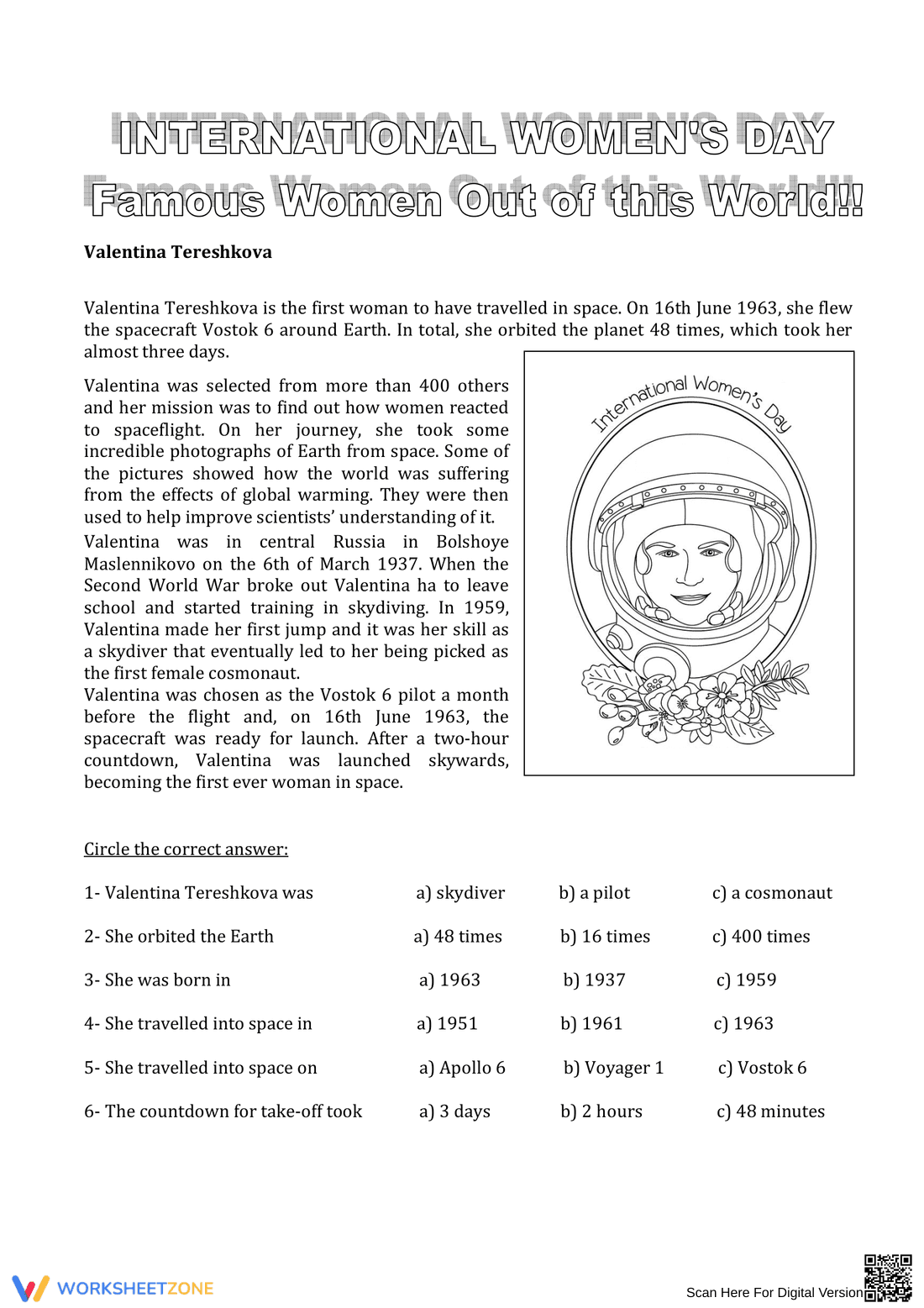
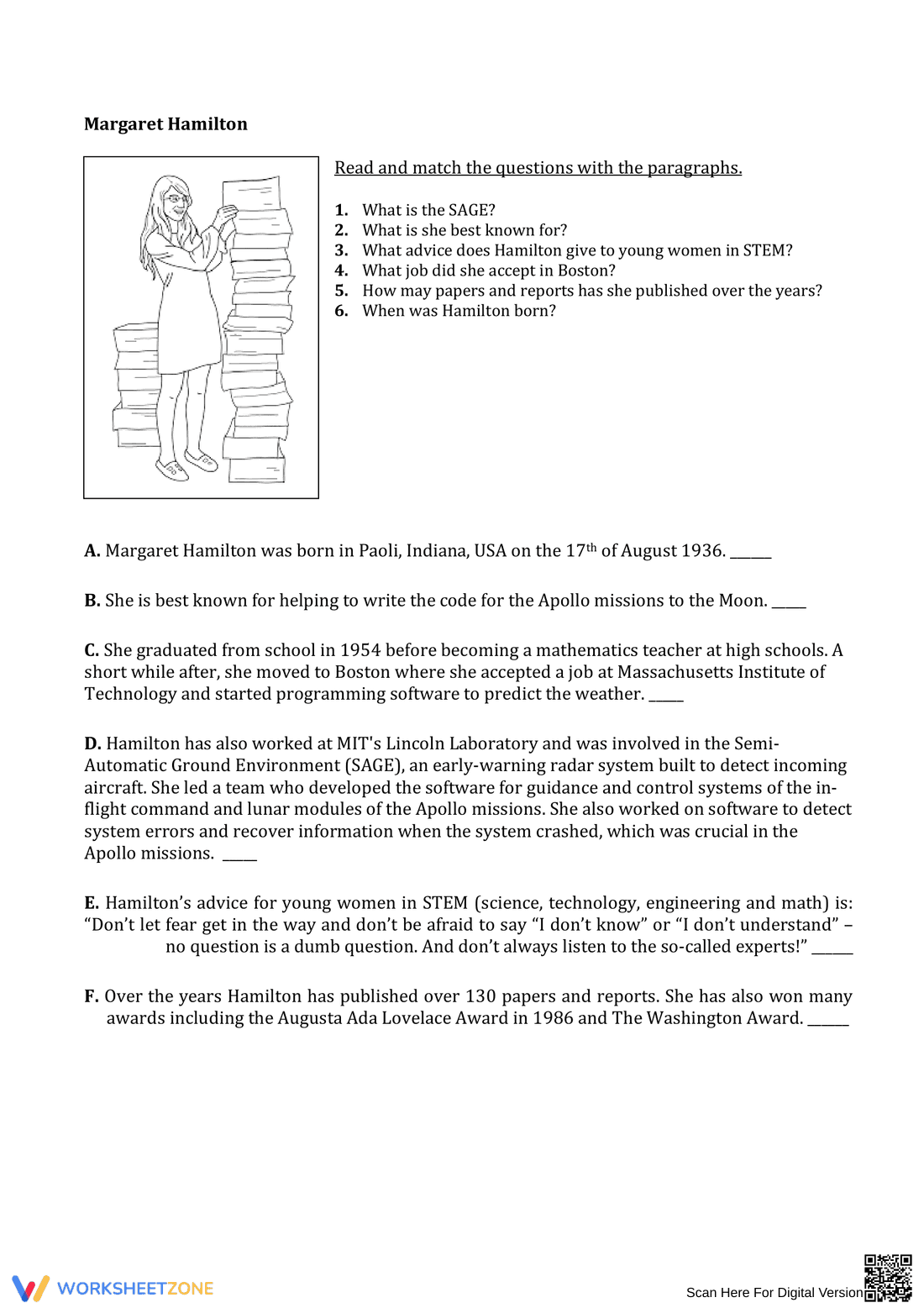
This Grade 5-8 informational text worksheet helps students master reading comprehension by exploring the lives of Valentina Tereshkova and Margaret Hamilton. Students will extract specific evidence from biographical passages to answer multiple-choice questions and match inquiry prompts to paragraph content. It is an effective tool for building literacy while celebrating historical contributions in STEM.
At a Glance
- Grade: 5-8 · Subject: English Language Arts
- Standard:
CCSS.ELA-LITERACY.RI.5.1— Quote accurately from a text when explaining what the text says explicitly.- Skill Focus: Text-based evidence and matching
- Format: 2 pages · 12 problems · Answer key included · PDF
- Best For: Women's History Month or STEM literacy
- Time: 20–30 minutes
What's Inside
This two-page resource features two distinct biographical profiles. The first page focuses on Valentina Tereshkova, the first woman in space, accompanied by 6 multiple-choice questions that test chronological and factual recall. The second page highlights Margaret Hamilton, the lead software engineer for the Apollo missions, featuring a matching exercise where students must link 6 specific questions to the correct informational paragraphs. The layout includes clear headings and engaging illustrations to support visual learners.
Zero-Prep Workflow
- Print (1 minute): Select the two-page PDF and print enough copies for your class. No additional materials or teacher guides are required.
- Distribute (1 minute): Hand out the worksheets as a standalone activity or as part of a larger unit on space exploration or biography.
- Review (5 minutes): Use the provided answer key to conduct a quick whole-class check or allow students to self-correct their work.
Total teacher preparation time is under 2 minutes, making this an ideal resource for substitute folders or last-minute lesson adjustments.
Standards Alignment
The primary standard addressed is `CCSS.ELA-LITERACY.RI.5.1`: "Quote accurately from a text when explaining what the text says explicitly and when drawing inferences from the text." This worksheet also supports RI.6.1 by requiring students to cite textual evidence to support analysis of what the text says. Both standard codes can be copied directly into lesson plans, IEP goals, or district curriculum mapping tools.
How to Use It
Use this worksheet as a bell-ringer activity to start an ELA block or as a formative assessment after a lesson on identifying key details. It works well for independent practice during literacy centers. To use it as a formative assessment, observe if students are flipping back to the text to verify their answers or relying on memory; the latter indicates a need for further instruction on evidence-based reading. Completion typically takes 20 to 30 minutes.
Who It's For
This resource is designed for middle school students in grades 5 through 8, but it is also highly effective for high school ESL/ELL students who need high-interest, accessible informational texts. It pairs naturally with a science lesson on the Apollo missions or a social studies unit on the Cold War and the Space Race.
Research by Fisher & Frey (2014) emphasizes that complex informational texts are best understood when students interact with specific text-dependent questions. This worksheet applies that principle by requiring 12 distinct interactions with the text across two different formats. By focusing on `CCSS.ELA-LITERACY.RI.5.1`, the activity ensures students move beyond surface-level reading to find specific evidence. This approach is consistent with NAEP findings that suggest frequent exposure to diverse biographical texts improves overall reading proficiency and content-area vocabulary. The structured nature of the matching and multiple-choice tasks provides the necessary scaffolding for students to build confidence in their ability to navigate non-fiction prose independently. This resource serves as a reliable bridge between basic literacy and the rigorous demands of secondary-level textual analysis.


