


























Views
Downloads
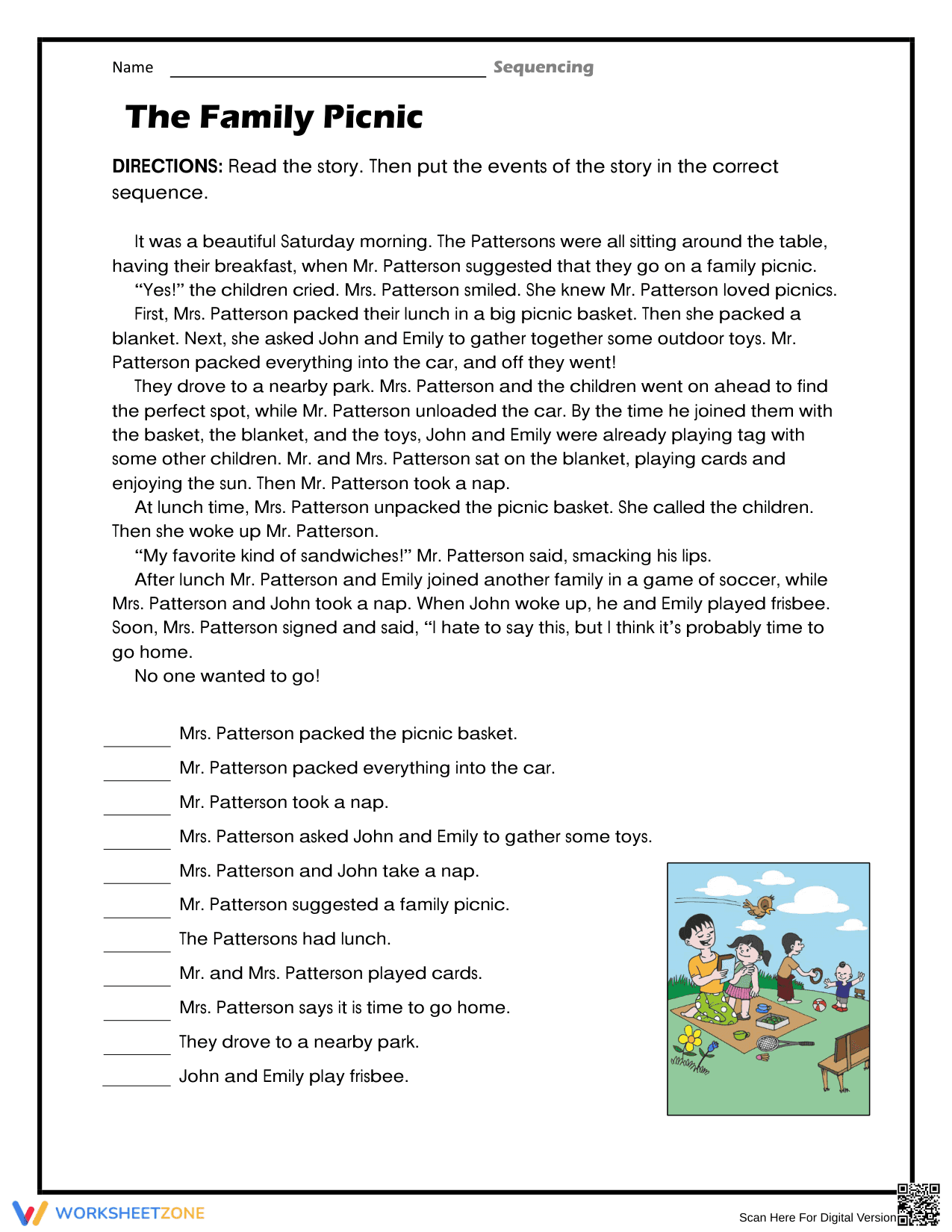

Essential Family Picnic Sequencing Worksheet | Grade 1-2
Paste this activity's link or code into your existing LMS (Google Classroom, Canvas, Teams, Schoology, Moodle, etc.).
Students can open and work on the activity right away, with no student login required.
You'll still be able to track student progress and results from your teacher account.
Improve story recall and chronological ordering skills with this "The Family Picnic" sequencing worksheet. Designed for early elementary students, this resource requires learners to read a detailed narrative about the Patterson family's day at the park and then arrange 11 key events in their correct temporal order. This activity directly supports reading comprehension and logical reasoning.
At a Glance
- Grade: 1–2 · Subject: English Language Arts
- Standard:
CCSS.ELA-LITERACY.RL.1.2— Retell stories and identify key details in the order they occurred- Skill Focus: Chronological Sequencing
- Format: 1 page · 11 problems · Answer key included · PDF
- Best For: Literacy centers and independent reading practice
- Time: 15–20 minutes
This comprehensive one-page PDF features an original story, "The Family Picnic," following a family through their day. Students encounter 11 sentences describing plot points, from packing lunch to heading home. Each sentence has a clear line for numbering the events from 1 to 11. A complete answer key is included for quick grading or student self-correction.
The zero-prep workflow is designed for teacher efficiency. First, print the single-page document (30 seconds). Second, distribute it to students for independent practice (30 seconds). Third, review answers using the provided key (1 minute). Total preparation time is under two minutes, perfect for sub plans or literacy centers during a busy school day.
This resource aligns to CCSS.ELA-LITERACY.RL.1.2, requiring students to retell stories and identify key details. It also supports CCSS.ELA-LITERACY.RL.2.5 by helping learners describe story structure. These standard codes can be copied directly into lesson plans, IEP goals, or district curriculum mapping tools for easy tracking and instructional alignment.
Use this worksheet during independent practice. After teaching transition words like "First" and "Next," assign this to gauge mastery of sequence identification. For a formative check, observe if students refer back to the text to verify order. Completion typically takes 15 to 20 minutes in a standard classroom setting.
This activity is tailored for 1st and 2nd graders transitioning to complex narratives. It supports English Language Learners with clear vocabulary and relatable themes. This resource pairs naturally with anchor charts focused on transition words or reading passages that emphasize beginning, middle, and end structures in narrative fiction texts.
According to research by Fisher & Frey (2014) on the gradual release of responsibility, structured independent practice with complex tasks is essential for internalizing reading comprehension strategies. This "Family Picnic" sequencing worksheet provides exactly that by challenging students to maintain an 11-point sequence across a full-page narrative. By identifying key details in CCSS.ELA-LITERACY.RL.1.2, students build the cognitive framework necessary for more advanced plot analysis in later grades. The inclusion of clear chronological markers within the text allows for scaffolded success, ensuring that the student action of retelling is grounded in textual evidence rather than intuition. This printable resource serves as a reliable tool for measuring literal comprehension and the ability to synthesize information into a coherent timeline. Teachers can confidently integrate this into any ELA curriculum to provide high-quality, standards-aligned practice that requires zero additional setup or instructional materials.


