


























Views
Downloads



Printable Factoring Numbers 4-50 Worksheet | Grade 7 Math
Paste this activity's link or code into your existing LMS (Google Classroom, Canvas, Teams, Schoology, Moodle, etc.).
Students can open and work on the activity right away, with no student login required.
You'll still be able to track student progress and results from your teacher account.
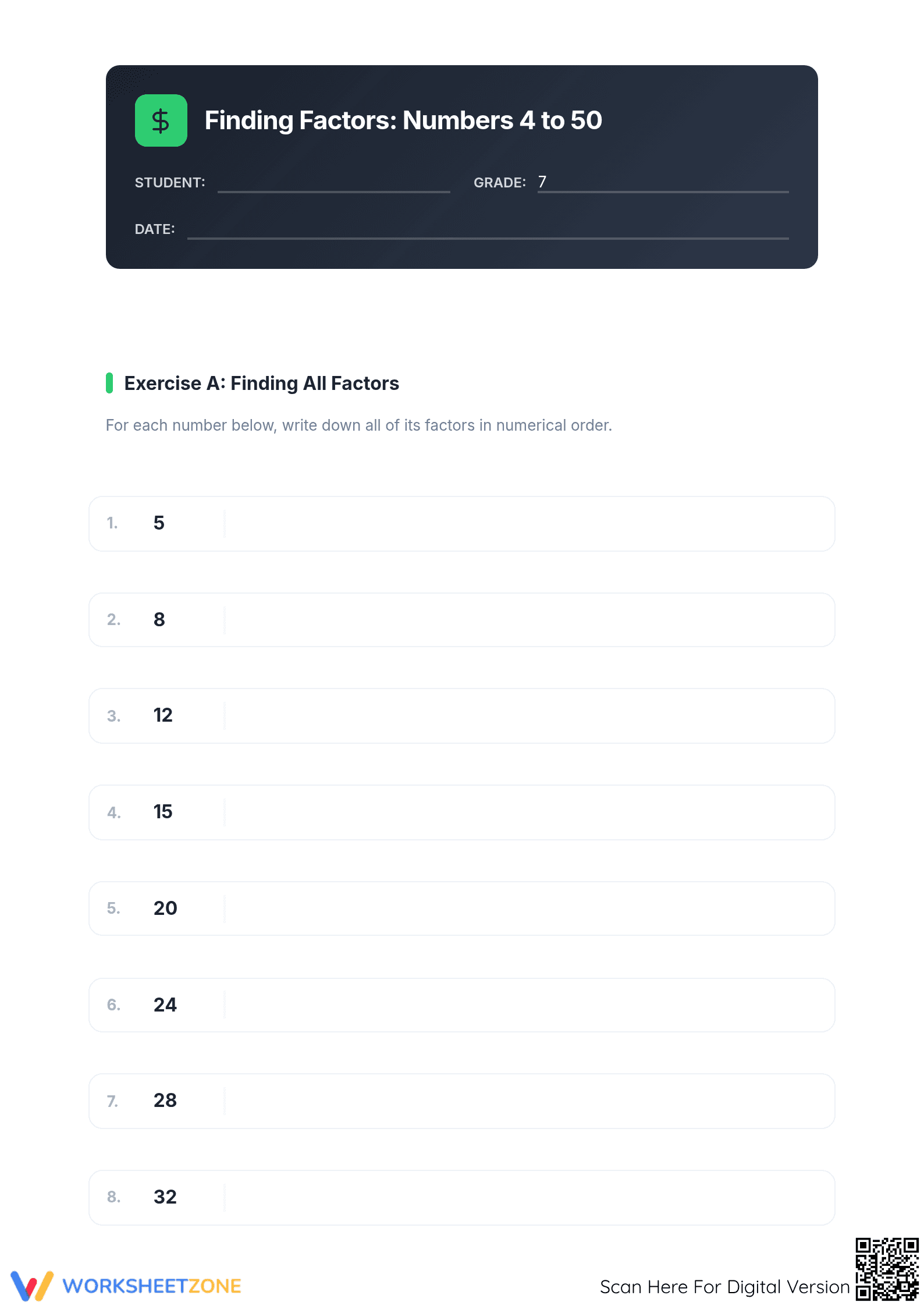
This Grade 7 factoring numbers worksheet provides comprehensive practice for students to identify all factor pairs and numerical factor lists for integers between 4 and 50. By mastering these foundational arithmetic skills, learners build the necessary fluencies for simplifying fractions, finding common denominators, and transitioning into algebraic expressions. The structured layout ensures consistent student engagement and progress.
At a Glance
- Grade: 7 · Subject: Math
- Standard:
CCSS.MATH.CONTENT.6.NS.B.4— Find all factor pairs and list factors for whole numbers up to 50- Skill Focus: Integer factoring and prime factor identification
- Format: 5 pages · 44 problems · Answer key included · PDF
- Best For: Independent practice and foundational skill reinforcement
- Time: 25–35 minutes
What's Inside
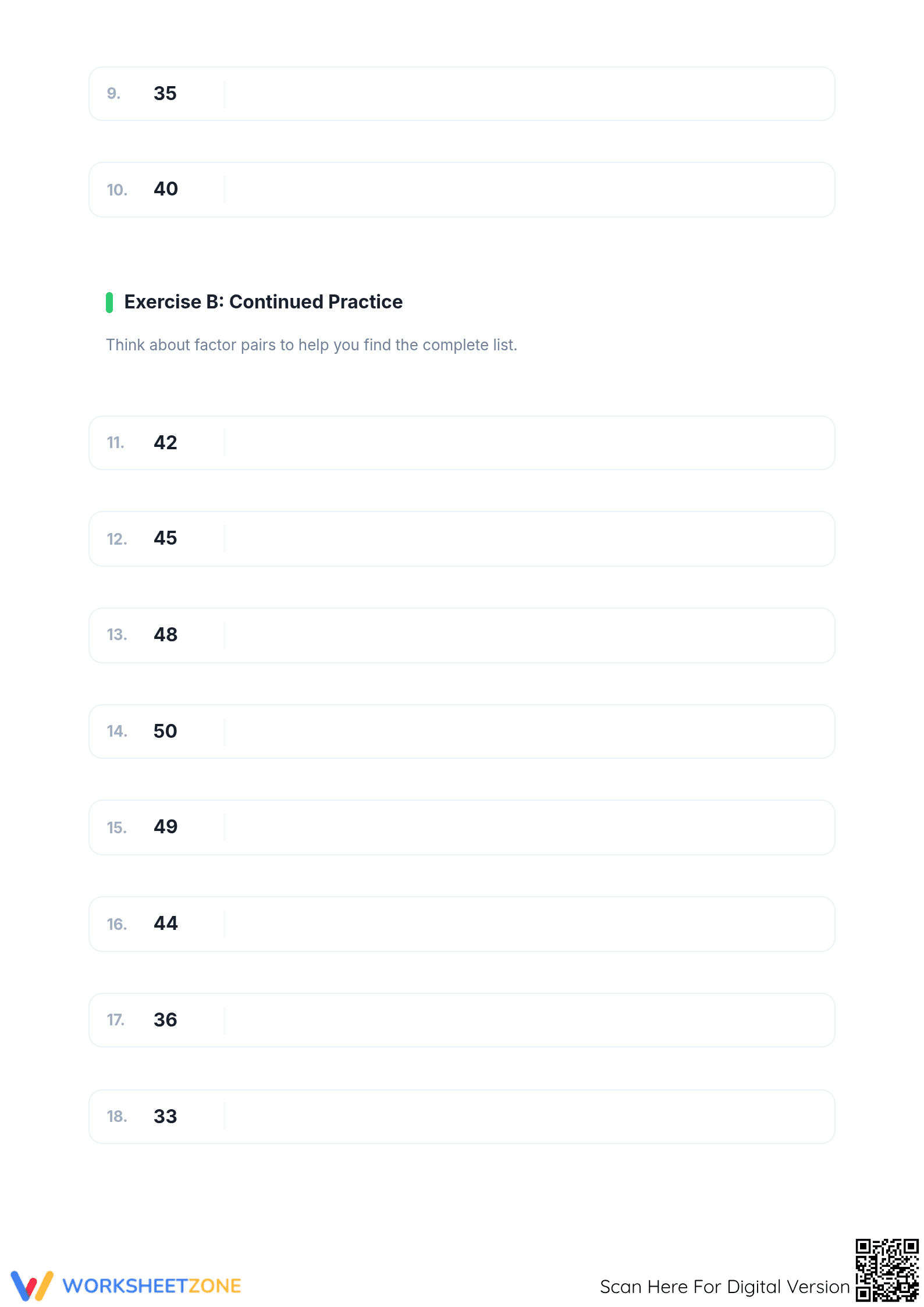
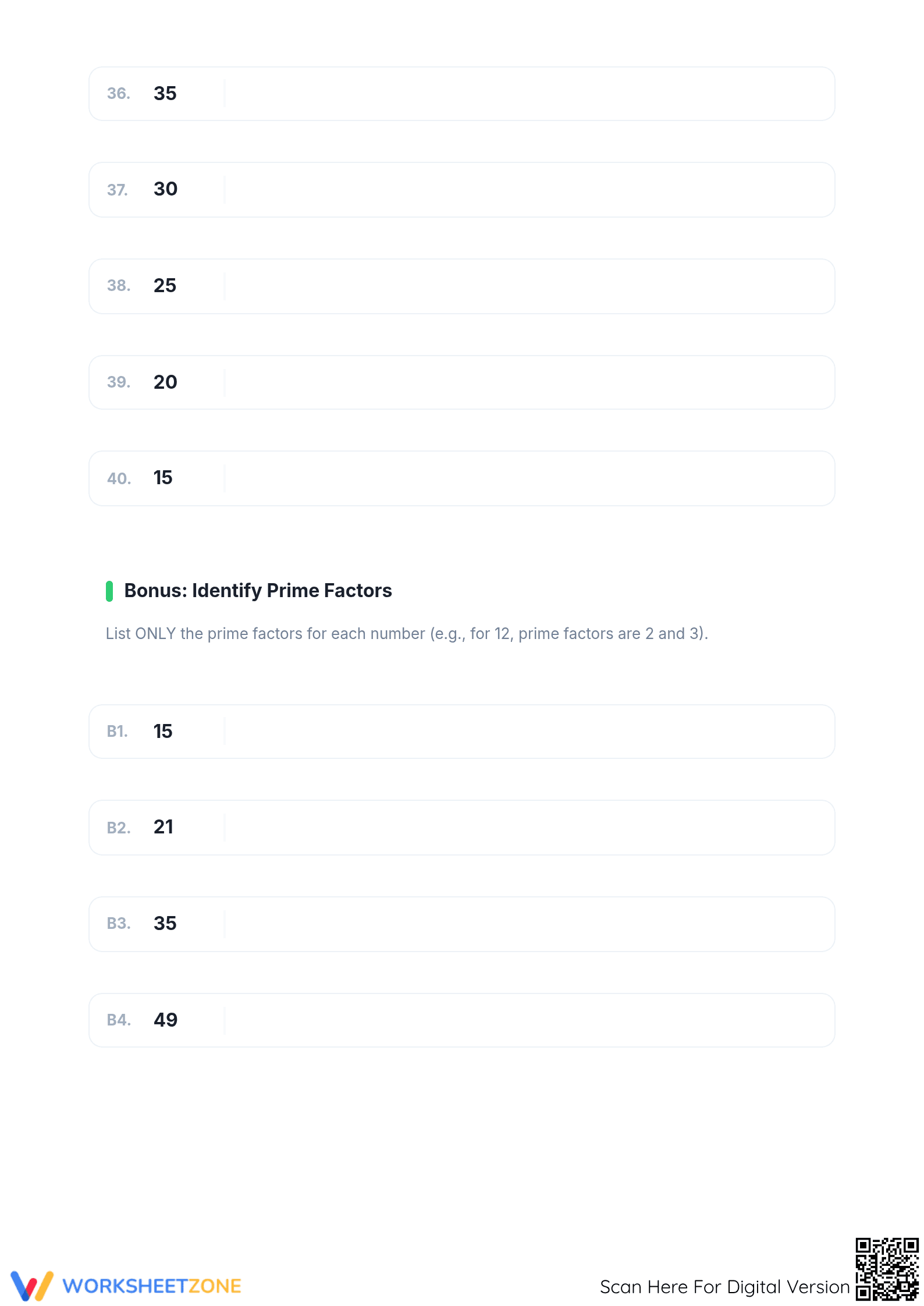
This 5-page PDF resource contains four distinct exercises ranging from basic identification to mastery-level practice. It includes 44 structured problems where students must list factors in numerical order. The final section features a bonus challenge focused on prime factors, helping students distinguish between composite and prime values. A complete answer key is provided for immediate grading or self-correction.
Zero-Prep Workflow
This resource is designed for an immediate classroom workflow with zero teacher preparation. First, print the 5-page document in under 30 seconds. Second, distribute the sheets to students for independent work or assign them as a homework task. Finally, review the student work using the included answer keys to identify common misconceptions within 5 minutes. The total prep time is under two minutes, making it an excellent choice for emergency substitute plans.
Standards Alignment
The primary standard addressed is CCSS.MATH.CONTENT.6.NS.B.4, which requires students to find common factors and multiples. This worksheet specifically targets the prerequisite skill of identifying all factors for numbers up to 50. It also supports higher-level standards involving the multiplication and division of rational numbers. Both standard codes can be copied directly into lesson plans, IEP goals, or district curriculum mapping tools.
How to Use It
Use this worksheet as a bridge activity following direct instruction on divisibility rules. It is particularly effective during the first ten minutes of class as a bell-ringer or as a formative assessment after a unit on number sense. Teachers should observe whether students are utilizing factor trees or T-charts to organize their work. The expected completion time for the full pack is 30 minutes, depending on student fluency.
Who It's For
This resource is ideal for Grade 7 students requiring reinforcement in basic arithmetic operations. It is particularly beneficial for learners who struggle with fraction simplification or those preparing for the transition into pre-algebra. Differentiation is naturally supported by the increasing complexity across the four exercises. This pack pairs naturally with a divisibility rules anchor chart or a multiplication table for students needing additional scaffolding.
The systematic practice of factoring provided in this resource aligns with the findings of the RAND AIRS 2024 report, which emphasizes the importance of procedural fluency in early middle school mathematics as a predictor of success in secondary algebra. By isolating the skill of finding factor pairs for numbers between 4 and 50, the worksheet reduces cognitive load, allowing students to focus on the relationships between numbers. Research from Fisher & Frey (2014) indicates that such targeted practice supports the gradual release of responsibility model, moving from guided numerical lists to independent mastery. This worksheet addresses a critical gap identified by NAEP in student number sense, providing 44 opportunities for repetitive engagement with composite number structures. Aligned with CCSS.MATH.CONTENT.6.NS.B.4, it serves as a reliable tool for data-driven instruction and IEP progress monitoring, ensuring students meet the rigorous demands of the Common Core State Standards while building essential fluency.


