


























Views
Downloads
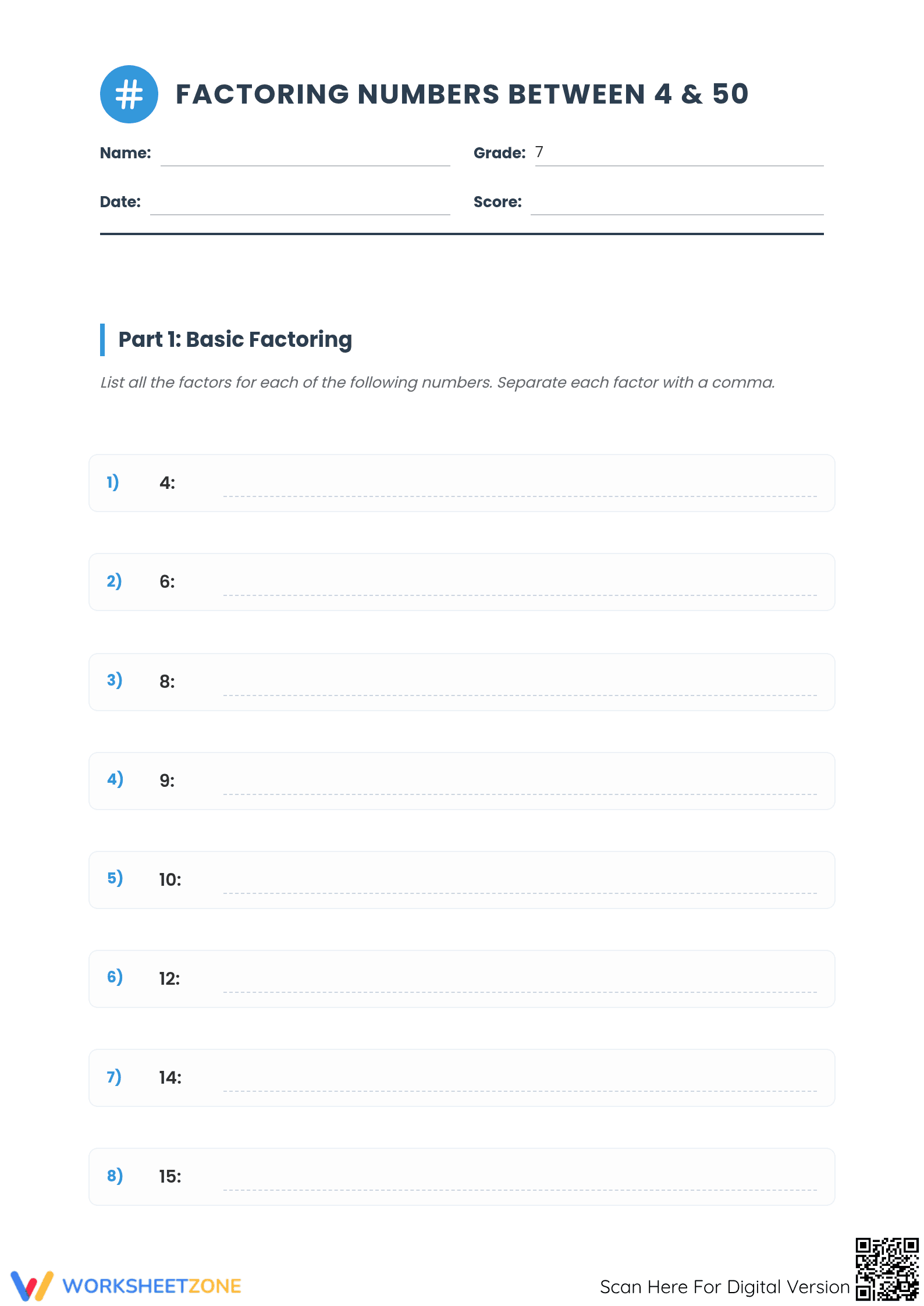
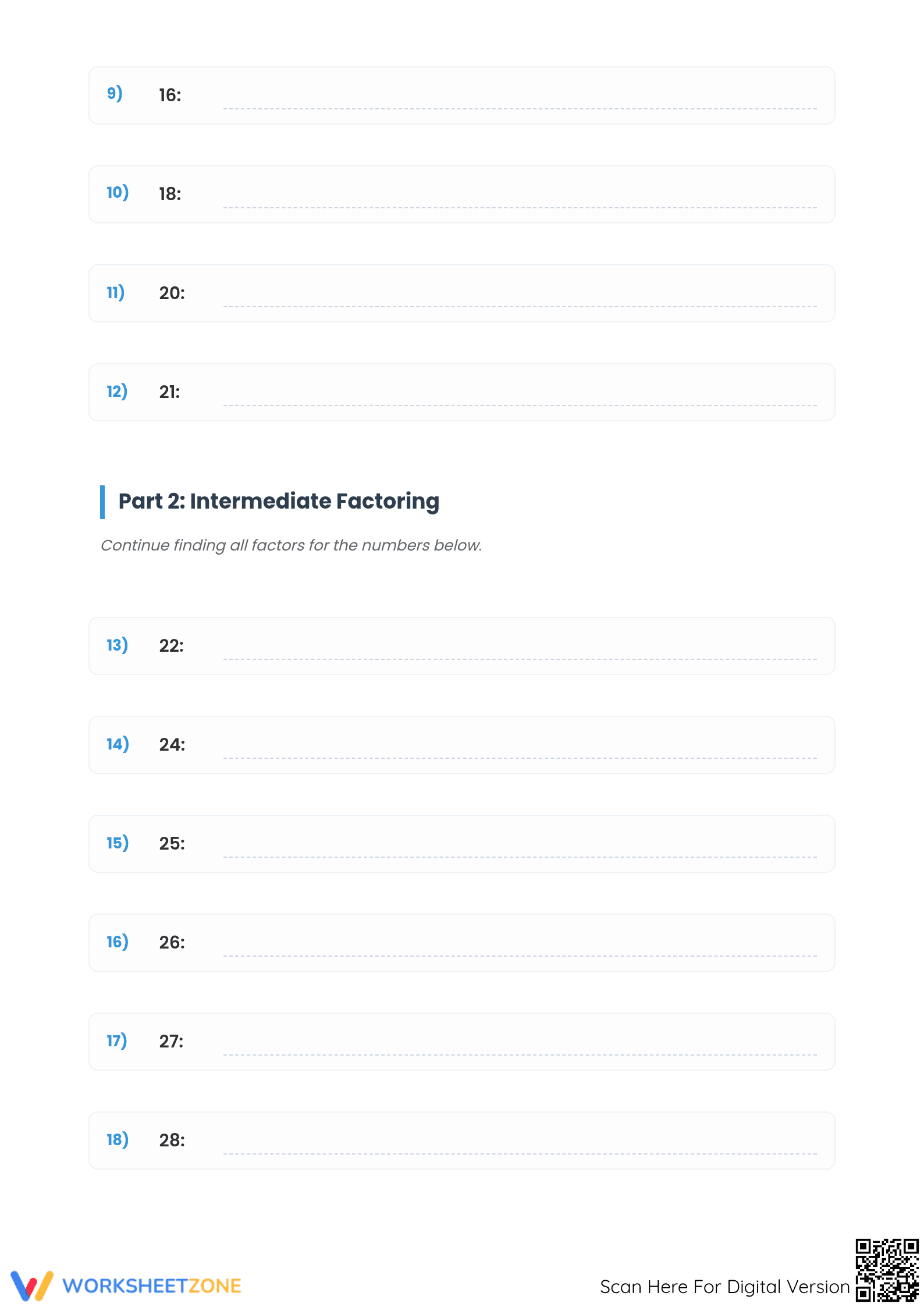
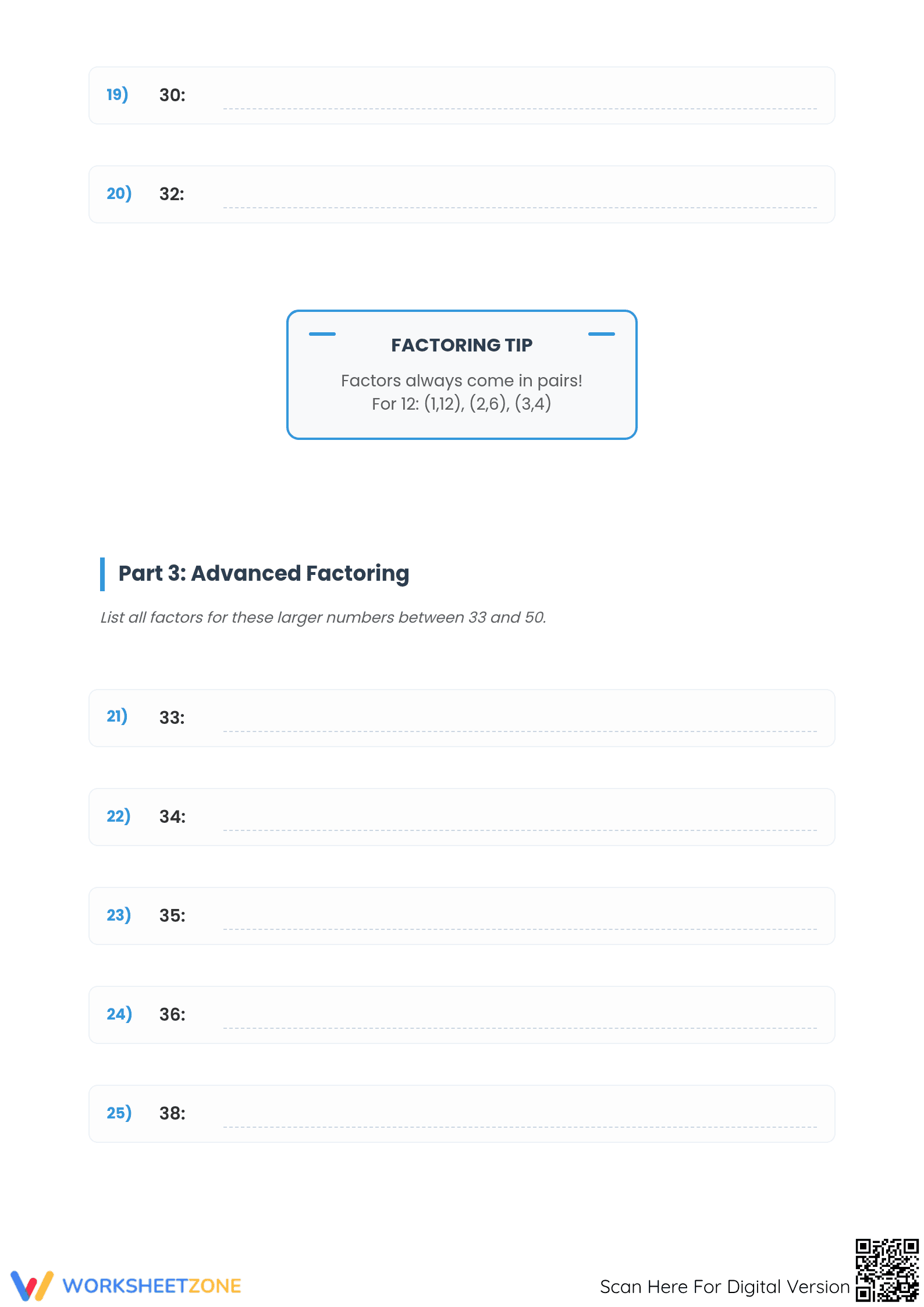
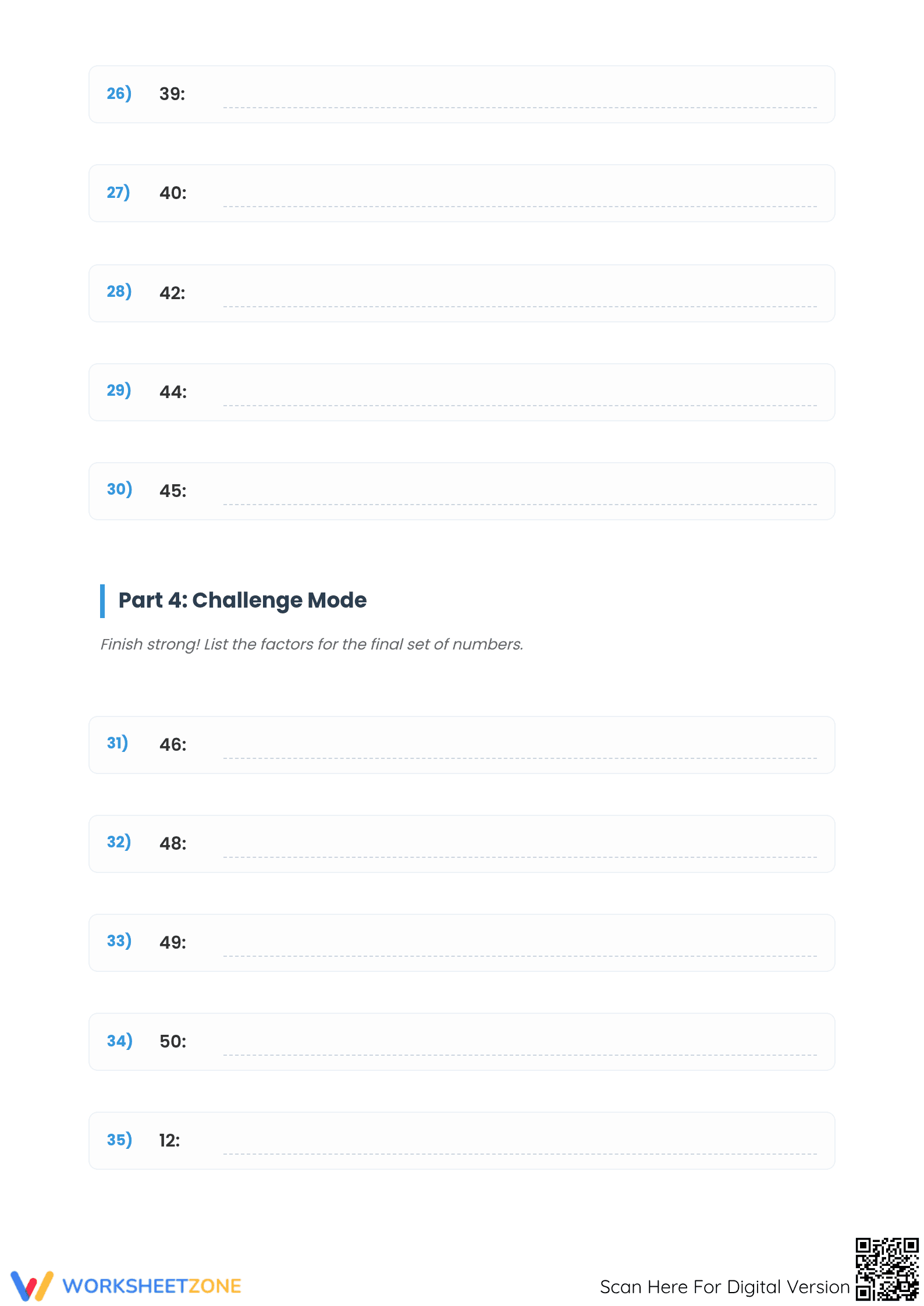

Printable Factoring Numbers (4-50) Worksheet | Grade 7 Math
Paste this activity's link or code into your existing LMS (Google Classroom, Canvas, Teams, Schoology, Moodle, etc.).
Students can open and work on the activity right away, with no student login required.
You'll still be able to track student progress and results from your teacher account.
This comprehensive Grade 7 math worksheet focuses on mastering the fundamental skill of factoring numbers between 4 and 50. By breaking down integers into their constituent components, students develop the essential numerical fluency required for simplifying fractions, finding common denominators, and eventually solving complex algebraic equations with confidence.
At a Glance
At a Glance
- Grade: 7 · Subject: Math
- Standard:
CCSS.MATH.CONTENT.6.NS.B.4— Find all factor pairs for a whole number in the range 1-100- Skill Focus: Factoring and Prime Factorization
- Format: 5 pages · 44 problems · Answer key included · PDF
- Best For: Independent practice and skill reinforcement
- Time: 30–45 minutes
What's Inside
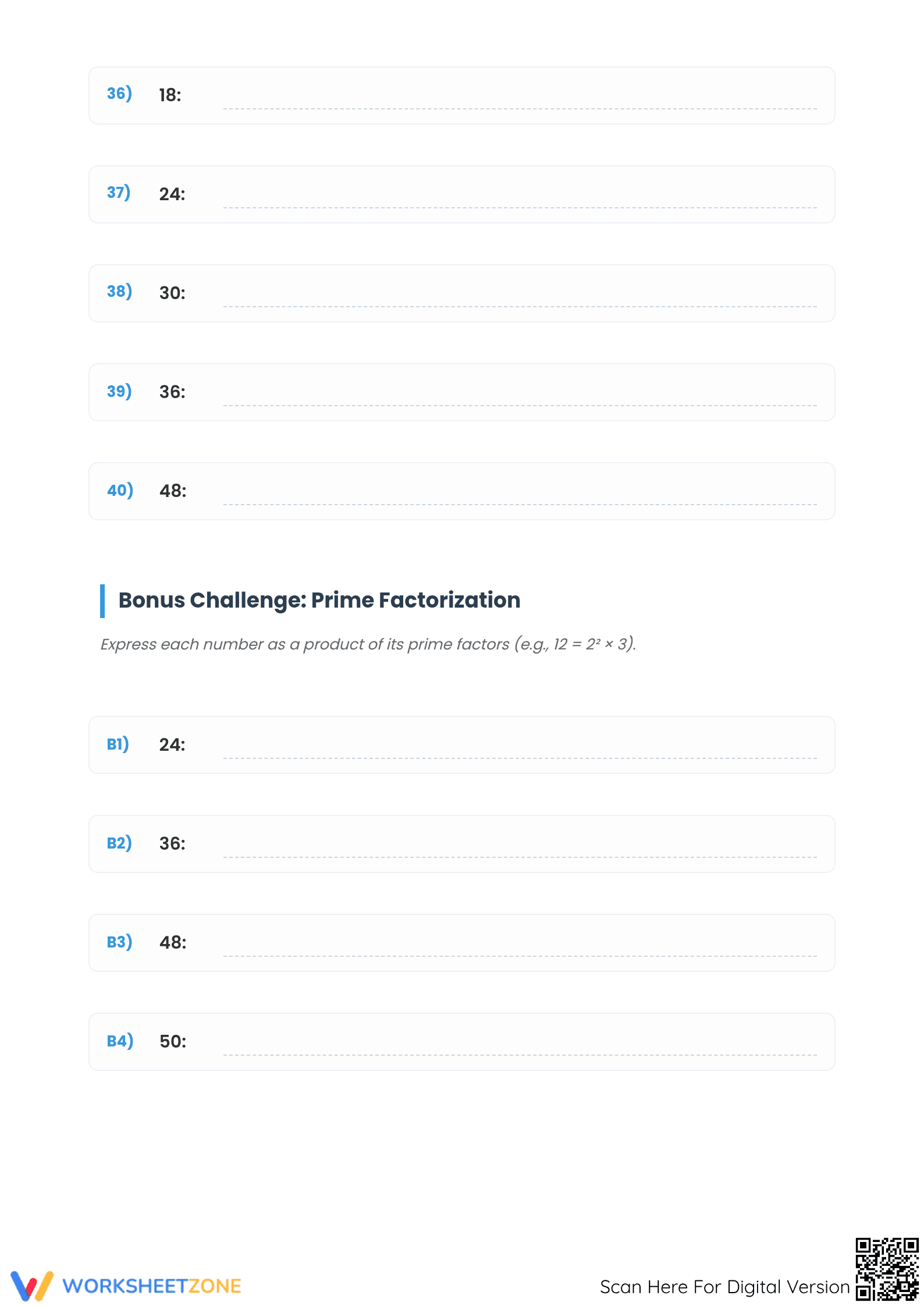
Inside this five-page instructional packet, learners will find 40 structured factoring problems organized into four distinct difficulty tiers: Basic, Intermediate, Advanced, and Challenge Mode. The resource also includes a specialized bonus section featuring four prime factorization tasks to bridge the gap between simple factors and exponentiation, all supported by a clear answer key.
Zero-Prep Workflow
The zero-prep workflow is designed for maximum efficiency. Teachers can print the five-page PDF in less than 30 seconds, distribute the packets to the entire class in approximately one minute, and use the included answer key for a rapid five-minute review at the end of the period, requiring zero advance preparation or specialized materials.
Standards Alignment
This resource is directly aligned with `CCSS.MATH.CONTENT.6.NS.B.4`, which requires students to identify all factor pairs for whole numbers up to 100. It also supports 7th-grade standards for expressions and equations by providing the necessary prerequisite skills for factoring linear expressions with rational coefficients. Both standard codes can be copied directly into lesson plans, IEP goals, or district curriculum mapping tools.
How to Use It
Use this worksheet as a focused "warm-up" activity during the first ten minutes of a lesson on equivalent fractions to activate prior knowledge. Alternatively, it serves as an excellent formative assessment tool; observe how students approach "Challenge Mode" to identify those who may need additional scaffolding with prime numbers versus those ready for advanced algebraic concepts.
Who It's For
This practice set is ideal for Grade 7 students requiring a rigorous review of number theory, as well as 6th-grade learners ready for extension. The progressive difficulty levels make it naturally differentiated for diverse classroom needs, and it pairs perfectly with a prime numbers anchor chart or a direct instruction lesson on the Greatest Common Factor.
Research and Citation
Factoring remains a cornerstone of middle school mathematics, serving as a vital bridge between arithmetic operations and algebraic reasoning. According to the RAND AIRS 2024 report, students who exhibit high proficiency in identifying factor pairs and prime factorization demonstrate significantly higher success rates when transitioning to quadratic equations and polynomial division in secondary education. This worksheet provides the repetitive, structured practice necessary to move these skills into long-term memory, ensuring that students do not struggle with basic calculations while trying to grasp higher-order mathematical abstractions. By moving from basic factoring to challenge problems, the resource enforces the concept that factors always come in pairs—a fundamental realization that prevents errors in more complex problem-solving scenarios. This evidence-based approach to numerical fluency is essential for closing achievement gaps in Title I classrooms and supporting individualized education programs focused on foundational math mastery and quantitative literacy across all STEM disciplines.


