


























Views
Downloads

Essential Grade 7 Factoring Numbers 4-100 Worksheet
Paste this activity's link or code into your existing LMS (Google Classroom, Canvas, Teams, Schoology, Moodle, etc.).
Students can open and work on the activity right away, with no student login required.
You'll still be able to track student progress and results from your teacher account.
Master Factoring Skills with Structured Practice
Strengthen your students' number sense with this comprehensive 5-page factoring worksheet. Designed for Grade 7 Math, this resource provides a systematic approach to identifying all factor pairs for numbers between 4 and 100. Students will progress from basic prime and composite identification to advanced sets, ensuring they build the fluency required for algebraic success.
At a Glance
- Grade: 7 · Subject: Math
- Standard:
CCSS.MATH.CONTENT.6.NS.B.4— Find all factor pairs for whole numbers up to 100 accurately- Skill Focus: Decomposing whole numbers into factors
- Format: 5 pages · 40 problems · Answer key included · PDF
- Best For: Middle school number theory mastery
- Time: 25–45 minutes
What's Inside
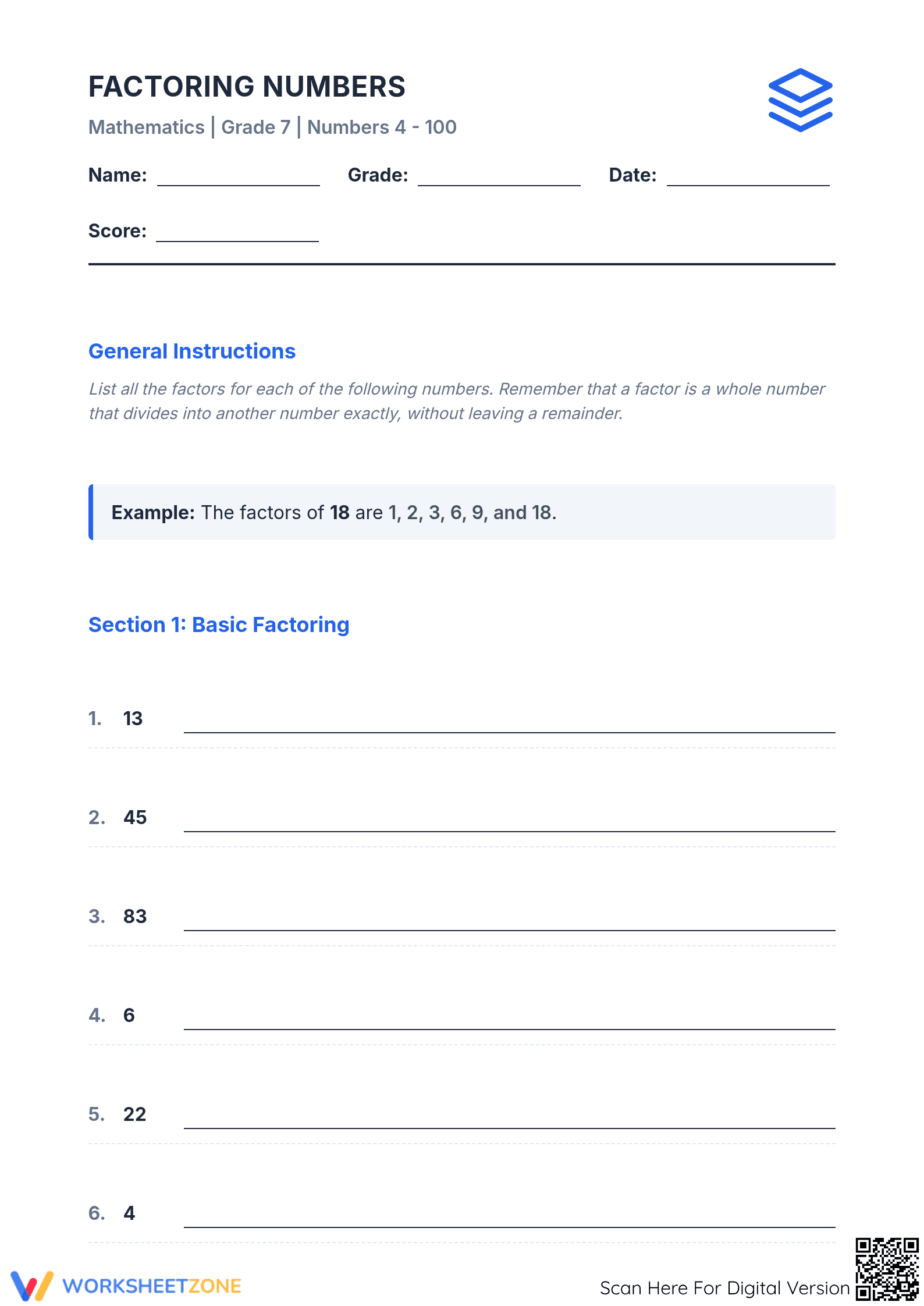
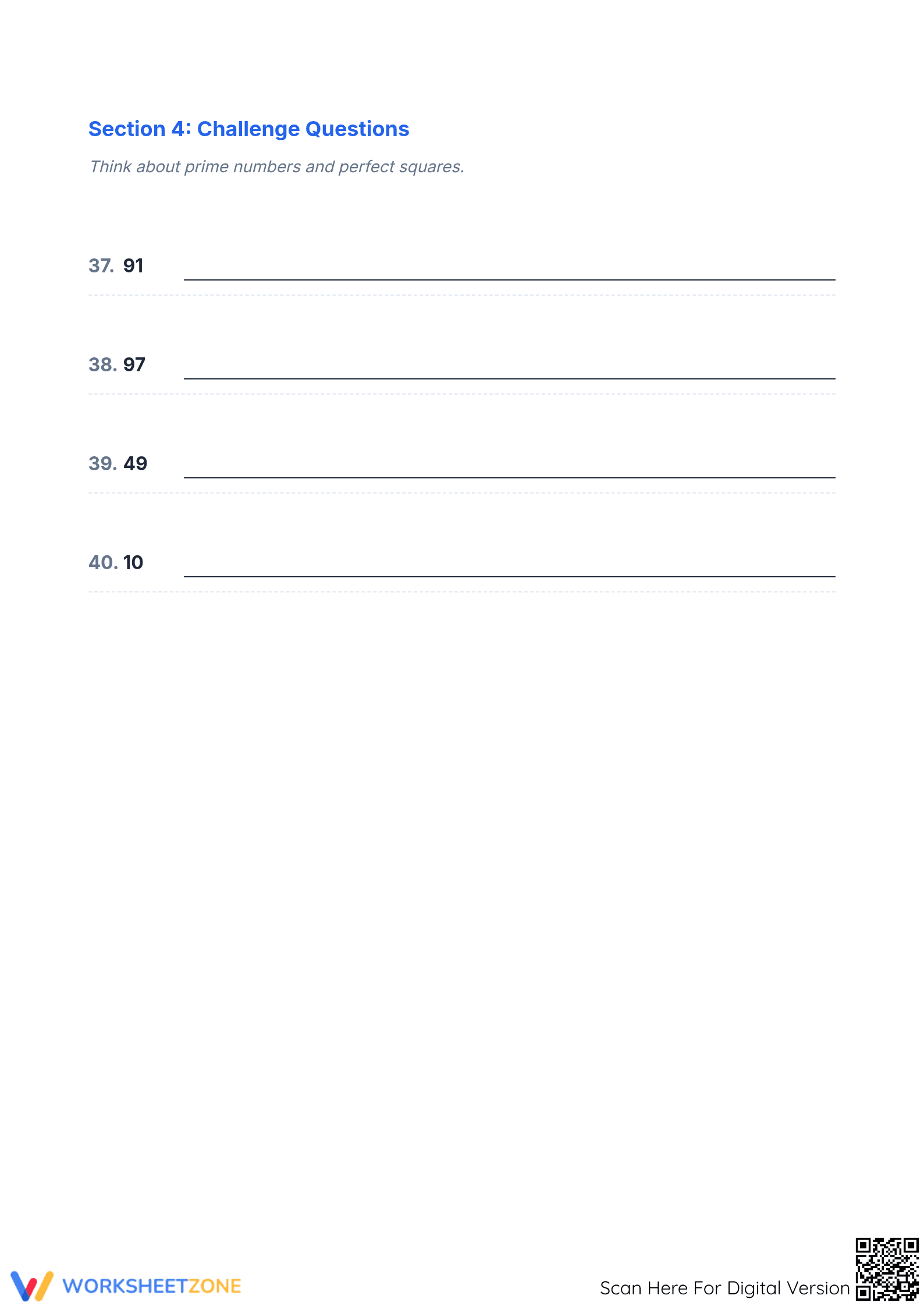
This extensive PDF packet includes 40 carefully selected factoring problems distributed across five instructional pages. The layout is clean and organized, featuring a worked example at the top of the first page to model the expected format. Each section increases in complexity, covering prime numbers, perfect squares, and composite numbers with high factor density. A complete answer key is provided for rapid grading and student self-correction.
Skill Progression
- Guided Practice: Page one includes an example and six basic tasks (e.g., 13, 6, 22) to establish the habit of listing factors in ascending order.
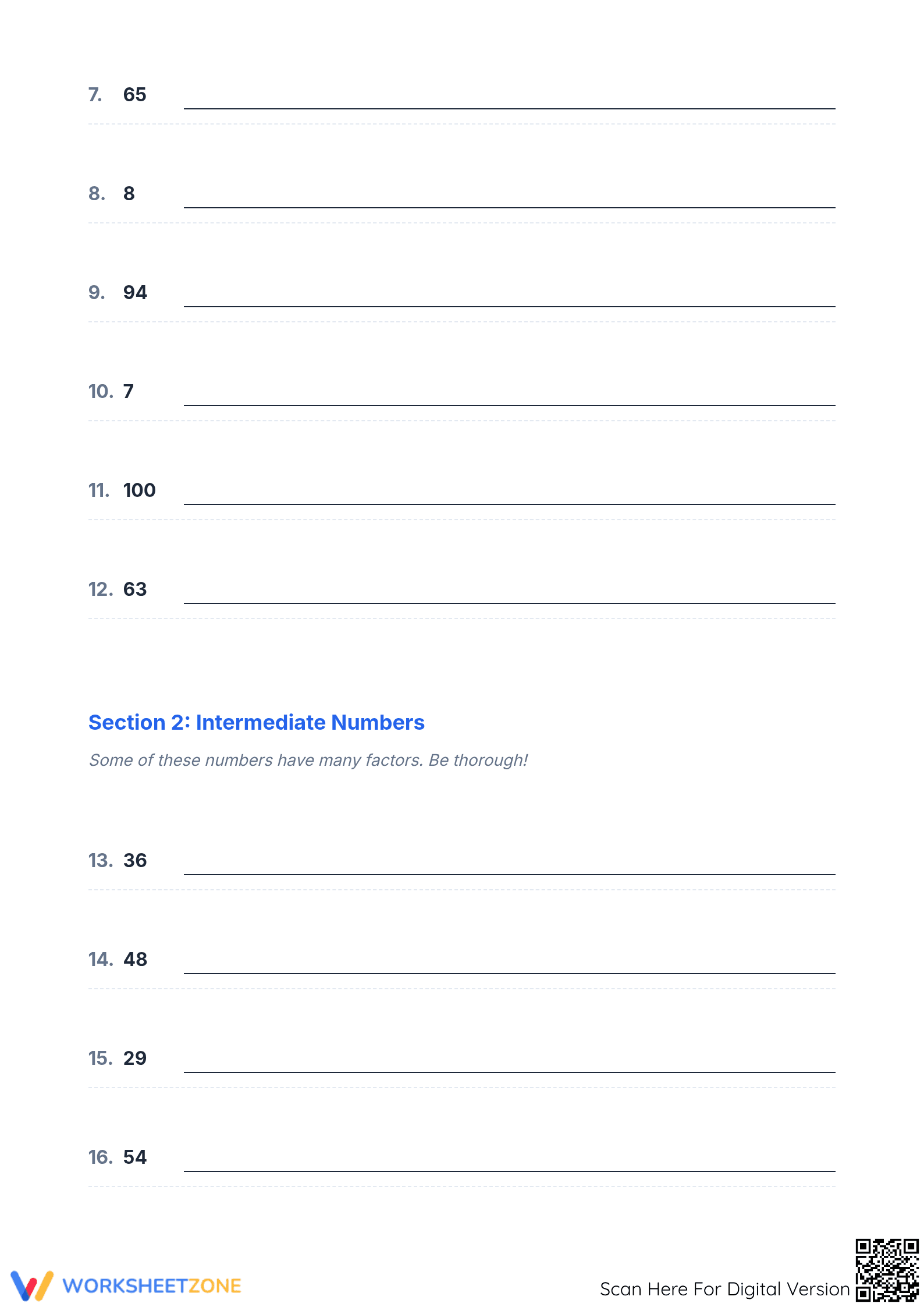
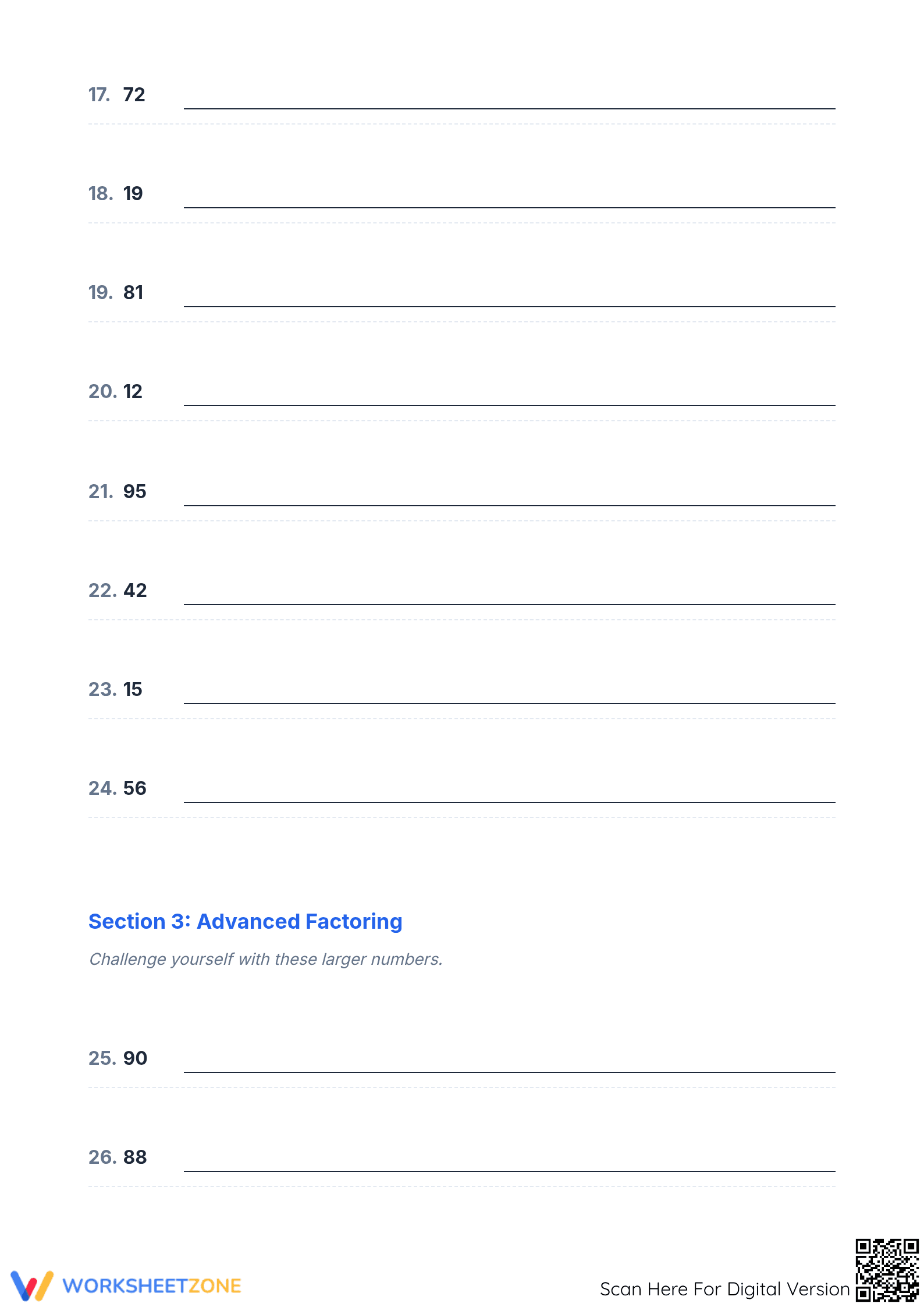
- Supported Practice: Sections two and three introduce numbers like 36 and 72. These 18 problems encourage students to apply divisibility rules systematically.
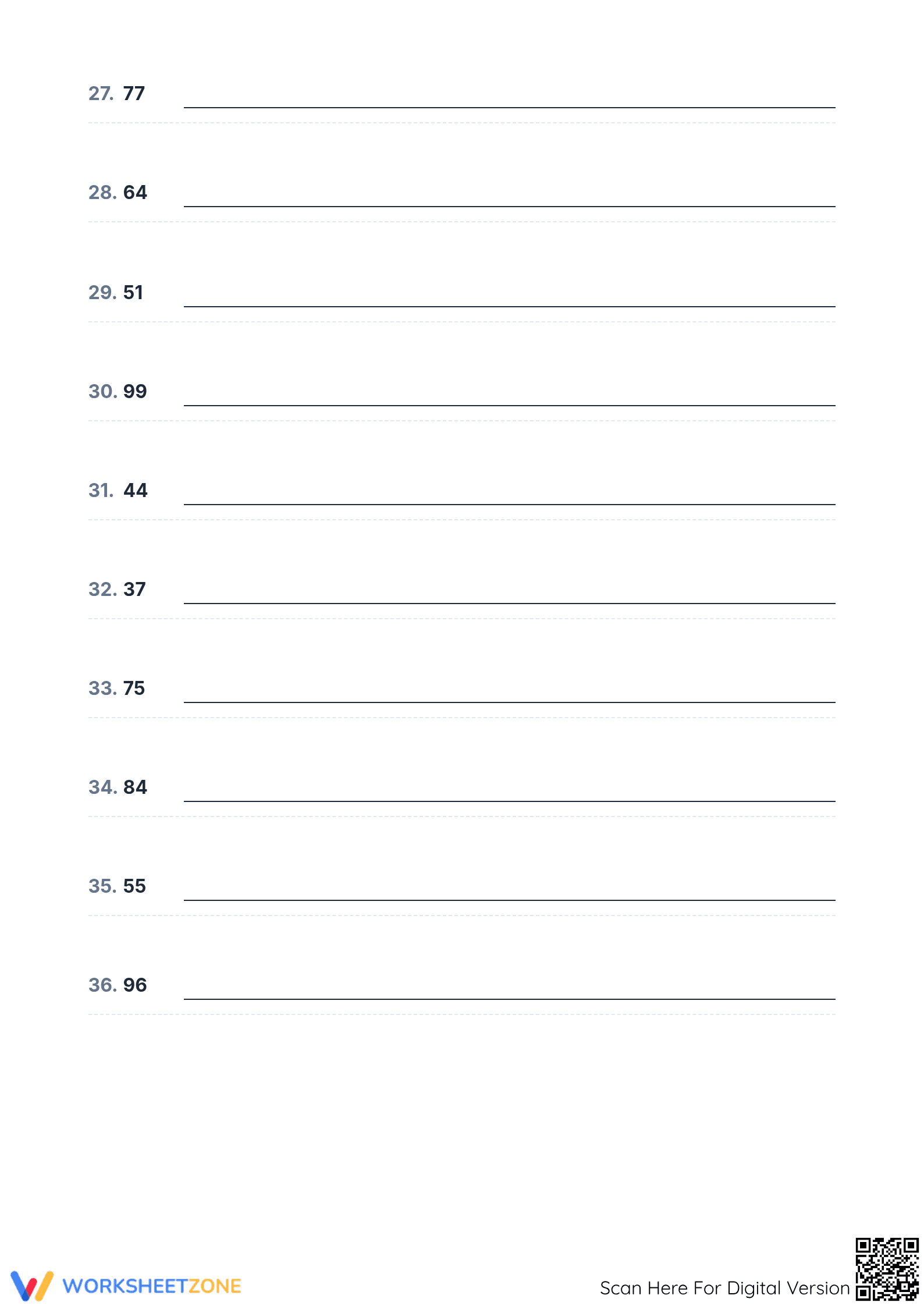
- Independent Practice: The final sections provide 16 advanced problems, including numbers like 96 and 97, forcing students to distinguish between composite sets and primes.
This scaffolded approach follows the gradual release of responsibility, moving students from basic identification to complex decomposition across 40 distinct opportunities for mastery.
Standards Alignment
The primary alignment is to `CCSS.MATH.CONTENT.6.NS.B.4`, finding factor pairs for whole numbers up to 100. This skill is vital for Grade 7 mastery of `7.EE.A.1`, which involves factoring linear expressions with rational coefficients. Both standard codes can be copied directly into lesson plans, IEP goals, or district curriculum mapping tools.
How to Use It
Assign this worksheet as a practice session after instruction on divisibility rules. It works well as a bell-ringer or independent station activity during units on rational numbers. For formative assessment, observe students tackling Section 2; those missing pairs like (3, 12) for 36 may need multiplication fact support. Total completion time is approximately 35 minutes.
Who It's For
This resource is ideal for Grade 7 students reinforcing number theory foundations before algebra. It is suited for general education, interventions, or as a sub plan. Pair this with a divisibility rules anchor chart for students requiring extra visual scaffolding during the independent practice phase.
Effective mathematics instruction in the middle grades requires a robust understanding of number theory, specifically the ability to decompose composite numbers into their constituent factors. This 40-item worksheet provides the high-repetition practice necessary to internalize factor pairs for integers between 4 and 100, a skill identified by EdReports (2024) as foundational for success in algebraic manipulation and fraction operations. By moving from prime identification in basic sets to complex factoring in challenge sections, students build the cognitive fluency required for greatest common factor (GCF) and least common multiple (LCM) applications. Research from the NAEP suggests that students who demonstrate mastery over multiplicative structures are significantly more likely to succeed in higher-level functions and expressions. This resource bridges the gap between elementary arithmetic and secondary algebra by enforcing precise mathematical vocabulary and systematic listing strategies. The included answer key allows for immediate feedback, which Fisher & Frey (2014) highlight as a critical component of the gradual release of responsibility model.


