


























Views
Downloads


Essential Factoring Mastery Worksheet | Grade 7 Math
Paste this activity's link or code into your existing LMS (Google Classroom, Canvas, Teams, Schoology, Moodle, etc.).
Students can open and work on the activity right away, with no student login required.
You'll still be able to track student progress and results from your teacher account.
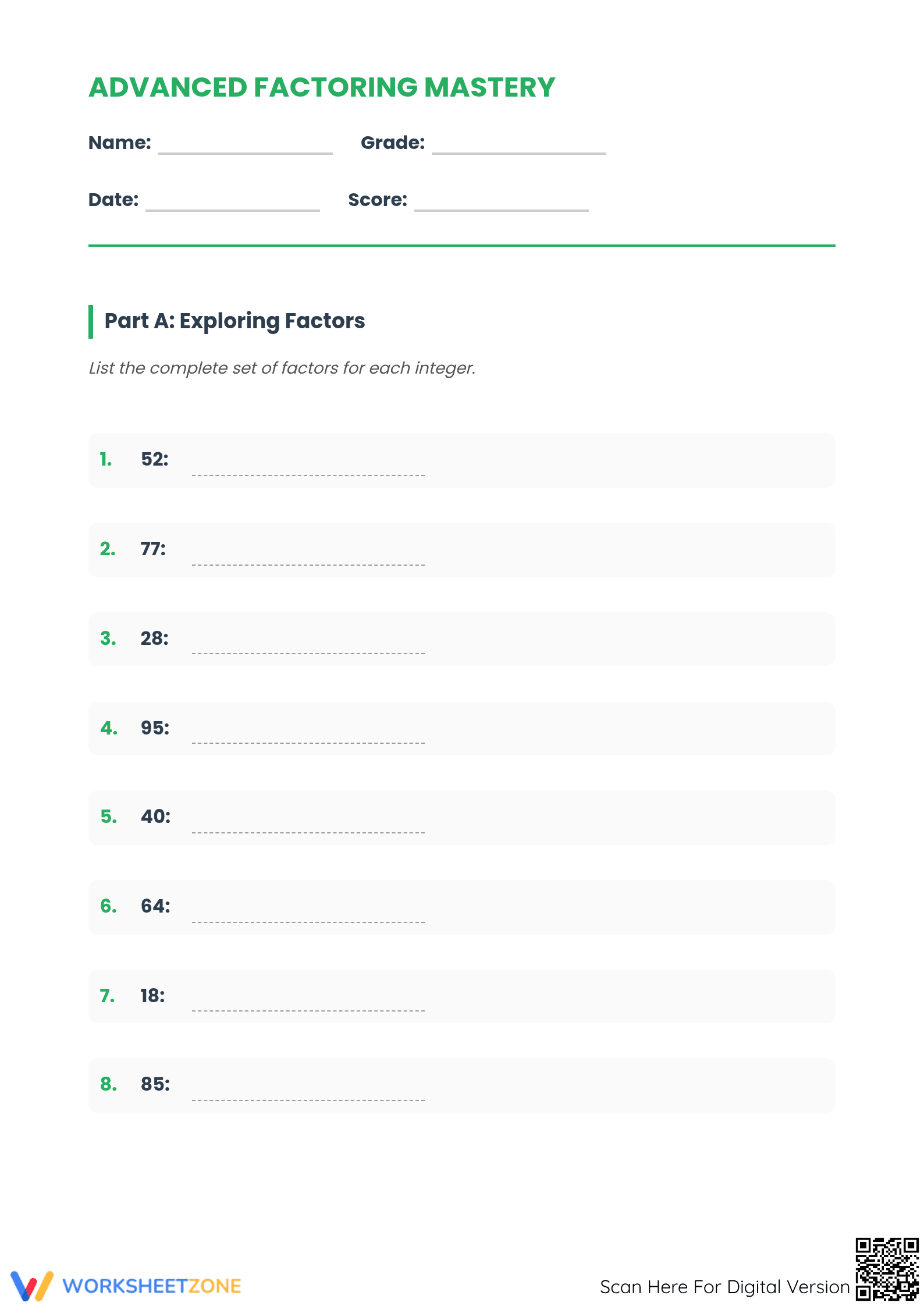
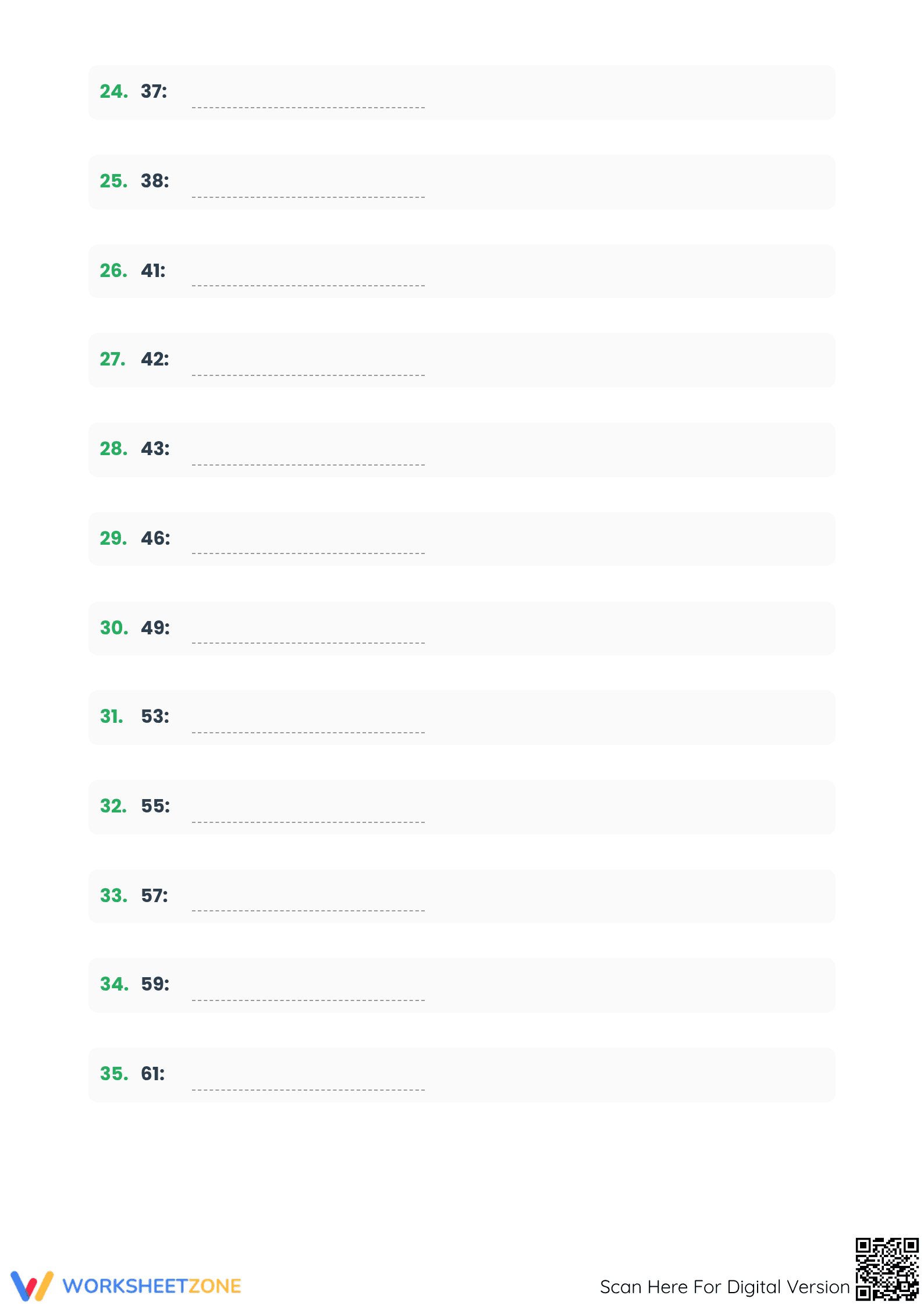
This comprehensive 5-page worksheet provides Grade 7 students with intensive practice in identifying all factors for integers between 4 and 100. Students will progress from basic factor lists to analyzing complex composite numbers and investigating special numerical properties. This resource ensures total mastery of divisibility rules and foundational number theory required for advanced algebraic concepts.
At a Glance
- Grade: 7 · Subject: Math
- Standard:
6.NS.B.4— Find all factor pairs for whole numbers and identify common factors between integers- Skill Focus: Integer Factoring & Composites
- Format: 5 pages · 44 problems · Answer key included · PDF
- Best For: Intensive skill practice and number theory review
- Time: 45–60 minutes
What's Inside
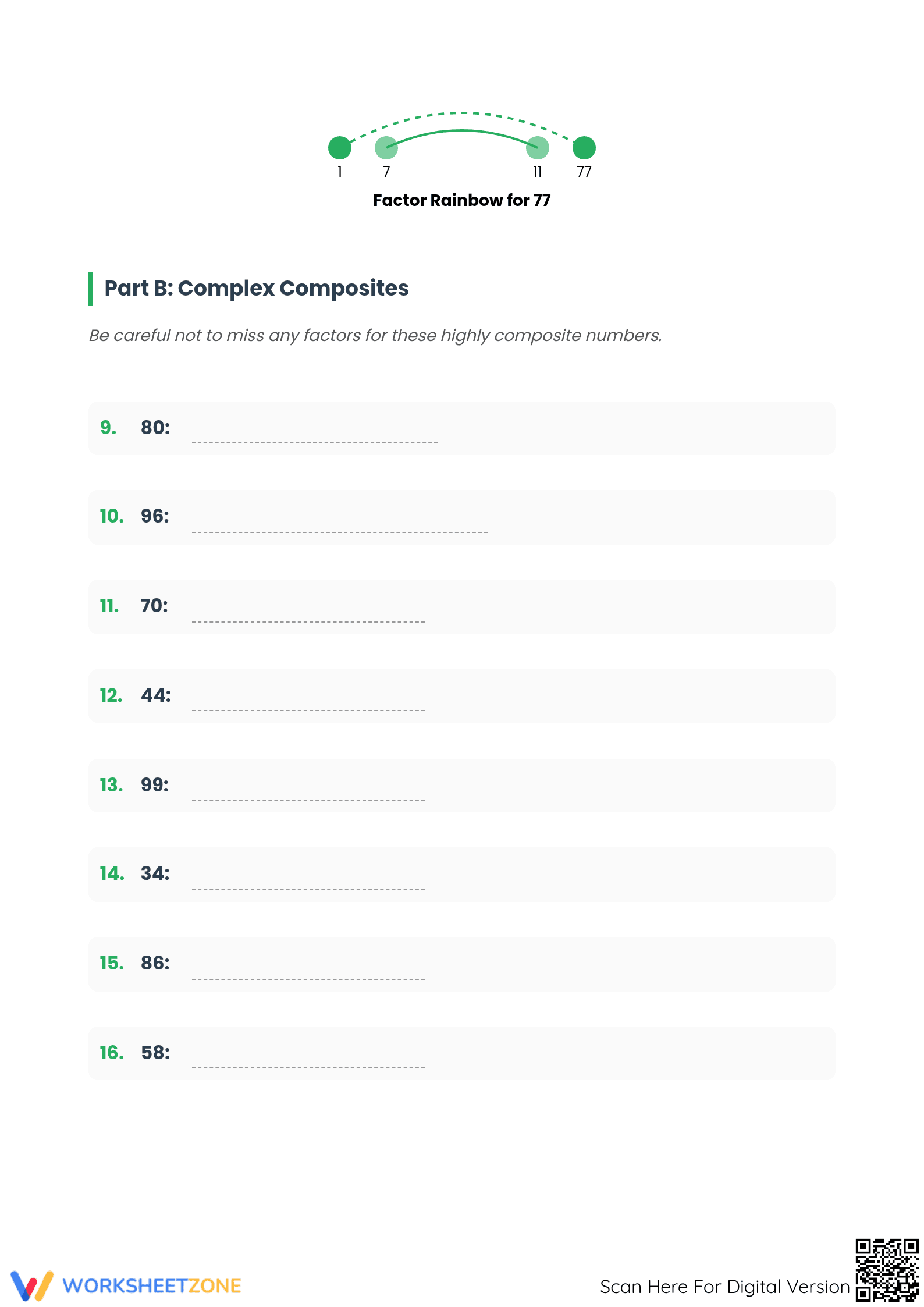
Across five high-quality pages, students engage with forty distinct integer factoring challenges and four deep-analysis questions. The worksheet includes visual aids like a "Factor Rainbow" to model proper paired factoring techniques. The layout provides ample whitespace for students to list complete factor sets for numbers ranging from prime integers to highly composite values like 80 and 96. A full answer key is included to facilitate quick grading or student self-correction.
Skill Progression
- Guided Practice: Part A focuses on integers under 50, building student confidence in recognizing basic divisibility patterns and listing factor pairs sequentially.
- Supported Practice: Part B transitions to "Complex Composites" like 99 and 70, requiring students to utilize the provided rainbow model for accuracy with larger integers.
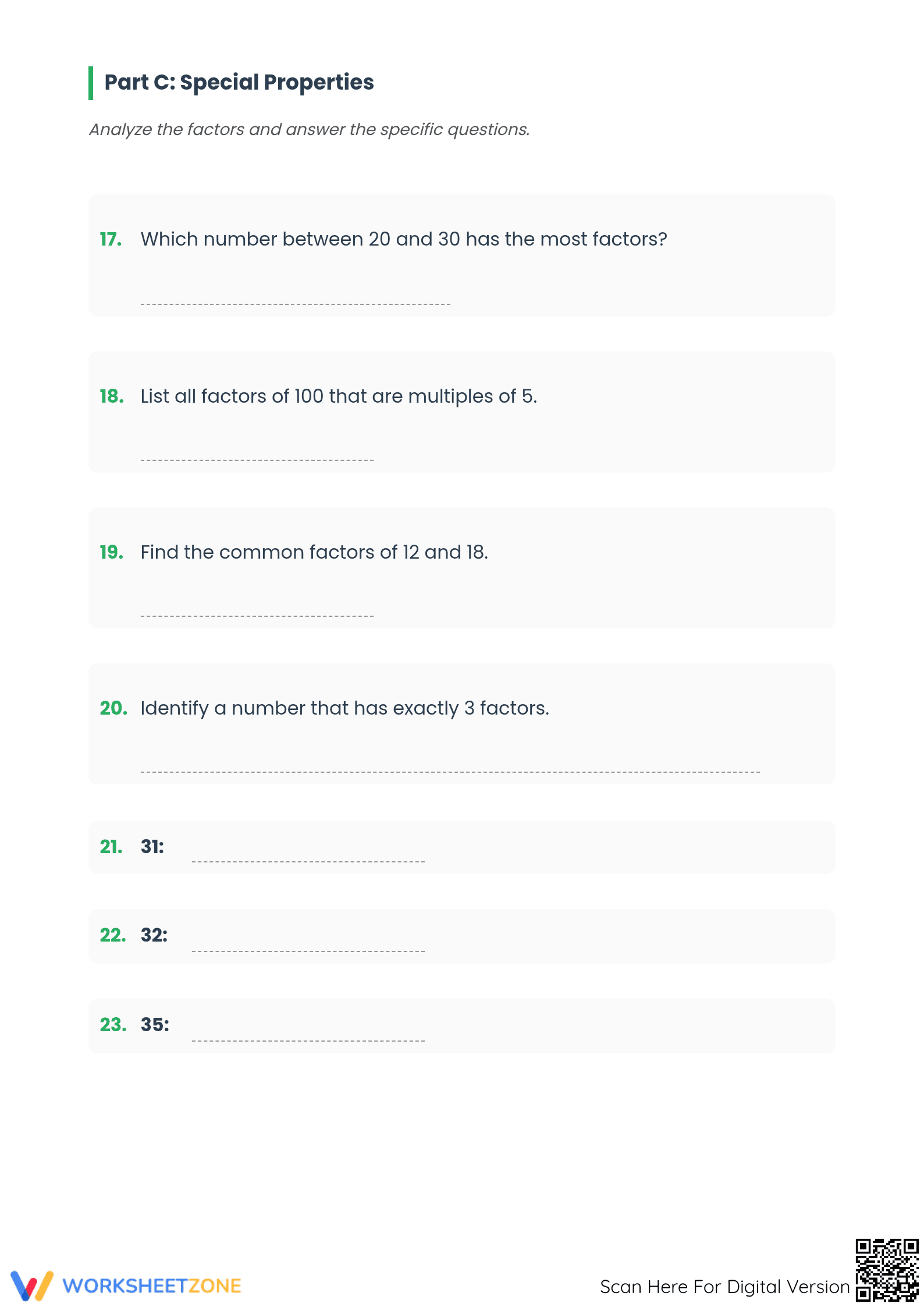
- Independent Practice: Part C challenges students with "Special Properties," including identifying numbers with specific factor counts and finding common factors between different integers.
The worksheet follows a gradual-release model, moving from structured identification to critical analysis of number properties and relationships.
Standards Alignment
This resource is directly aligned to the common core standard `6.NS.B.4`: "Find the greatest common factor of two whole numbers less than or equal to 100." While labeled for Grade 7, it serves as a critical prerequisite review for operations with rational numbers and algebraic expressions. This standard code can be copied directly into lesson plans, IEP goals, or district curriculum mapping tools.
How to Use It
This worksheet is ideal for use during a direct instruction unit on number theory or as a comprehensive review before introducing prime factorization and GCF. Teachers should use the "Special Properties" section as a formative assessment tool; observe student logic on question 17 to gauge their understanding of composite density. The complete set typically takes 45 to 60 minutes for a Grade 7 student to finish accurately.
Who It's For
Designed primarily for seventh-grade math students, this packet is also an excellent intervention resource for eighth-grade learners struggling with algebraic coefficients. It pairs naturally with a unit on divisibility rules or a short instructional video on factor pairs. Differentiation is built into the increasing complexity of the integers provided, allowing teachers to assign specific pages based on individual readiness levels.
According to a meta-analysis by Fisher & Frey (2014), the mastery of foundational number theory, specifically the identification of factor pairs, is a significant predictor of success in middle school algebra and rational number operations. This worksheet provides the high-volume, structured practice necessary to move students from procedural fluency to conceptual understanding of integer relationships. By requiring students to not only list factors but also analyze the properties of specific numbers—such as identifying which integers possess the highest factor density—this resource aligns with evidence-based instructional strategies for mathematical retention. The inclusion of the 6.NS.B.4 standard ensures that the practice remains focused on high-leverage skills identified by national frameworks. Research indicates that frequent, low-stakes practice with factor identification reduces cognitive load when students later encounter complex fraction simplification and polynomial factoring in secondary mathematics courses.


