


























Views
Downloads

Essential Factoring Numbers 4-100 Worksheet | Grade 7 Math
Paste this activity's link or code into your existing LMS (Google Classroom, Canvas, Teams, Schoology, Moodle, etc.).
Students can open and work on the activity right away, with no student login required.
You'll still be able to track student progress and results from your teacher account.
Mastering number theory is a critical milestone for middle school mathematicians. This comprehensive Grade 7 worksheet helps students develop a deep understanding of factoring, prime factorization, and the properties of prime and composite numbers. By completing these exercises, learners gain the fluency needed to simplify complex fractions and solve algebraic equations with confidence.
At a Glance
- Grade: 7 · Subject: Math
- Standard:
CCSS.MATH.CONTENT.6.NS.B.4— Find factors of numbers up to 100 and identify prime factors- Skill Focus: Factoring and Prime Decomposition
- Format: 4 pages · 30 problems · Answer key included · PDF
- Best For: Independent practice or formative assessment
- Time: 45–60 minutes
What's Inside
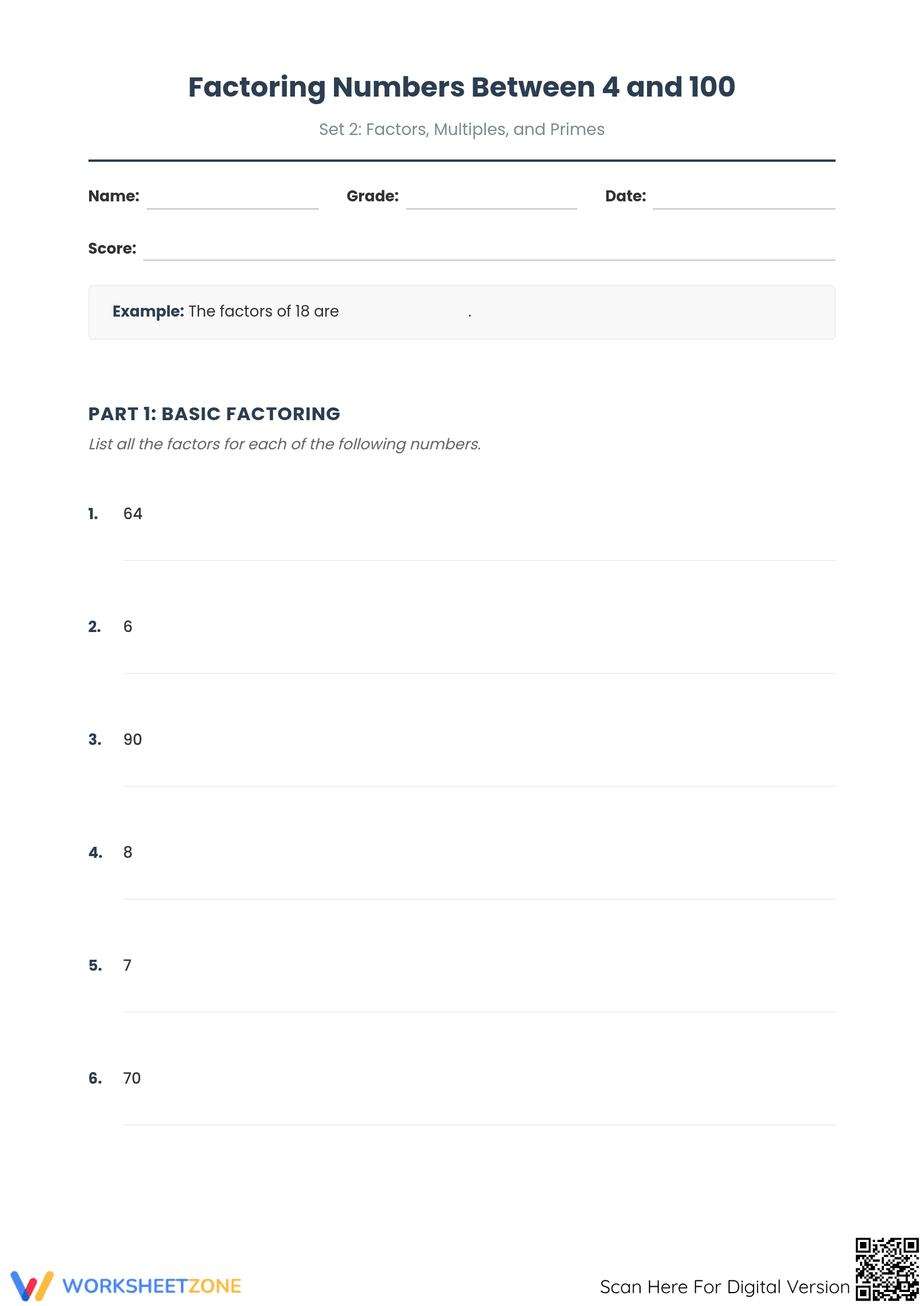
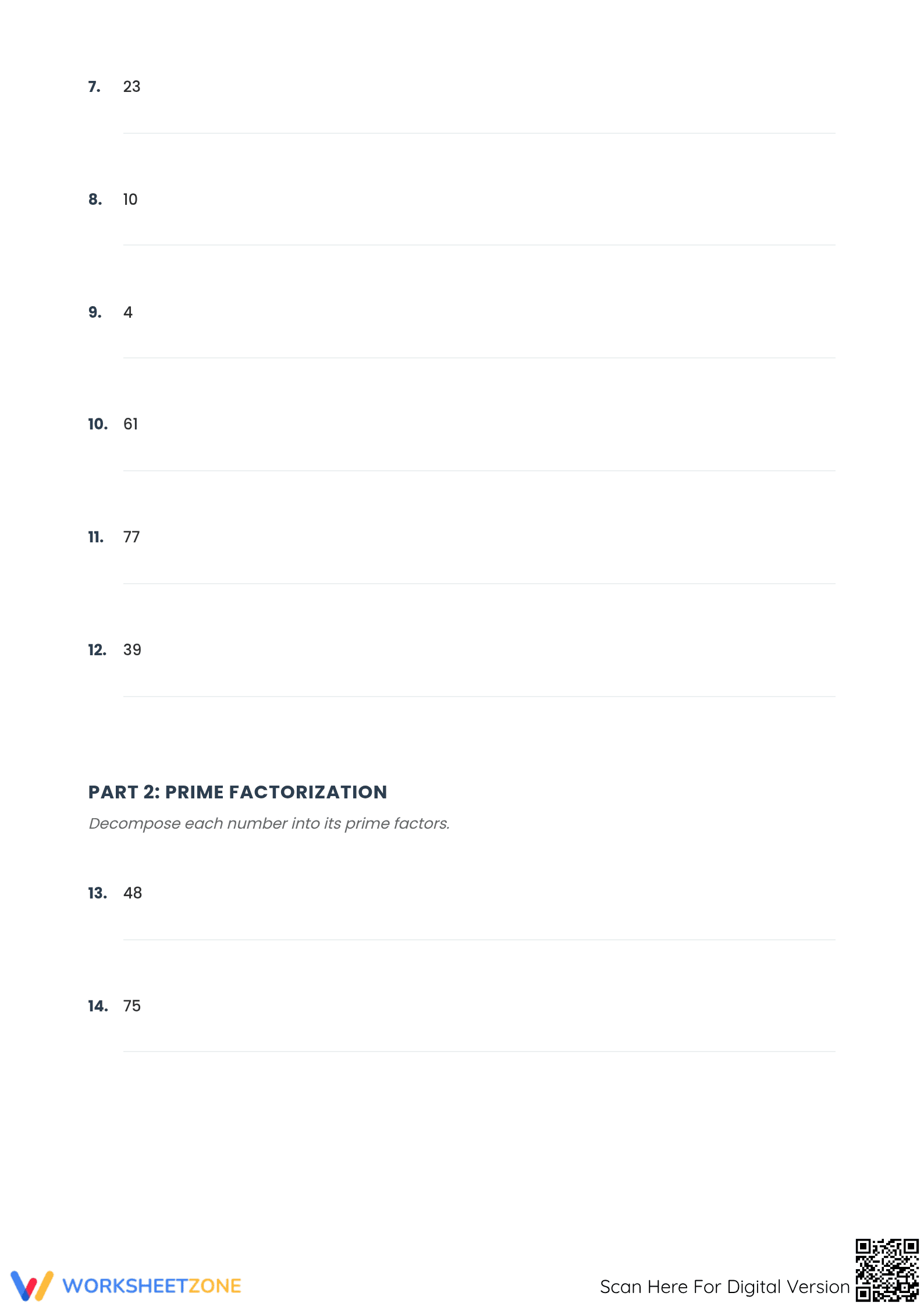
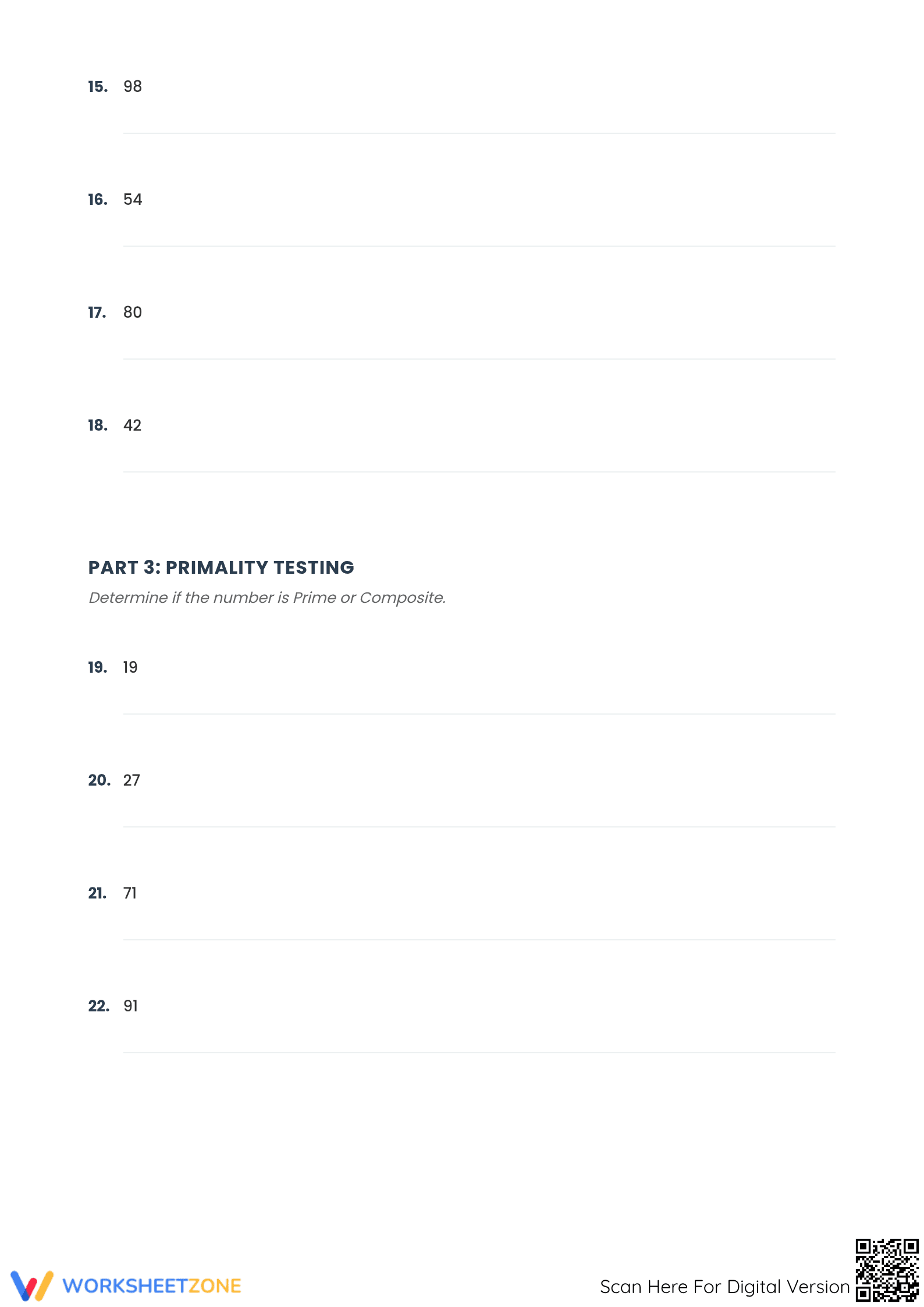
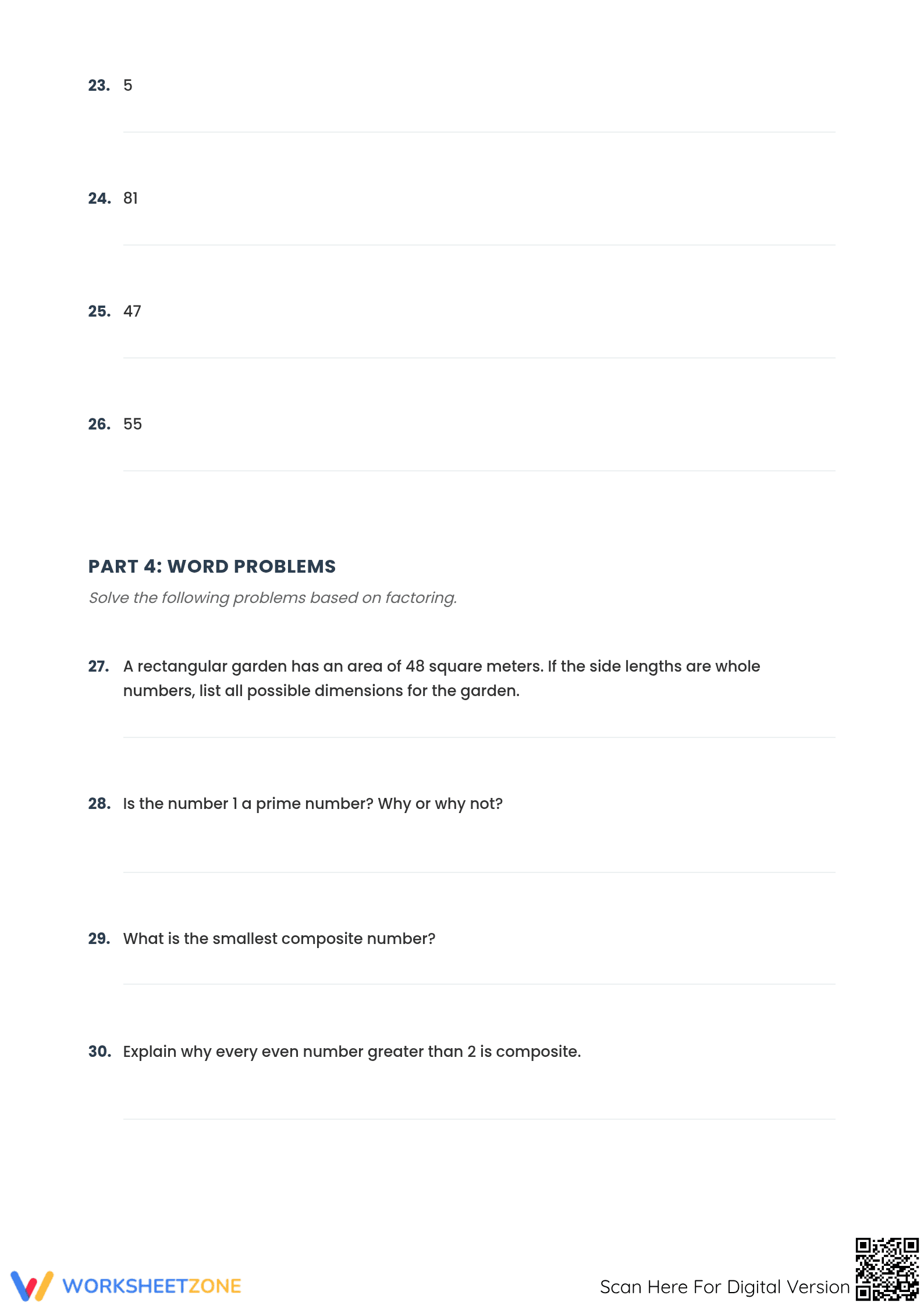
This four-page PDF includes 30 unique problems divided into four targeted sections. Students will work through basic factoring sets, prime factorization trees, and primality testing. The resource features a structured layout with ample workspace for calculations and includes word problems that apply these skills to geometric area concepts. A full answer key ensures efficient grading and immediate student feedback.
Skill Progression
- Guided Practice: Part 1 contains 12 problems focused on listing all factors for numbers between 4 and 100, building basic number sense.
- Supported Practice: Part 2 introduces 6 prime factorization tasks where students decompose numbers into their fundamental building blocks.
- Independent Practice: Parts 3 and 4 challenge students with primality testing and 4 analytical word problems that require higher-order thinking.
This sequence follows a gradual-release model, ensuring students master foundational concepts before attempting theoretical applications.
Standards Alignment
This resource is primary aligned to `CCSS.MATH.CONTENT.6.NS.B.4`: "Find the greatest common factor of two whole numbers less than or equal to 100 and the least common multiple of two whole numbers less than or equal to 100." While used as a Grade 7 review, it reinforces the foundational skills necessary for standard `7.NS.A.2`. Both standard codes can be copied directly into lesson plans, IEP goals, or district curriculum mapping tools.
How to Use It
Use this worksheet during the independent practice phase of your number theory unit. It is particularly effective as a mid-unit formative assessment to identify students who struggle with finding complete factor sets. Educators should observe students during Part 2 to see if they accurately identify the smallest prime factors. Expected completion time is approximately 50 minutes for the full set.
Who It's For
This resource is designed for Grade 7 students, but is highly appropriate for Grade 6 acceleration or Grade 8 remediation. It pairs naturally with a lesson on the Greatest Common Factor (GCF) or a classroom anchor chart detailing divisibility rules. Differentiation is supported through the compartmentalized sections, allowing teachers to assign specific parts based on student readiness.
Factoring is a foundational competency for middle school mathematics, serving as the gateway to algebraic reasoning and rational number operations. This worksheet aligns with CCSS.MATH.CONTENT.6.NS.B.4, focusing on identifying factors and prime factorization for numbers between 4 and 100. Research from Fisher & Frey (2014) emphasizes that scaffolded practice—moving from basic identification to prime decomposition and application-based word problems—is essential for developing mathematical fluency. By identifying primes and composites, students build the cognitive schema necessary for simplifying fractions and solving complex equations. This comprehensive 4-page resource provides 30 targeted tasks that reinforce these critical number sense skills. Effective instructional design requires that students encounter these concepts through multiple modalities, including theoretical explanations and practical applications. Utilizing this worksheet as a formative assessment allows educators to pinpoint specific misconceptions in number theory. This rigorous practice ensures students are prepared for higher-level Grade 7 standards involving rational numbers.


