


























Views
Plays

External Text Structure Worksheet | Grade 3-4 Essential
Paste this activity's link or code into your existing LMS (Google Classroom, Canvas, Teams, Schoology, Moodle, etc.).
Students can open and work on the activity right away, with no student login required.
You'll still be able to track student progress and results from your teacher account.
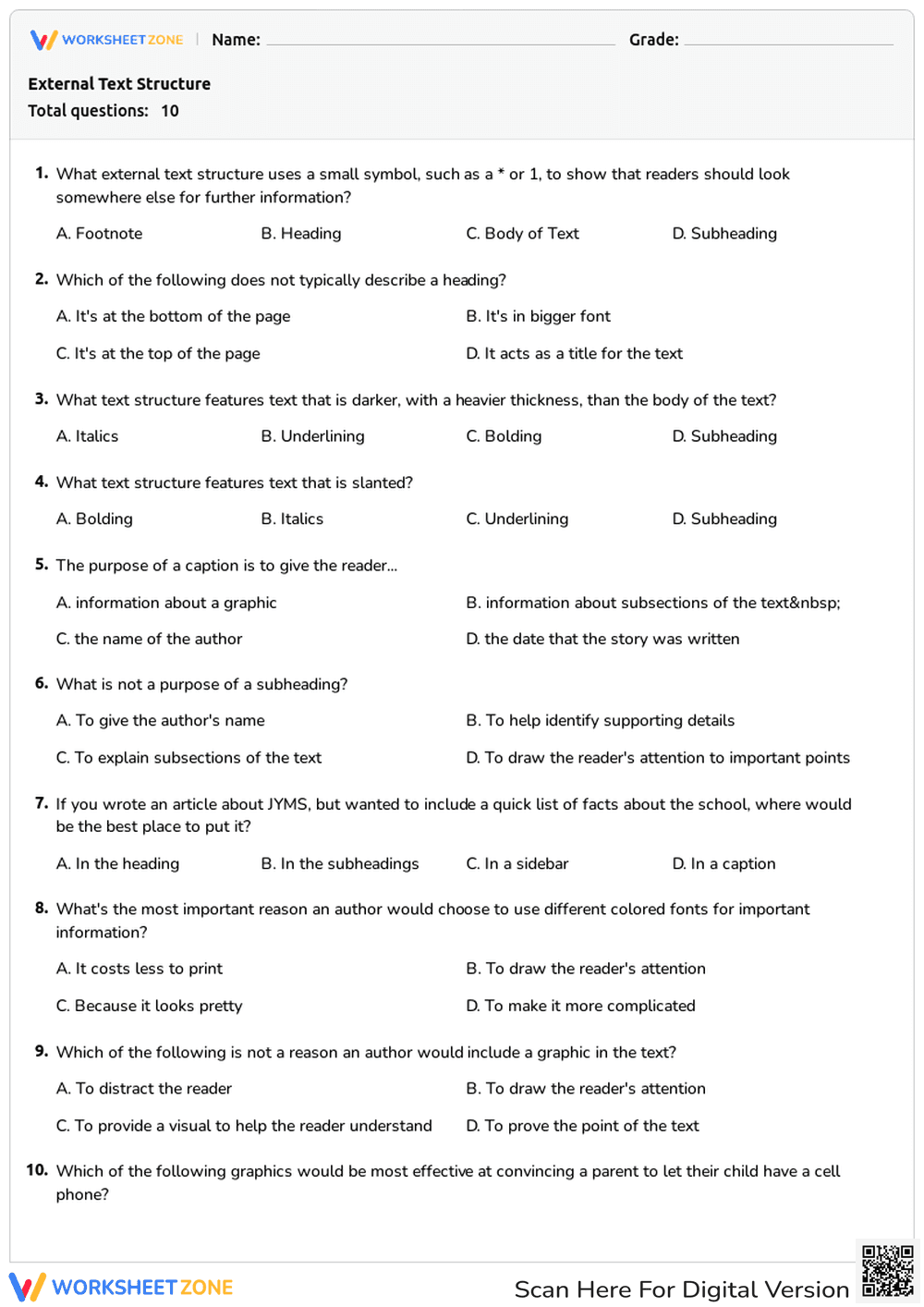
This Grade 3 and 4 ELA worksheet focuses on identifying and understanding external text structures in informational writing. Students analyze the specific purposes of headings, subheadings, captions, and sidebars to improve their reading comprehension. By mastering these visual cues, learners can navigate complex non-fiction texts more efficiently and locate key information quickly.
At a Glance
- Grade: 3-4 · Subject: ELA
- Standard:
CCSS.ELA-LITERACY.RI.3.5— Use text features to locate information relevant to a given topic efficiently- Skill Focus: External Text Features
- Format: 2 pages · 10 problems · Answer key included · PDF
- Best For: Formative assessment or quick reading quiz
- Time: 15–20 minutes
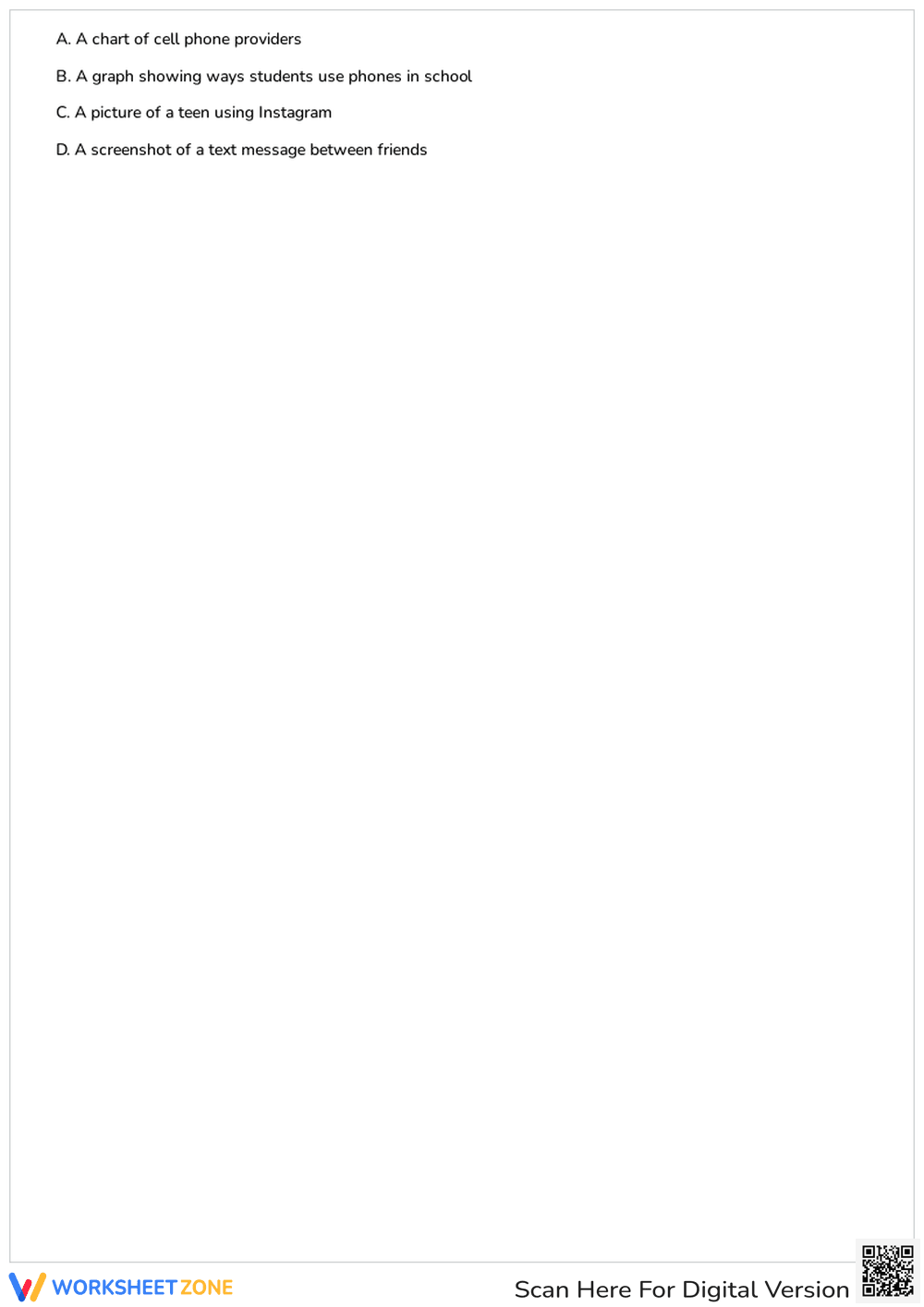
What's Inside: This two-page PDF contains 10 carefully crafted multiple-choice questions. Each question targets a specific external text feature, including footnotes, bolding, italics, captions, and graphics. The layout is clean and student-friendly, providing ample space for reading. It includes a comprehensive answer key for rapid grading and immediate student feedback.
Zero-Prep Workflow: This resource is designed for immediate classroom implementation with a total teacher prep time of under 2 minutes. First, print the two-page document for your class. Second, distribute the sheets during your informational text unit or as a standalone sub plan. Finally, review the answers using the included key to identify common misconceptions about text organization.
Standards Alignment: The primary focus is `CCSS.ELA-LITERACY.RI.3.5`, which requires students to use text features and search tools to locate information. It also supports RI.4.7 by asking students to interpret how visual elements like graphics contribute to a text. Both standard codes can be copied directly into lesson plans, IEP goals, or district curriculum mapping tools.
How to Use It: Use this worksheet as a summative quiz after a week of direct instruction on non-fiction elements. Alternatively, assign it as a pre-assessment to gauge prior knowledge before starting a research project. During the activity, observe if students can distinguish between the structural purpose of a subheading versus a sidebar. Completion typically takes 15 to 20 minutes.
Who It's For: This resource is ideal for third and fourth-grade students developing their informational reading skills. It provides necessary scaffolding for English Language Learners who benefit from explicit definitions of visual cues. Pair this worksheet with a high-interest non-fiction article or an anchor chart displaying various text features for a complete instructional cycle.
Understanding external text structures is a foundational component of literacy, as highlighted by Fisher & Frey (2014) in their research on scaffolded reading instruction. This worksheet aligns with CCSS.ELA-LITERACY.RI.3.5 by requiring students to evaluate the functional utility of headings, captions, and graphics. By isolating these features in a 10-question assessment, educators can pinpoint exactly where students struggle with non-fiction navigation. Research from the NAEP consistently shows that students who effectively utilize text features score higher on informational reading comprehension tasks. This resource provides the targeted practice necessary to bridge the gap between recognizing a feature and understanding its rhetorical purpose. Using this structured approach ensures that Grade 3 and 4 learners develop the strategic reading habits required for upper-elementary success and complex text analysis.


