


























Views
Downloads

Essential Character Traits Worksheet | Grade 3 ELA
Paste this activity's link or code into your existing LMS (Google Classroom, Canvas, Teams, Schoology, Moodle, etc.).
Students can open and work on the activity right away, with no student login required.
You'll still be able to track student progress and results from your teacher account.
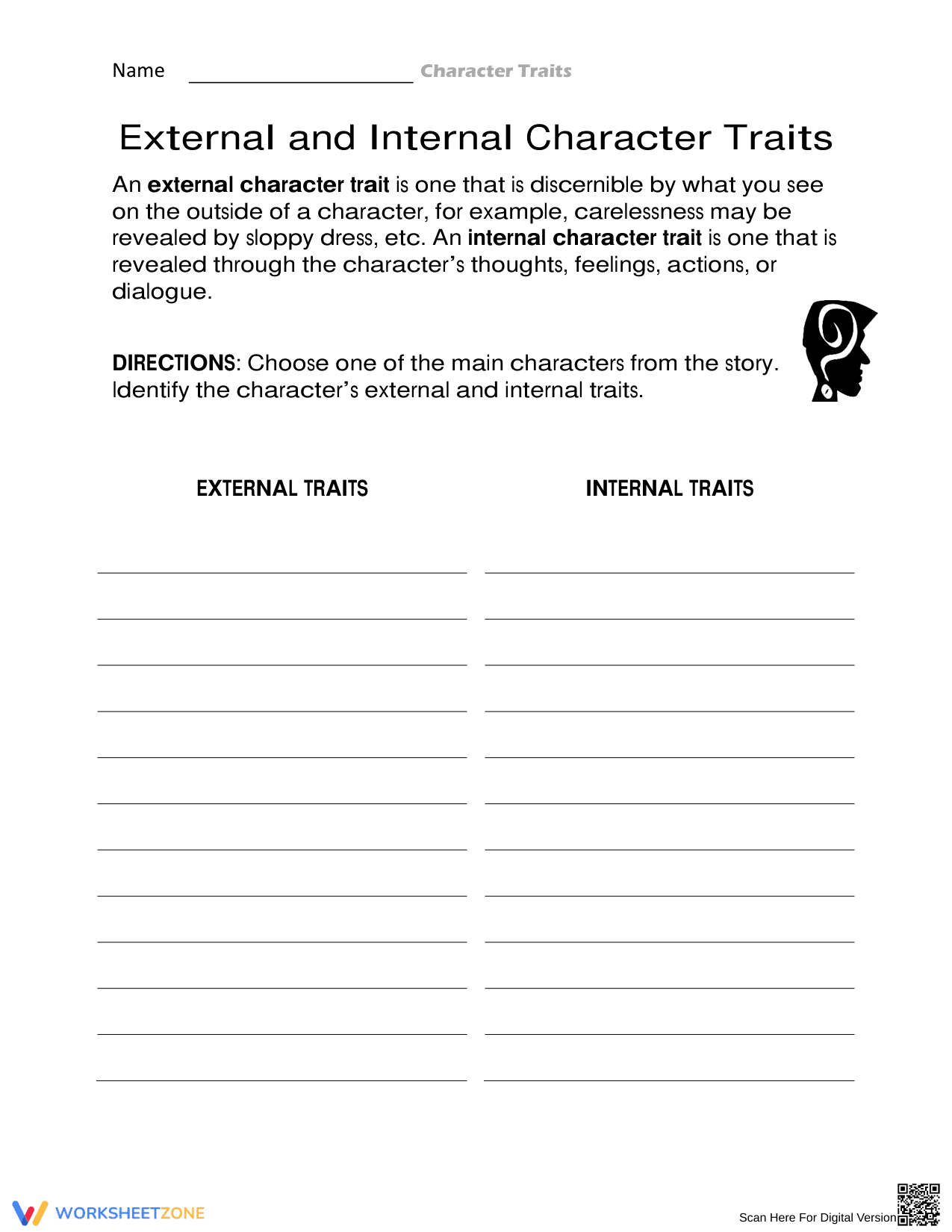
Identify a character's external and internal traits with this printable literacy worksheet. This activity helps students distinguish between observable physical characteristics and hidden emotional qualities to build a complete character profile. It ensures learners move beyond surface-level descriptions to understand motivations and actions within any narrative text.
At a Glance
- Grade: 3 · Subject: ELA
- Standard:
CCSS.ELA-LITERACY.RL.3.3— Describe characters in a story including their traits, motivations, or feelings- Skill Focus: Character Trait Analysis
- Format: 1 page · 2 task columns · Open-ended design · PDF
- Best For: Literacy centers and independent reading response
- Time: 15–20 minutes
This single-page PDF features a clear, dual-column graphic organizer. The top section provides concise definitions of external traits and internal traits. Below, students have 12 ruled lines per category to record evidence from their text. This open-ended format allows the worksheet to be paired with any story or novel.
Print this single-sheet PDF in under 30 seconds for your class. Distribute copies during your reading block; the included definitions mean no extra lecturing is required. Review responses in less than one minute per paper by checking for text-based evidence. This efficiency makes it ideal for sub plans or quick assessments.
The primary focus is CCSS.ELA-LITERACY.RL.3.3, requiring students to "Describe characters in a story including their traits, motivations, or feelings." By distinguishing between seen and felt qualities, students practice "describe in depth" requirements. This code can be copied directly into lesson plans, IEP goals, or curriculum mapping tools.
Use this during independent practice after a read-aloud. Ask students to find three physical and three internal traits. For a formative observation, check if students confuse actions with traits—this reveals if they need more support with inferencing. Completion time is usually 15 to 20 minutes for most elementary students.
This is suited for Grades 2-4 and English Language Learners who benefit from the visual split between concrete and abstract traits. It works well as a differentiation tool when paired with graphic novels. Natural pairings include character anchor charts or "Show, Don't Tell" writing workshops for creative character development.
Literary analysis centered on characterization is a foundational component of modern ELA instruction. According to the RAND AIRS 2024 report, utilizing structured graphic organizers for character trait identification significantly improves a student's ability to cite text-based evidence and make logical inferences. This worksheet addresses the core requirements of CCSS.ELA-LITERACY.RL.3.3 by providing a dual-pathway for analysis: observable external traits and inferred internal traits revealed through dialogue and action. By explicitly defining these categories, the resource scaffolds the complex cognitive task of character mapping for primary and intermediate learners. Research by Fisher & Frey (2014) emphasizes that such categorical sorting helps students transition from literal comprehension to deeper interpretive reading. This printable tool offers a reliable, evidence-based method for teachers to assess mastery of character analysis while providing students with the cognitive frames necessary for academic success in reading and writing.


