


























Views
Downloads

Printable Everyday Use Comprehension Worksheet | Grade 11
Paste this activity's link or code into your existing LMS (Google Classroom, Canvas, Teams, Schoology, Moodle, etc.).
Students can open and work on the activity right away, with no student login required.
You'll still be able to track student progress and results from your teacher account.
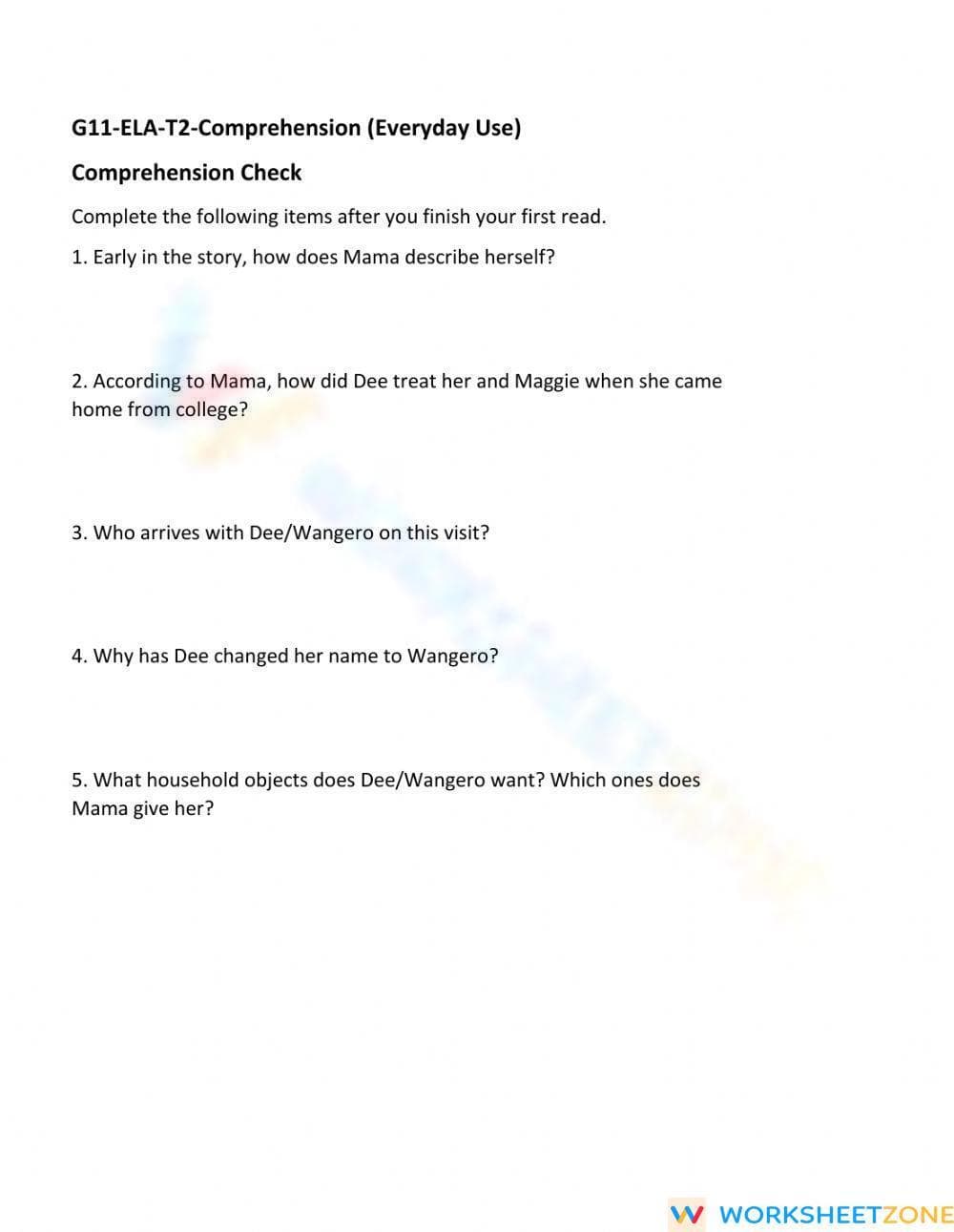
This Grade 11 literature worksheet provides a focused comprehension check for Alice Walker's short story "Everyday Use." Students engage with five critical thinking questions that require citing textual evidence and analyzing character motivations. By identifying key plot points and symbolic household objects, learners demonstrate mastery of complex narrative themes and character development.
At a Glance
- Grade: 11 · Subject: ELA
- Standard:
CCSS.ELA-LITERACY.RL.11-12.1— Cite strong textual evidence to support analysis of what the text says explicitly.- Skill Focus: Reading Comprehension & Analysis
- Format: 1 page · 5 problems · Answer key included · PDF
- Best For: Post-reading assessment and literature circles
- Time: 15–20 minutes
This single-page resource contains five open-ended comprehension questions designed for immediate use after the first reading of the story. The worksheet covers essential elements including character descriptions of Mama, Dee's treatment of her family, and the significance of specific household items. It features a clean, distraction-free layout and includes a complete answer key for efficient grading.
The three-step workflow ensures maximum efficiency: first, print the single-page PDF (30 seconds); second, distribute the copies to students for independent work (1 minute); and third, review the answers using the included key (5 minutes). This streamlined process requires less than two minutes of total teacher preparation, making it an ideal choice for unexpected sub plans or quick formative assessments.
The primary standard addressed is CCSS.ELA-LITERACY.RL.11-12.1, which requires students to cite strong and thorough textual evidence to support analysis of what the text says explicitly as well as inferences drawn from the text. Additionally, it supports RL.11-12.3 by analyzing authorial choices. Both standard codes can be copied directly into lesson plans, IEP goals, or district curriculum mapping tools.
Assign this worksheet immediately following a silent reading session or as a guided activity during a literature circle to ensure all students have captured the literal and inferential details of the text. Observe students as they identify symbolic objects to gauge their understanding of character motivation. Completion time is typically 15 to 20 minutes.
This resource is tailored for Grade 11 and 12 English Language Arts students, including those in AP Literature or honors-level courses. It provides necessary scaffolding for general education students while remaining rigorous enough for advanced learners. Pair this worksheet with an anchor chart on characterization or a primary text passage from Alice Walker’s short story collection for a comprehensive lesson.
Aligned with the CCSS.ELA-LITERACY.RL.11-12.1 standard, this reading comprehension resource focuses on the essential skill of citing textual evidence to support literary analysis. According to the RAND AIRS 2024 report on secondary literacy, structured comprehension checks are vital for bridging the gap between literal decoding and high-level inferential reasoning in Grade 11 students. By providing five targeted prompts centered on the narrative "Everyday Use," this worksheet facilitates a direct assessment of a student's ability to extract specific details about character motivation and symbolic importance. Research indicates that immediate post-reading tasks significantly improve long-term retention of narrative structures and thematic elements. This standalone summary confirms the resource's utility in high school literature programs, offering a validated method for tracking progress toward mastery of evidence-based analysis as defined by national college and career readiness standards.


