




























Views
Downloads
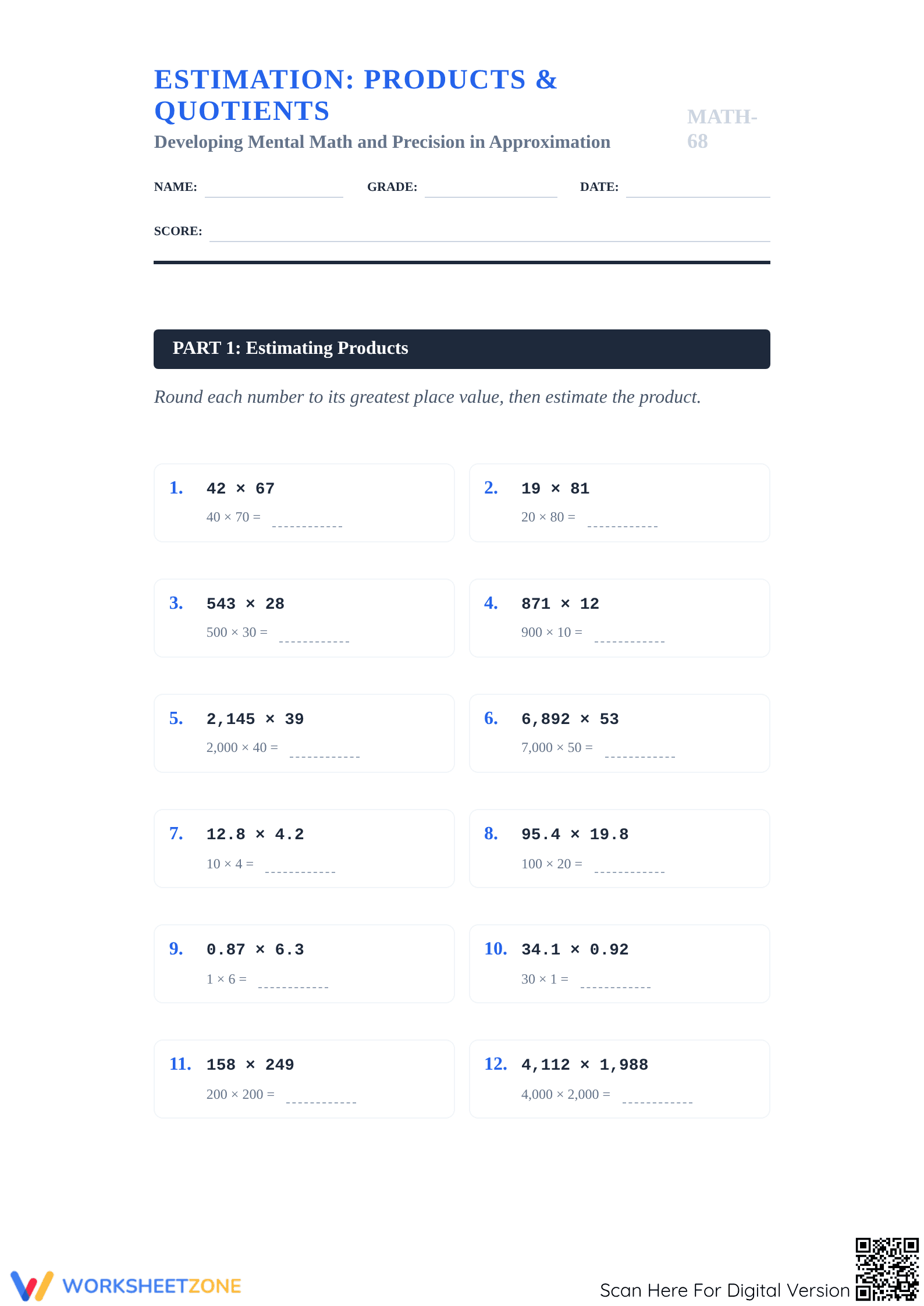
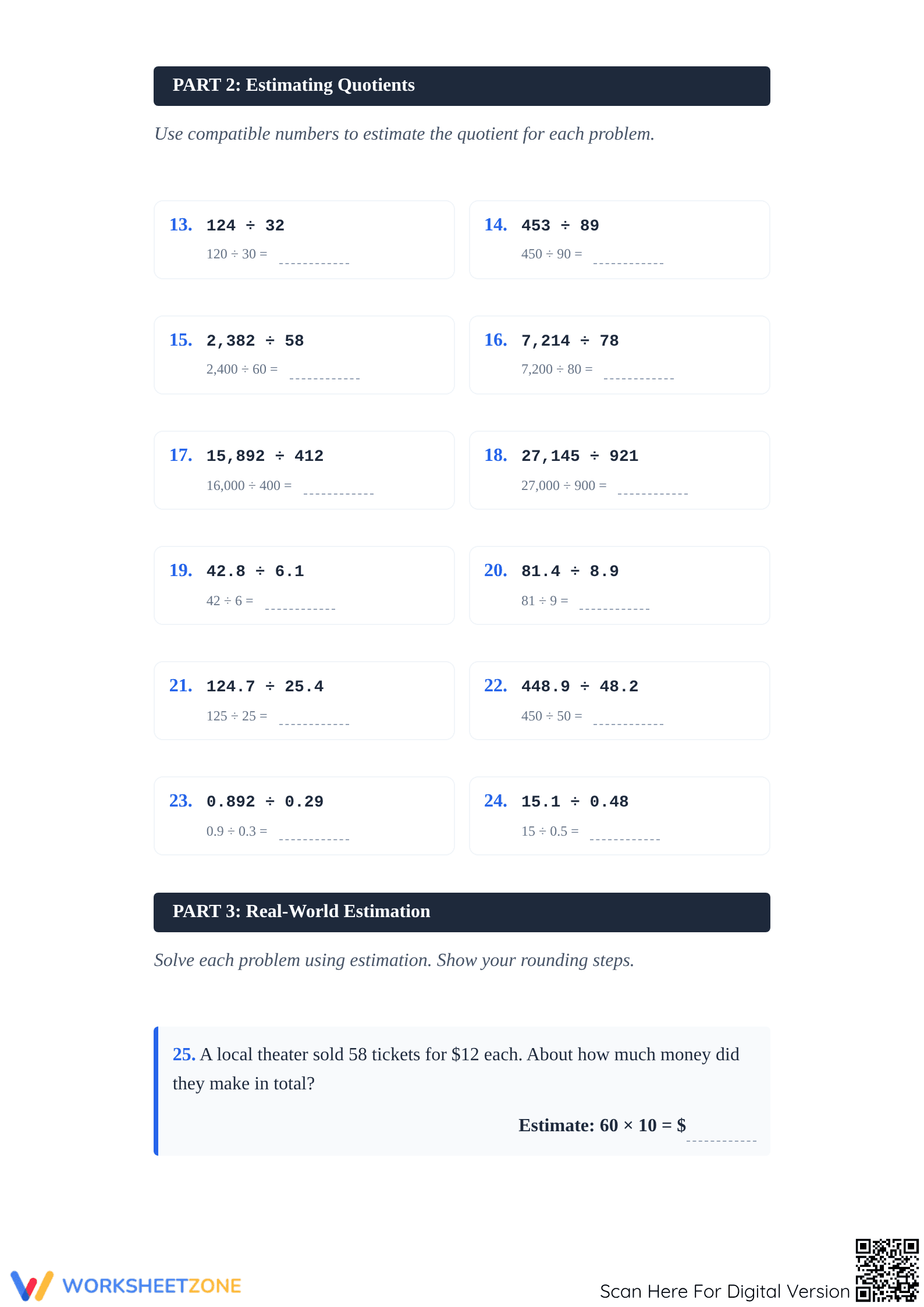
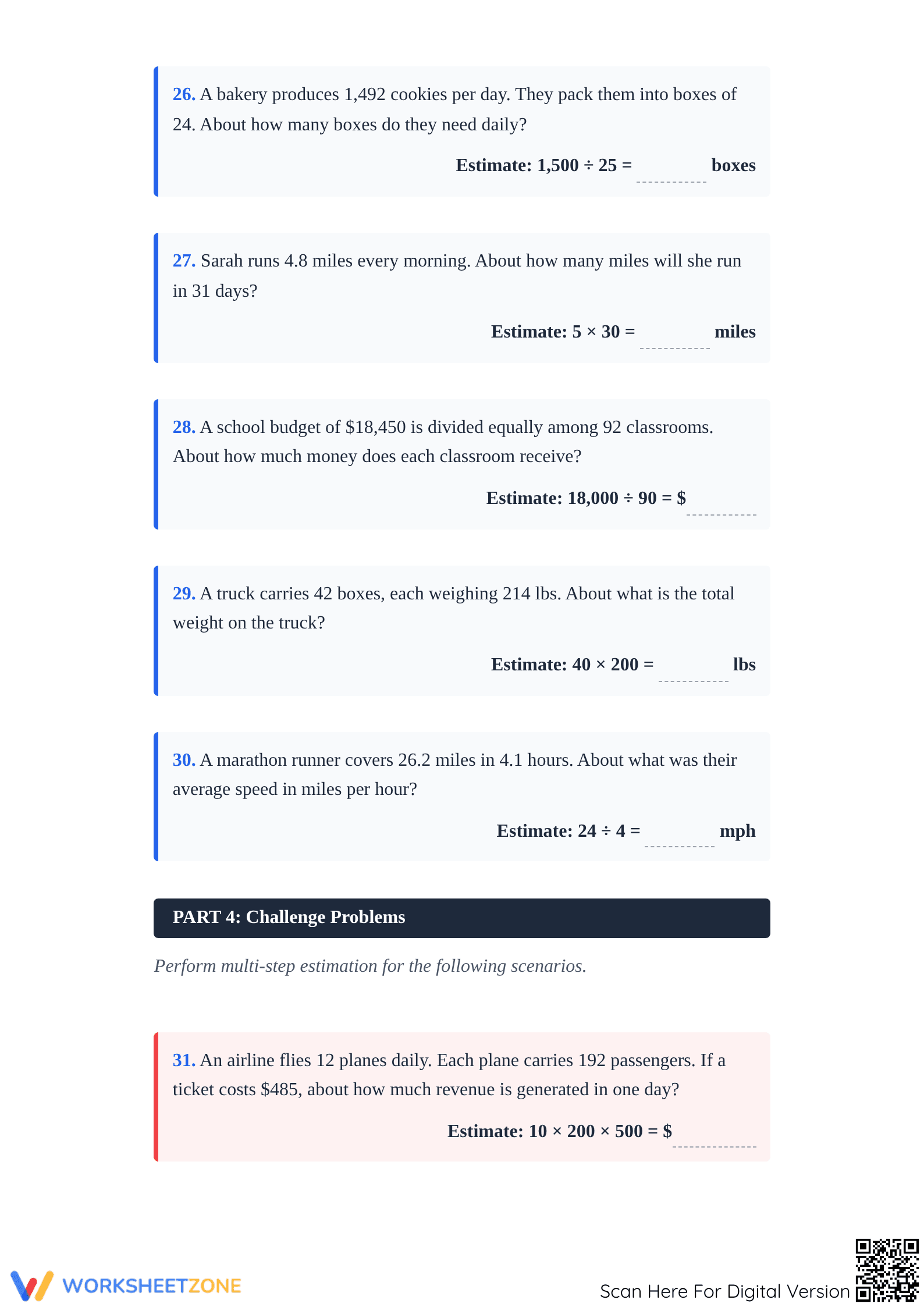
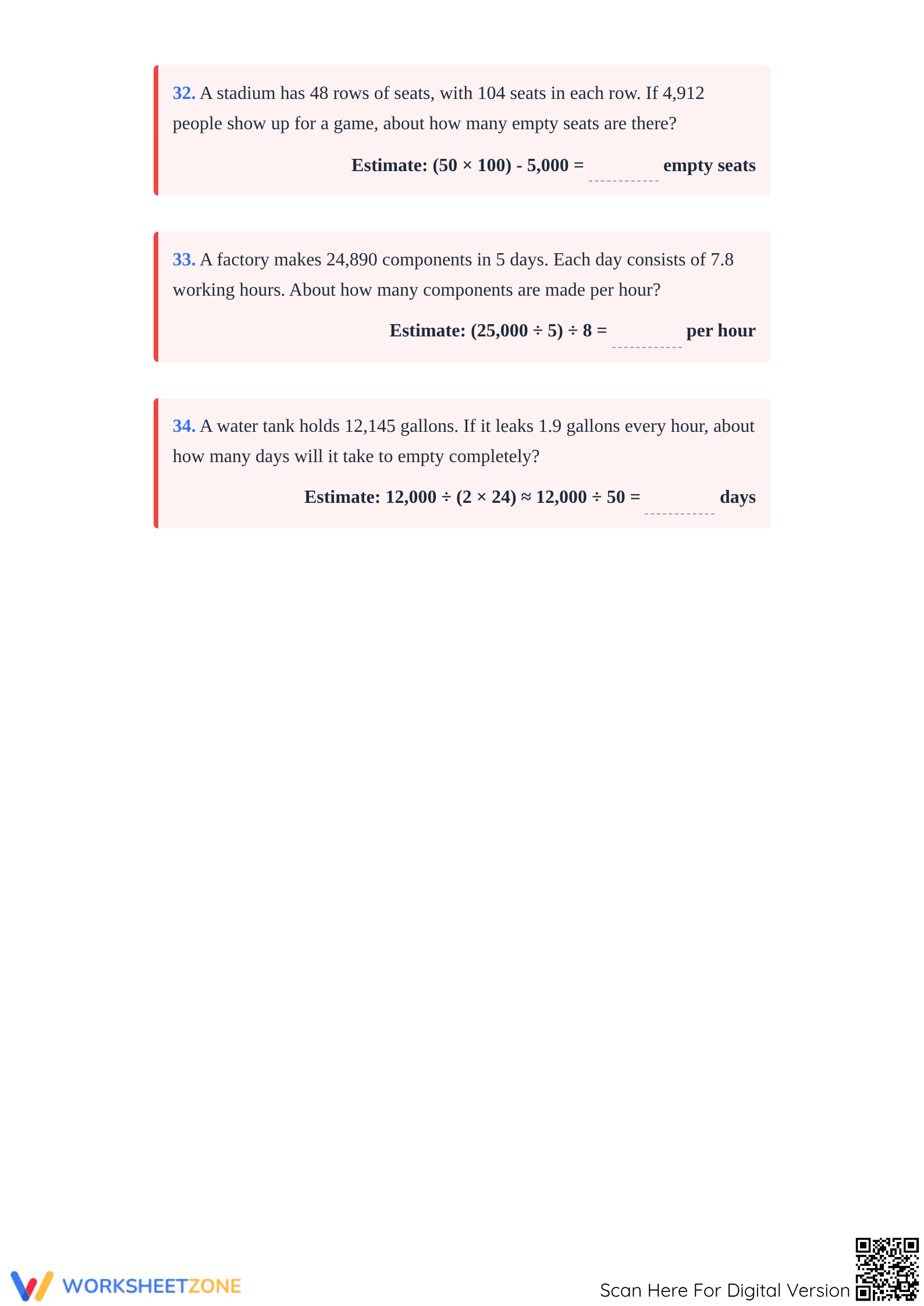

Printable Estimation Worksheet | Grade 8 Math

Paste this activity's link or code into your existing LMS (Google Classroom, Canvas, Teams, Schoology, Moodle, etc.).
Students can open and work on the activity right away, with no student login required.
You'll still be able to track student progress and results from your teacher account.
Mastering Math Estimation Skills
This Grade 8 math worksheet provides focused practice on the essential skill of estimating products and quotients. Students will work through a series of problems designed to build their number sense and ability to make reasonable calculations with whole numbers and decimals, strengthening their foundation for more complex algebraic concepts.
At a Glance
- Grade: 8 · Subject: Math
- Standard:
CCSS.MATH.CONTENT.8.NS.A.2— Use rational approximations to estimate the value of expressions.- Skill Focus: Estimation of Products and Quotients
- Format: 4 pages · 24 problems · Answer key included · PDF
- Best For: Independent practice, homework, formative assessment
- Time: 20–30 minutes
What's Inside
This resource contains a four-page PDF, including three pages of student-facing problems and a complete one-page answer key for easy grading. The worksheet features 24 distinct tasks that cover estimating products and quotients using various strategies. Problems are presented in multiple formats, including direct calculation and word problems, to ensure comprehensive practice.
A Clear Path to Skill Progression
This worksheet follows a gradual-release model to support student learning:
- Guided Practice: The initial problems involve rounding whole numbers and decimals to the nearest ten or whole number to estimate products and quotients, providing a clear starting point.
- Supported Practice: Subsequent tasks require students to apply these estimation skills to more complex scenarios, including multi-digit numbers and real-world word problems that demand careful interpretation.
- Independent Practice: The final section challenges students to solve a series of mixed problems, requiring them to flexibly apply different estimation strategies to find the most reasonable answer.
This "I Do, We Do, You Do" structure ensures students build confidence as they move towards mastery.
Standards Alignment
This worksheet is directly aligned with CCSS.MATH.CONTENT.8.NS.A.2, which requires students to "use rational approximations of irrational numbers... and estimate the value of expressions." While focusing on rational numbers, this worksheet builds the foundational estimation skills necessary for working with all types of numbers. The standard code can be copied directly into lesson plans or curriculum mapping tools.
How to Use It
This versatile worksheet is ideal for independent practice after a direct instruction lesson on estimation strategies. It can also serve as a homework assignment to reinforce the concept. For a formative assessment, observe students as they work through the first few problems. Note which students are rounding correctly and which are struggling to identify the appropriate place value, providing an opportunity for immediate reteaching. Expect students to complete the worksheet in approximately 20-30 minutes.
Who It's For
This resource is designed for Grade 8 math students but can be used for advanced 7th graders or as a review for 9th graders. The clear structure makes it accessible for most learners. To support struggling students, pair this worksheet with an anchor chart displaying rounding rules and worked examples. For an extension, have students calculate the actual product or quotient and find the difference from their estimate.
Developing strong number sense through estimation is a critical component of middle school mathematics. This worksheet supports CCSS.MATH.CONTENT.8.NS.A.2 by providing students with structured practice in estimating products and quotients. Proficiency in estimation is a key predictor of future success in algebra and higher-level math. This resource's design embodies the principle that effective practice moves from guided to independent work. By engaging with these 24 problems, students refine their ability to reason about numbers, a skill essential for problem-solving in academic and real-world applications. This targeted practice helps solidify a vital mathematical competency.


