


























Views
Downloads



CCSS.Math 6.NS.B.3 Worksheet: Computation — Grade 6 Aligned
Paste this activity's link or code into your existing LMS (Google Classroom, Canvas, Teams, Schoology, Moodle, etc.).
Students can open and work on the activity right away, with no student login required.
You'll still be able to track student progress and results from your teacher account.
This computation quiz for Grades 5-6 offers a robust assessment of mathematical fluency. It targets key number system skills, including multi-digit operations, decimal and fraction arithmetic, and percentages. Students demonstrate their ability to apply standard algorithms accurately across 25 distinct problems.
At a Glance
- Grade: 5–6 · Subject: Math
- Standard:
CCSS.MATH.CONTENT.6.NS.B.3— Fluently add, subtract, multiply, and divide multi-digit decimals using the standard algorithm.- Skill Focus: Computation Fluency
- Format: 5 pages · 25 problems · Answer key included · PDF
- Best For: Summative assessment, unit review, fluency check
- Time: 40–55 minutes
What's Inside
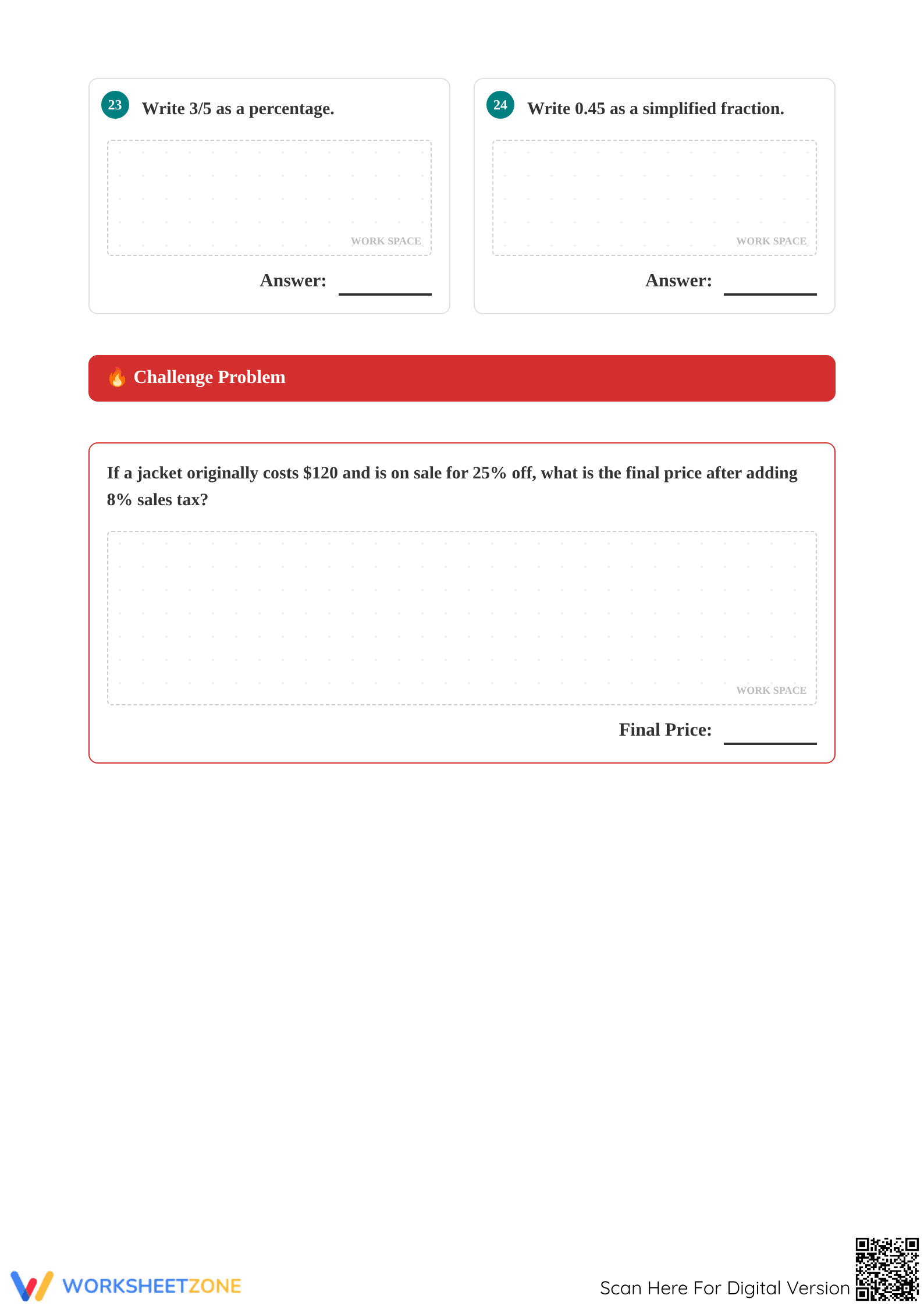
This five-page resource is a formal mathematics assessment. It contains 25 problems divided into four parts: Multi-digit Operations, Decimals, Fractions, and Mixed Skills (percentages, order of operations). A workspace is provided for each problem, and a complete answer key is included for efficient grading.
Evidence of Mastery
This assessment provides clear evidence of mastery for key Grade 5-6 computation standards, mapping to fluency expectations like CCSS.MATH.CONTENT.6.NS.B.3.
- Approaching: Student may complete whole number problems but struggle with fractions or multi-step challenges.
- Meeting: Student accurately solves problems across all number types using standard algorithms.
- Exceeding: Student efficiently solves all problems, including the final multi-step percentage challenge.
Scores can be entered into standards-based gradebooks or used as data for IEP progress monitoring.
Standards Alignment
This worksheet is primarily aligned to Common Core standard CCSS.MATH.CONTENT.6.NS.B.3 ("Fluently add, subtract, multiply, and divide multi-digit decimals..."). It also assesses supporting standards like 5.NBT.B.5 (multiplication) and 5.NF.A.1 (fractions). Standard codes can be copied directly into lesson plans, IEPs, or curriculum maps.
How to Use It
Use this as a summative assessment or a beginning-of-year diagnostic. Administer in one 40-55 minute session to gauge fluency. For formative data, observe students' use of standard algorithms. It's also effective for targeted reteaching; have students identify their two most challenging problems for small group review.
Who It's For
Ideal for Grade 5 students needing a challenge, Grade 6 students on-level, or Grade 7 students for review. To support learners, consider allowing a multiplication chart for the first section. This assessment pairs well with an anchor chart detailing the steps for the standard algorithm for long division.
This computation assessment offers a reliable measure of student fluency, a critical proficiency component noted by the National Assessment of Educational Progress (NAEP). Its structure, aligned with CCSS.MATH.CONTENT.6.NS.B.3, develops procedural fluency from conceptual understanding. Research from Fisher & Frey (2014) highlights the importance of moving students toward independent practice, a process this quiz evaluates. By assessing whole numbers, decimals, and fractions in one cohesive tool, educators can gather actionable data on number system mastery. This data is essential for planning targeted interventions and preparing learners for complex algebraic concepts where computational fluency is a prerequisite for success.


