




























Views
Downloads




Essential Volume & Surface Area Worksheet | Grade 6 Math

Paste this activity's link or code into your existing LMS (Google Classroom, Canvas, Teams, Schoology, Moodle, etc.).
Students can open and work on the activity right away, with no student login required.
You'll still be able to track student progress and results from your teacher account.
This Grade 6 math worksheet strengthens spatial reasoning and computation by challenging students to calculate the volume and surface area of right rectangular prisms with fractional edge lengths. Through realistic packaging and storage scenarios, learners differentiate between interior capacity and exterior wrapping while mastering fraction multiplication.
At a Glance
- Grade: 6 · Subject: Math
- Standard: Solve real-world and mathematical problems involving fractional-edge volume and surface area
- Skill Focus: Fractional-Edge Volume and Surface Area
- Format: 5 pages · 16 problems · Answer key included · PDF
- Best For: Geometry skill practice and packaging applications
- Time: 45–60 minutes
What's Inside
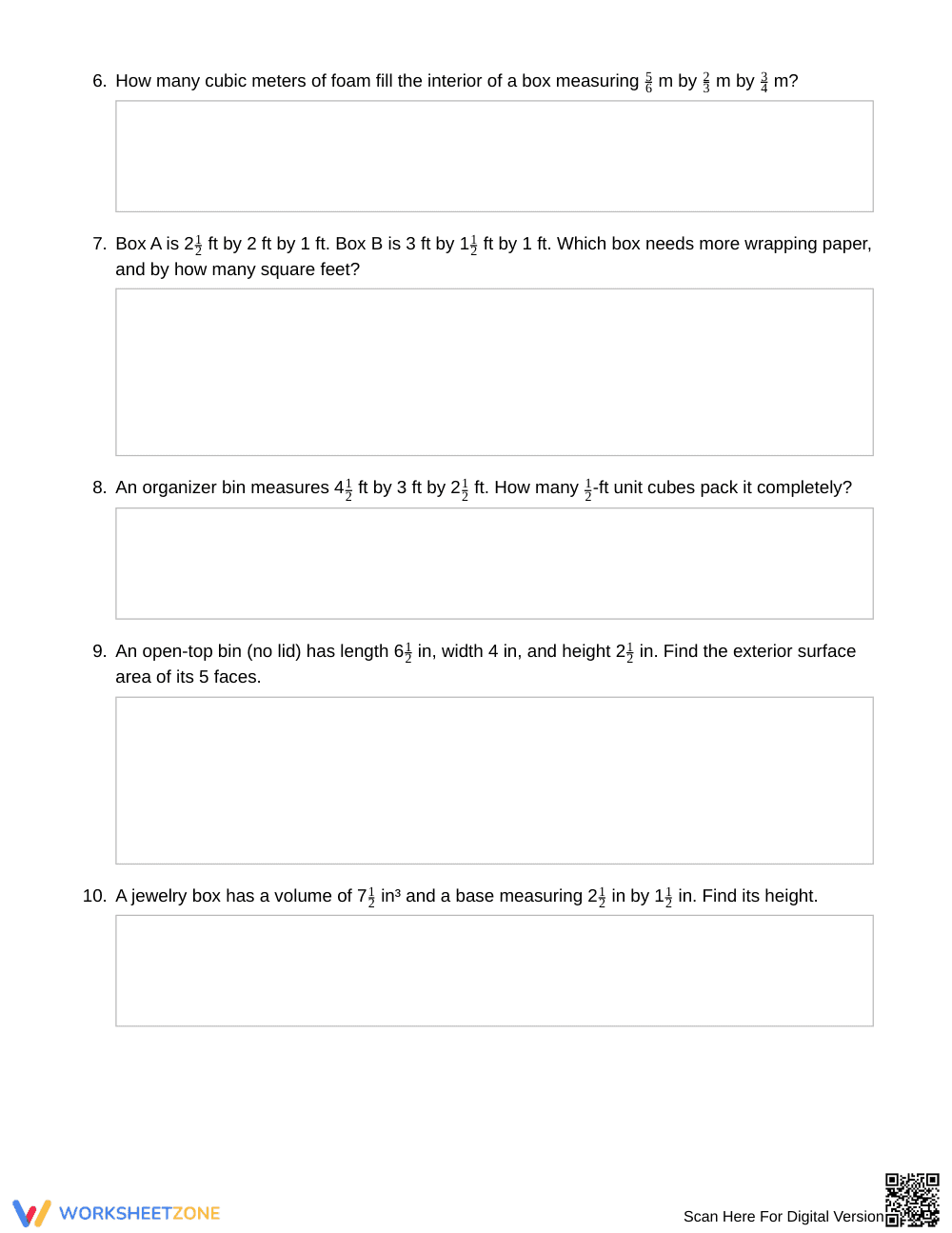
This 5-page printable resource delivers 16 rigorous math tasks organized into three distinct sections. It begins with a dedicated packaging formula reference box covering both standard formulas and unit-fraction cube packing logic. The activity includes visual diagrams, contextual word problems, comparison questions, missing-dimension calculations, and a comprehensive 2-page answer key.
Skill Progression
- Guided Practice (Part A, 4 tasks): Students unpack foundational concepts using unit-fraction cubes, compute basic surface areas, and identify whether real-world scenarios require volume or exterior area.
- Supported Practice (Part B, 8 tasks): Learners choose the correct geometric method, calculate storage capacity, compare different box dimensions, and solve for missing dimensions with rational numbers.
- Independent Practice (Part C, 4 tasks): Students tackle multi-step synthesis applications, comparing material efficiency across equal-volume cartons and calculating crate capacities.
This structured progression follows the gradual-release framework, moving students systematically from concrete unit packing to complex geometric problem-solving.
Standards Alignment
This resource aligns with Grade 6 geometry standards for finding the volume of right rectangular prisms with fractional edge lengths by packing them with unit cubes and applying standard volume formulas, as well as representing three-dimensional figures to determine total surface area. Both standard descriptions can be copied directly into lesson plans, IEP goals, or district curriculum mapping tools.
How to Use It
Deploy this worksheet during the mid-unit phase of your geometry instruction after introducing fractional operations and prism nets. It works effectively for guided small-group instruction or as an independent review station. For formative assessment, observe whether students confuse square and cubic unit labels when calculating surface area versus volume. Expected completion time is 45 to 60 minutes across one or two class periods.
Who It's For
Designed for Grade 6 mathematics classrooms, this activity supports general education students, remedial intervention groups, and accelerated Grade 5 learners. Pair this printable with physical unit cubes, hands-on folding nets, or anchor charts detailing fraction multiplication strategies to provide multisensory scaffolding for developing mathematicians.
Mastering three-dimensional geometric measurement with rational dimensions represents a critical milestone in Grade 6 mathematics. When students evaluate rectangular prisms using fractional edge lengths, they synthesize fraction multiplication with spatial volume and surface area concepts. According to research from Fisher & Frey (2014) on the gradual release of responsibility framework, structured instructional progressions that guide students from visual unit-fraction packing models to complex, multi-step comparative word problems significantly enhance mathematical reasoning and procedural fluency. This 5-page instructional worksheet provides 16 targeted tasks that scaffold method selection, correct unit identification, and real-world packaging calculations. By systematically distinguishing between interior storage capacity in cubic units and exterior cardboard surface area in square units, learners develop the robust geometric reasoning needed to succeed in advanced middle school mathematics and real-world problem-solving across applied contexts.


