




























Views
Downloads



Essential Vague This or That Worksheet | Grade 6 ELA

Paste this activity's link or code into your existing LMS (Google Classroom, Canvas, Teams, Schoology, Moodle, etc.).
Students can open and work on the activity right away, with no student login required.
You'll still be able to track student progress and results from your teacher account.
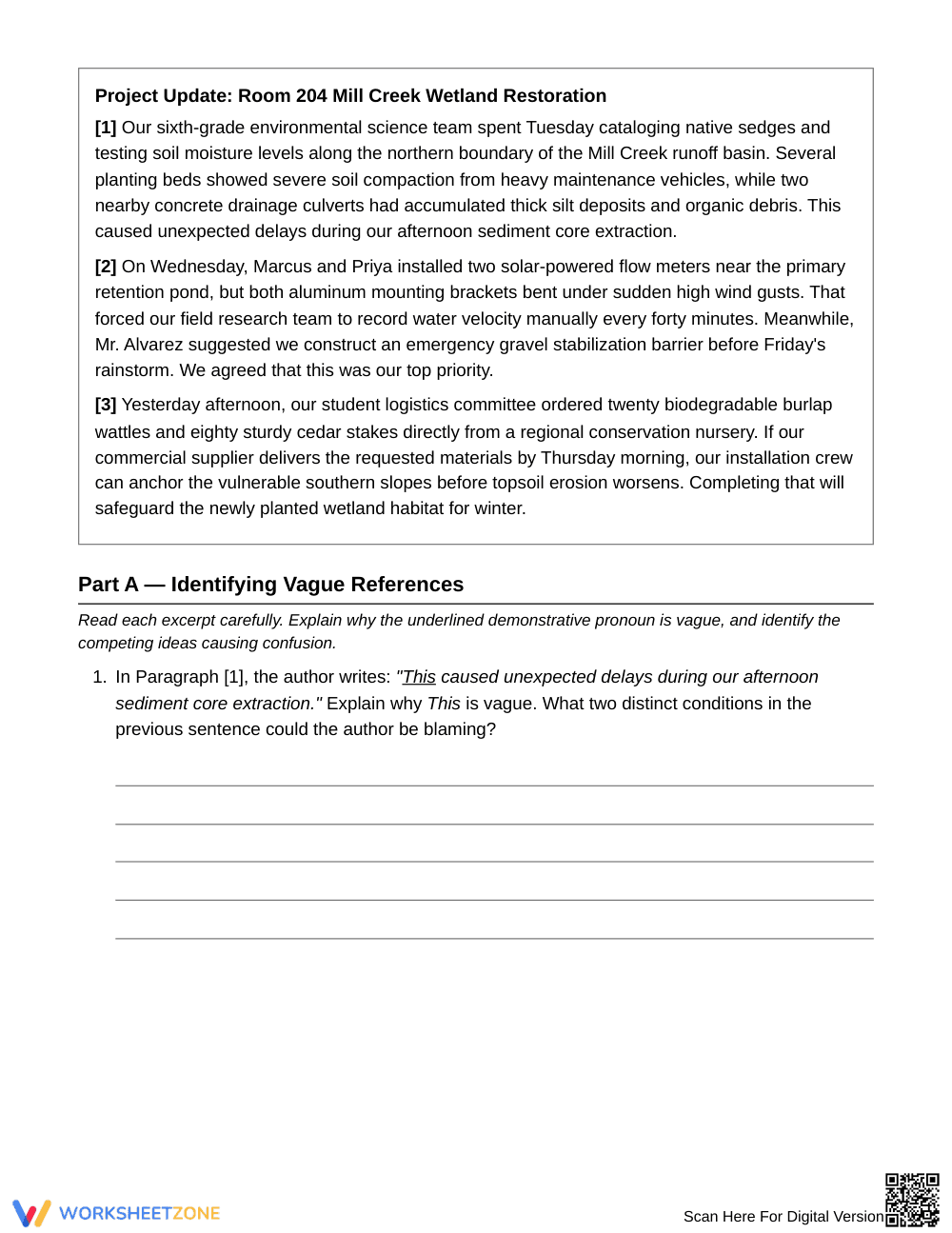
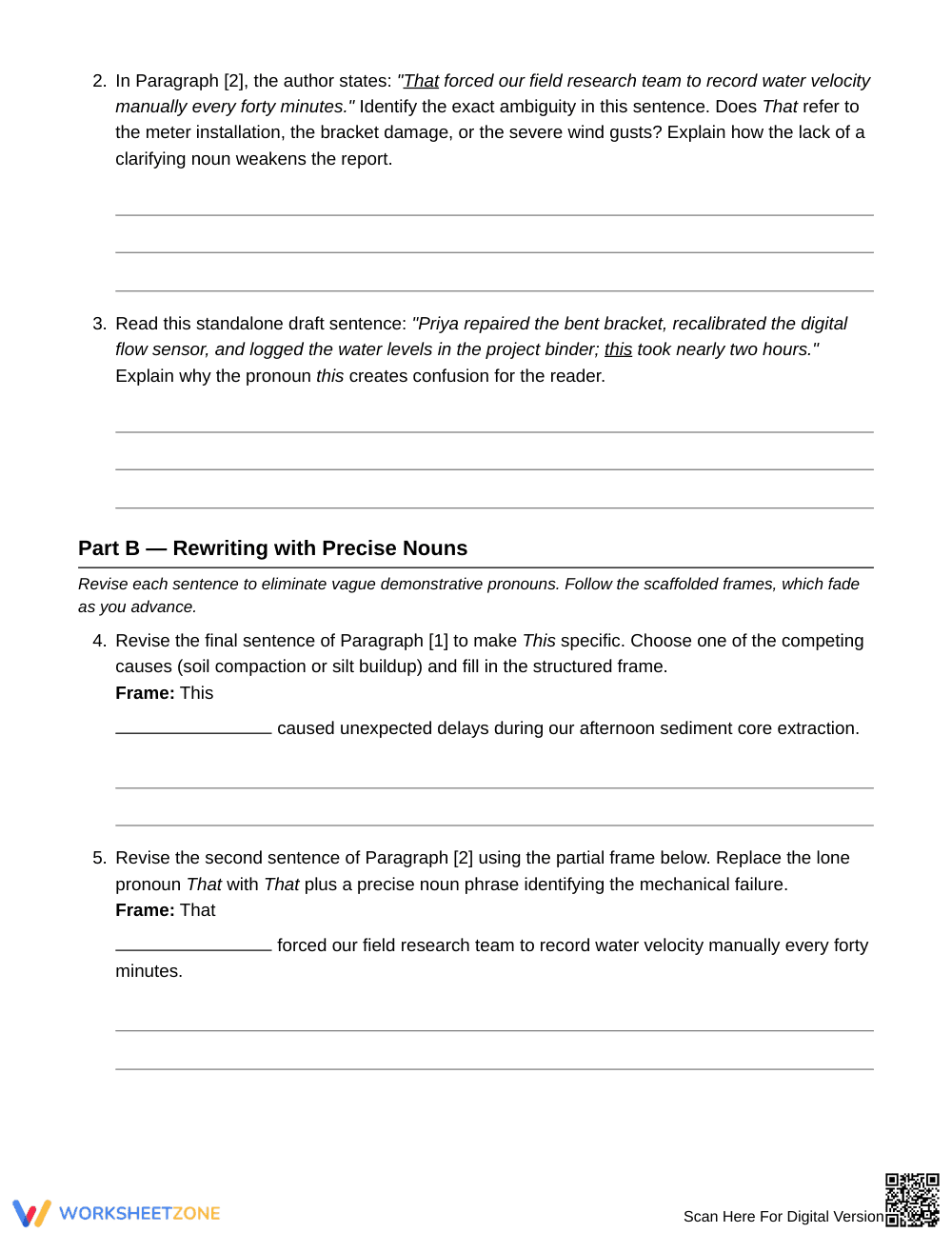
Eliminate ambiguous demonstrative pronouns in student writing with targeted grammar practice. This Grade 6 ELA worksheet guides learners through identifying unclear references, revising isolated pronouns into precise noun phrases, and evaluating clear antecedents using an authentic environmental science project update.
At a Glance
- Grade: 6 · Subject: ELA
- Standard:
L.6.1.d— Recognize and correct vague pronouns that lack clear, direct antecedents- Skill Focus: Replacing vague demonstrative pronouns
- Format: 5 pages · 12 problems · Answer key included · PDF
- Best For: Targeted grammar practice and revision
- Time: 25–35 minutes
What's Inside
This 5-page printable resource delivers 12 rigorous tasks structured around a contextual narrative about a wetland restoration project. Students examine real-world drafts to pinpoint ambiguous demonstratives, rewrite sentences using structured sentence frames that gradually fade into independent revisions, and justify grammatically sound uses. A comprehensive 3-page answer key provides complete model explanations and sample student revisions for efficient grading.
Skill Progression
- Guided Practice (Part A, 3 tasks): Students analyze authentic text excerpts with high scaffold support, identifying competing antecedents and explaining why solitary demonstratives create reader confusion.
- Supported Practice (Part B, 6 tasks): Learners revise ambiguous sentences using structured sentence frames, converting lone pronouns into demonstrative determiners paired with precise clarifying nouns before transitioning to unassisted sentence rewrites.
- Independent Practice (Part C, 3 tasks): Students evaluate nuanced draft sentences independently, distinguishing between genuinely vague pronouns and clear demonstrative references with single, explicit antecedents.
This systematic structure mirrors the gradual release of responsibility model, ensuring students master pronoun clarity before applying the skill autonomously.
Standards Alignment
This resource aligns directly with Common Core State Standard L.6.1.d: "Recognize and correct vague pronouns (i.e., ones with unclear or ambiguous antecedents)." Students practice converting broad demonstrative pronouns into explicit noun phrases across complex sentences. Both standard codes can be copied directly into lesson plans, IEP goals, or district curriculum mapping tools.
How to Use It
Deploy this worksheet after direct instruction on demonstrative determiners and pronoun-antecedent agreement. For formative assessment, observe whether students merely swap pronouns or supply accurate, content-specific nouns in Part B. Expected completion time is 25 to 35 minutes during an independent writing lab or small-group revision workshop.
Who It's For
Designed for sixth-grade general education students, this resource also supports English language learners and striving writers needing structured syntactic scaffolds. Pair this activity with an informational writing draft or an editing anchor chart on pronoun clarity.
Targeted sentence-level grammar instruction produces measurable gains in middle school writing precision. According to Fisher & Frey (2014), scaffolded practice that moves systematically from guided analysis to independent production establishes durable syntactic control. This worksheet addresses CCSS standard L.6.1.d by teaching students to recognize and correct vague pronouns, specifically ambiguous uses of this and that. By requiring students to diagnose competing antecedents in context and supply clarifying nouns, the 12 structured tasks foster metacognitive awareness during drafting and revision. Research demonstrates that isolating pronoun-antecedent ambiguity within authentic informational texts transfers directly to student writing quality, reducing reader confusion and reinforcing expository coherence.


