


























Views
Downloads



Essential Tracing Imagery Worksheet | Grade 8 ELA
Paste this activity's link or code into your existing LMS (Google Classroom, Canvas, Teams, Schoology, Moodle, etc.).
Students can open and work on the activity right away, with no student login required.
You'll still be able to track student progress and results from your teacher account.
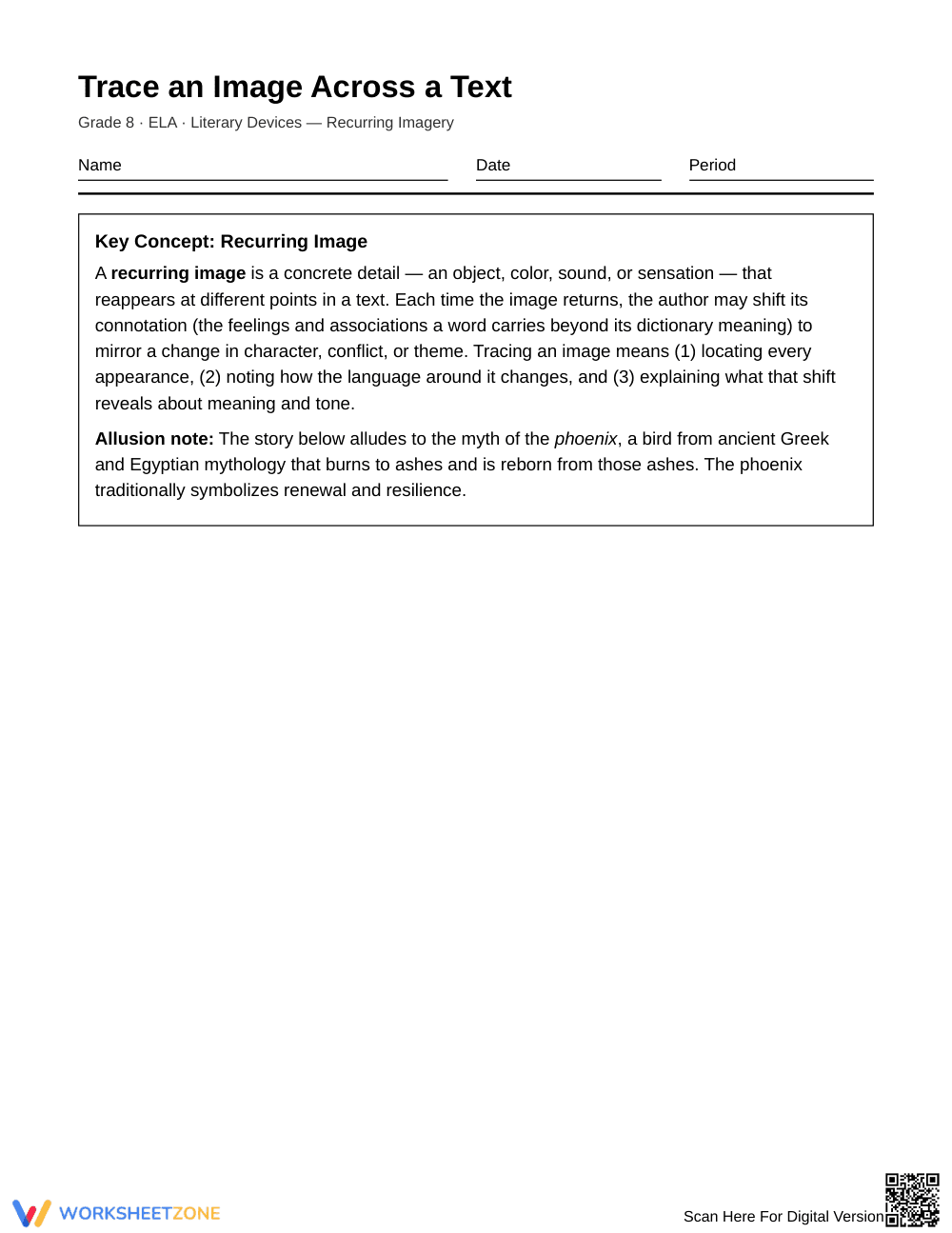
This Grade 8 ELA worksheet teaches students to trace recurring imagery across a text to analyze shifts in tone and theme. Working with the anchor story "The Courtyard," students track how an image's connotation evolves across four key moments to reveal deeper character conflict and thematic meaning.
At a Glance
- Grade: 8 · Subject: ELA
- Standard:
RL.8.4— Determine figurative and connotative word meanings and analyze impact on tone- Skill Focus: Tracing recurring imagery and connotation shifts
- Format: 6 pages · 10 problems · Answer key included · PDF
- Best For: Motif analysis and close reading practice
- Time: 40–50 minutes
This 6-page resource features a complete anchor narrative, a key concept box defining recurring imagery and phoenix allusions, and an annotated model. Students complete 10 text-dependent questions across three progressive sections, supported by a 4-page comprehensive answer key.
Skill Progression
- Guided practice: Part A includes 3 scaffolded tasks requiring students to cite specific appearances of the blossom image and explain connotation shifts.
- Supported practice: Part B provides 5 analytical questions examining image progression, allusion, and thematic connections.
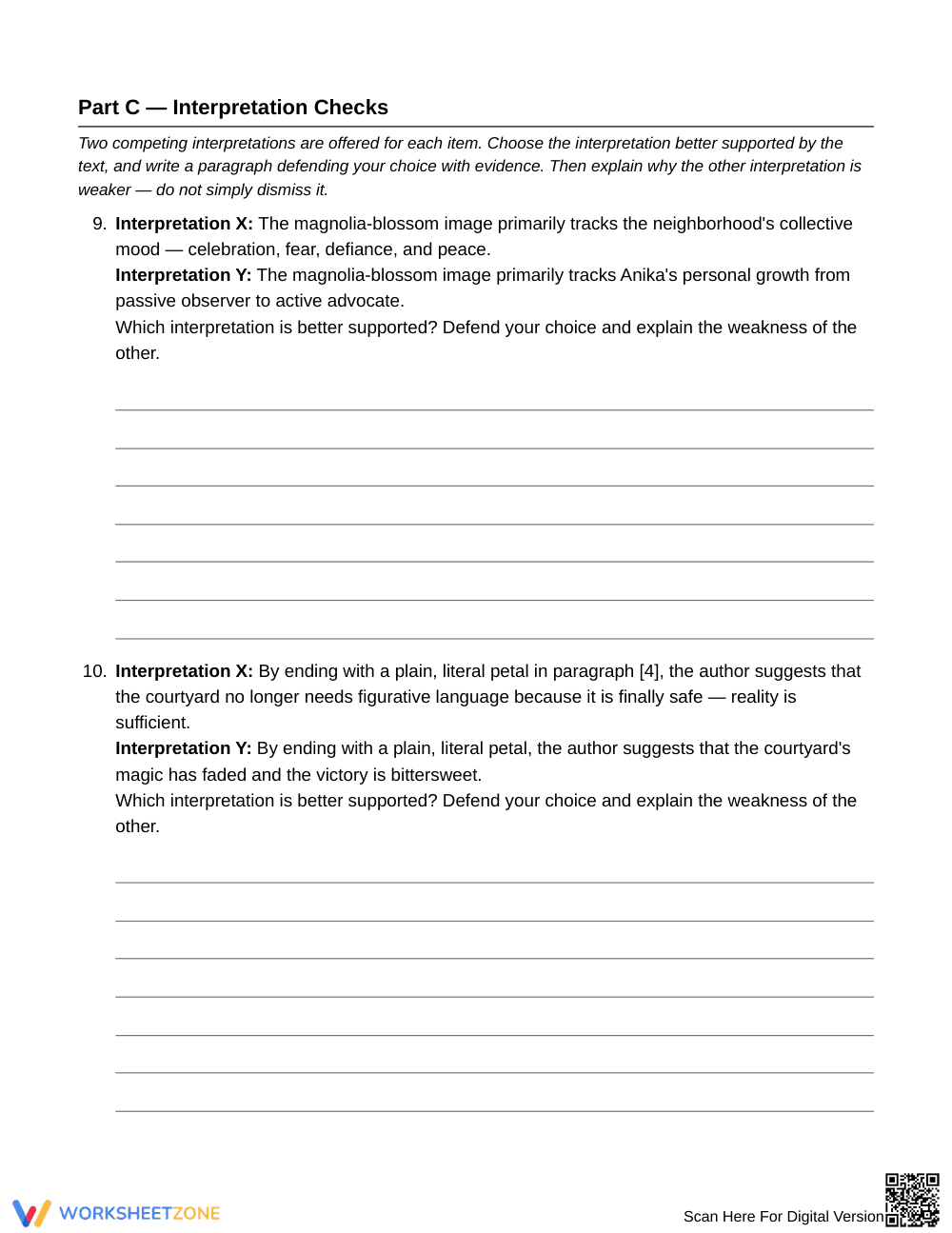
- Independent practice: Part C offers 2 interpretation checks where students evaluate competing arguments and defend claims with text evidence.
This sequence implements the gradual release of responsibility model to move learners from identification to evaluation.
Standards Alignment
This worksheet aligns with `RL.8.4`: "Determine the meaning of words and phrases as they are used in a text, including figurative and connotative meanings; analyze the impact of specific word choices on meaning and tone." It also supports `RL.8.1` through evidence citation. Both standard codes can be copied directly into lesson plans, IEP goals, or district curriculum mapping tools.
How to Use It
Use this worksheet after direct instruction on figurative language. Have students read the text and review the model annotation before completing Part A in pairs (20 minutes). Assign Parts B and C for independent analysis (25 minutes). For formative assessment, check if students grasp the connotation shift when the petal bruises brown in paragraph 2. Expected completion time is 40 to 50 minutes.
Who It's For
This resource serves Grade 8 ELA classrooms, advanced Grade 7 readers, and high school intervention groups needing motif analysis practice. Support developing readers with the annotated model or challenge advanced students to draft alternate image endings. Pair this activity with anchor lessons on literary devices or extended novel studies.
Middle school readers often struggle to interpret how authors develop figurative language across an entire narrative rather than within isolated sentences. According to Fisher & Frey (2014), structured instructional routines that pair clear teacher modeling with guided and independent text-dependent questioning significantly improve students' ability to evaluate complex literary craft. This worksheet directly operationalizes standard RL.8.4 by teaching eighth graders to determine figurative and connotative meanings as recurring images evolve across a text. Through 10 rigorous tasks based on an original anchor story, students examine how shifts in imagery reflect developing character conflicts, neighborhood themes, and mythological allusions. By requiring learners to defend competing analytical interpretations using cited evidence, the resource reinforces critical reading benchmarks measured on state assessments. This deliberate practice fosters the analytical independence students need for secondary literature courses.


