




























Views
Downloads

Essential Tone Shift Worksheet | Grade 10 English II

Paste this activity's link or code into your existing LMS (Google Classroom, Canvas, Teams, Schoology, Moodle, etc.).
Students can open and work on the activity right away, with no student login required.
You'll still be able to track student progress and results from your teacher account.
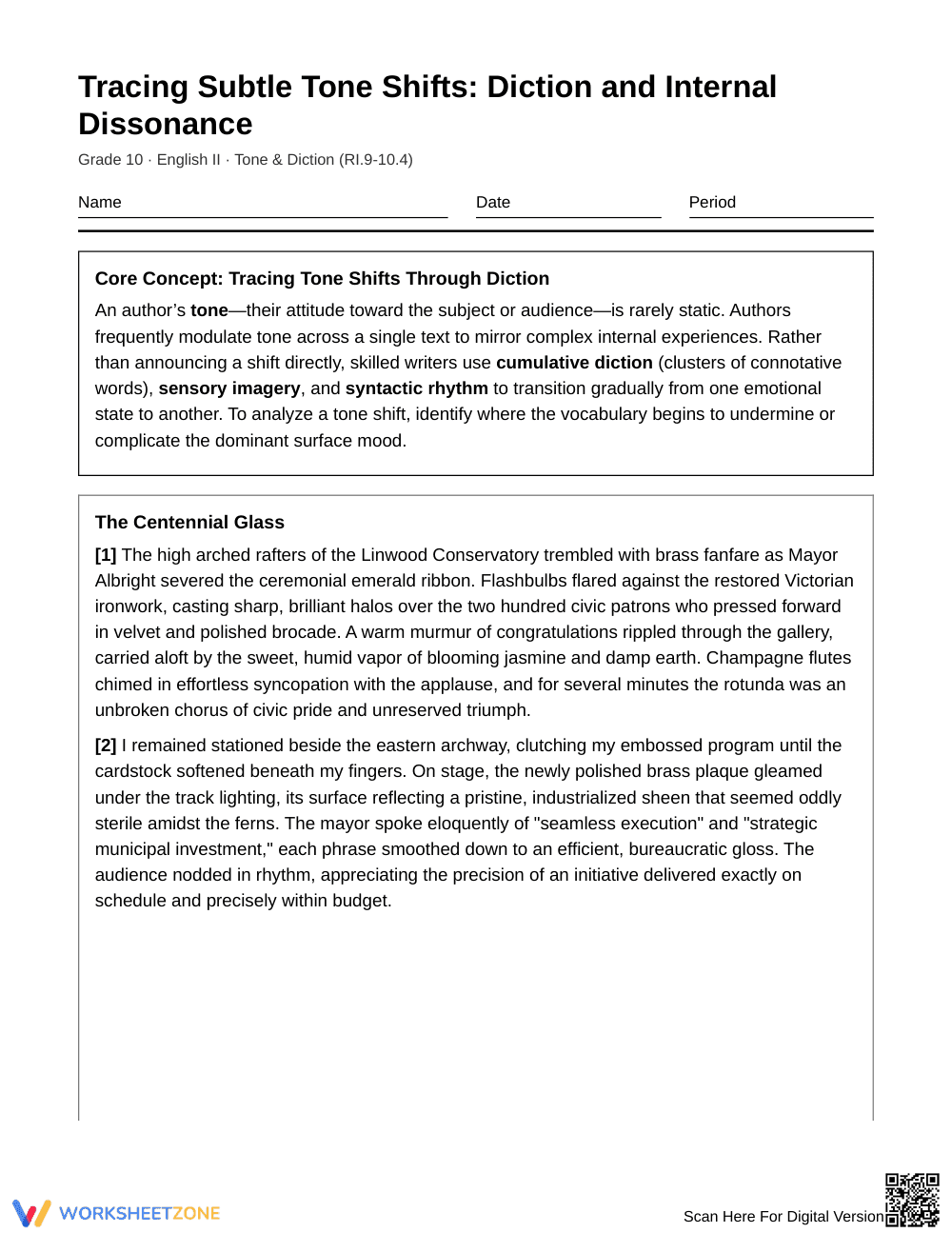
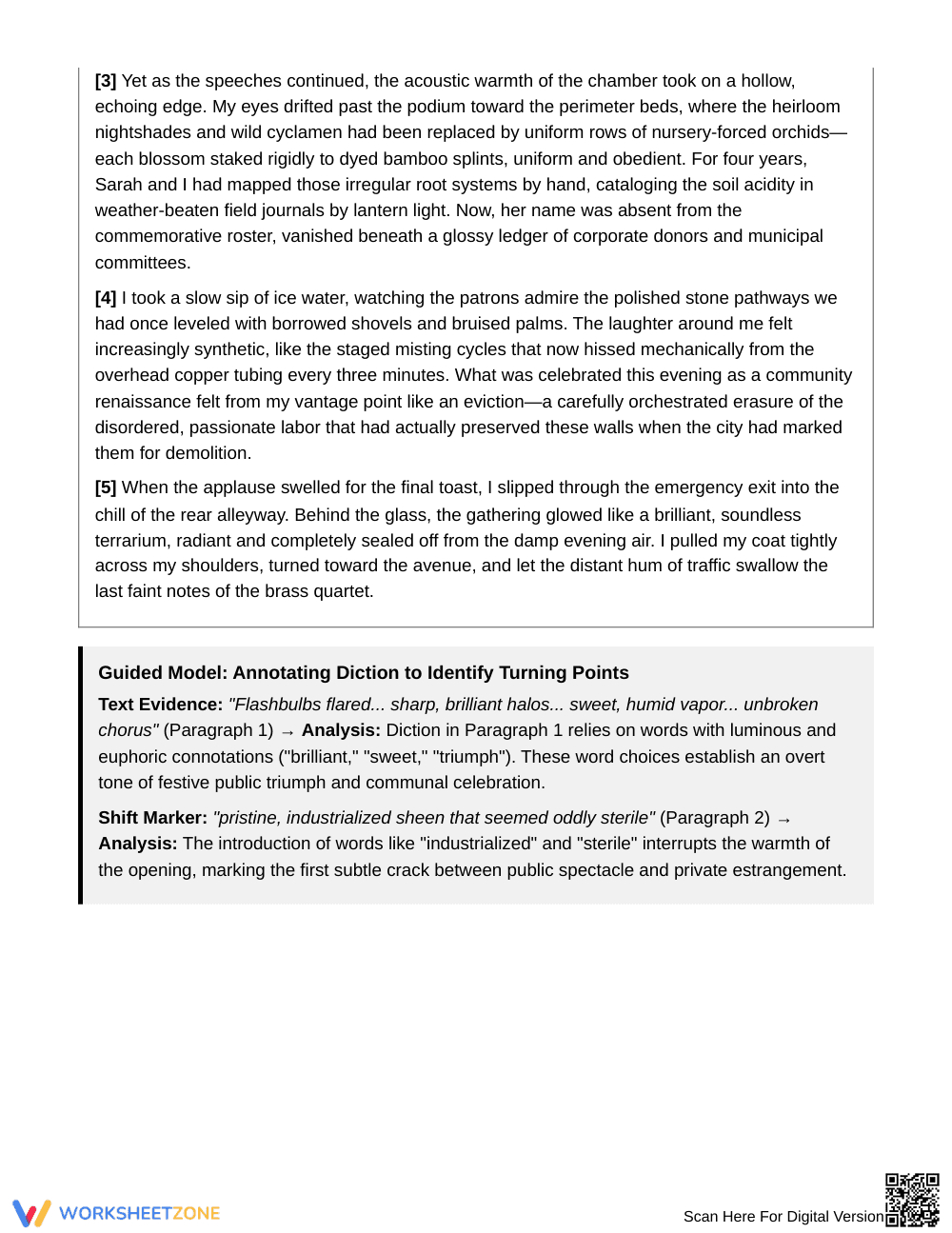
This high school English worksheet equips students to analyze how cumulative diction, sensory imagery, and internal dissonance produce nuanced tonal shifts across complex literary nonfiction. High school readers examine an original narrative passage, identifying where subtle vocabulary choices disrupt an initial celebratory mood to reveal deeper personal estrangement and critique.
At a Glance
- Grade: 10 · Subject: English II
- Standard:
RI.9-10.4— Determine the meaning of words and phrases, analyzing how word choices establish tone- Skill Focus: Tracing subtle tone shifts through diction
- Format: 6 pages · 10 problems · Answer key included · PDF
- Best For: Close reading instruction and rhetorical analysis practice
- Time: 40–50 minutes
What's Inside
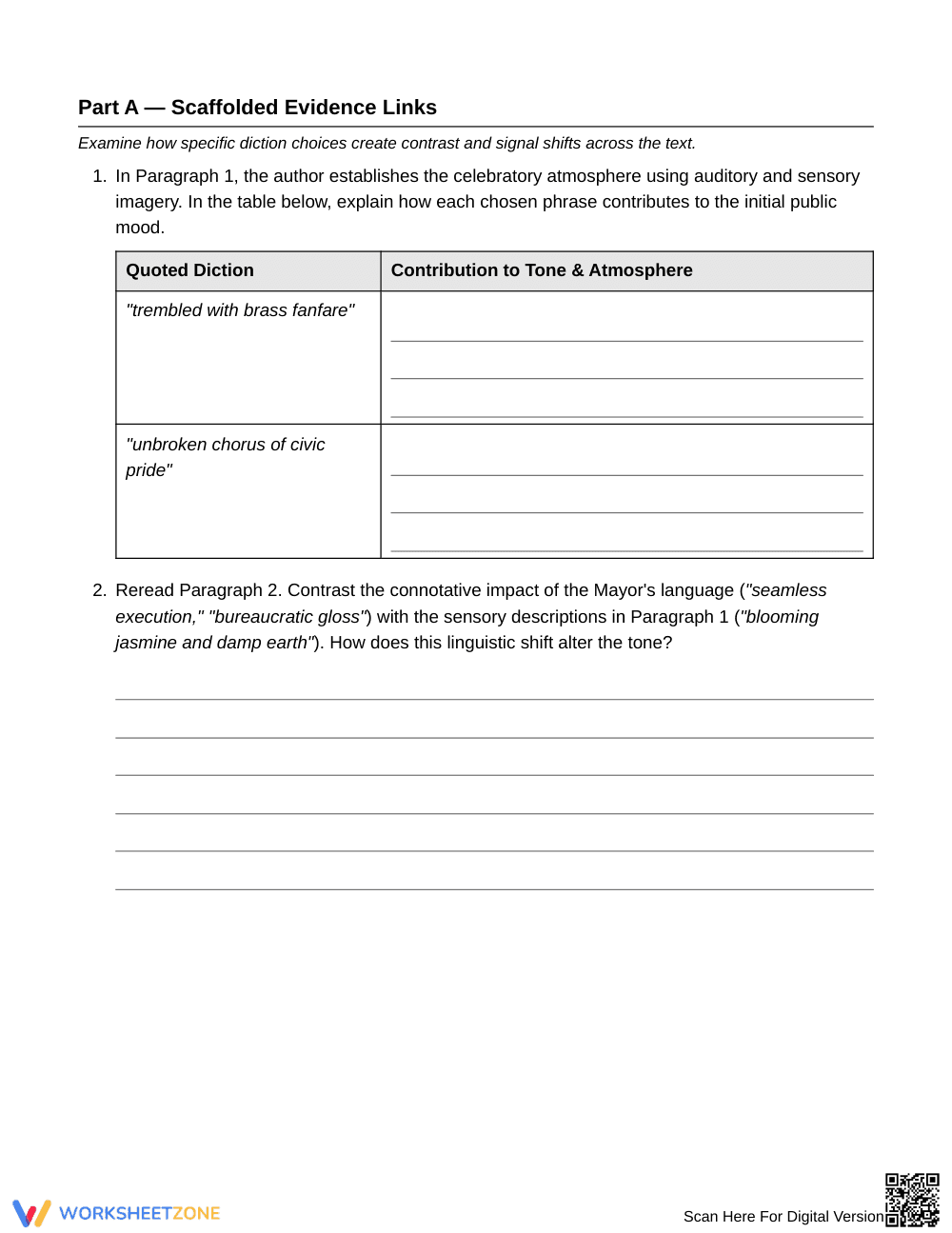
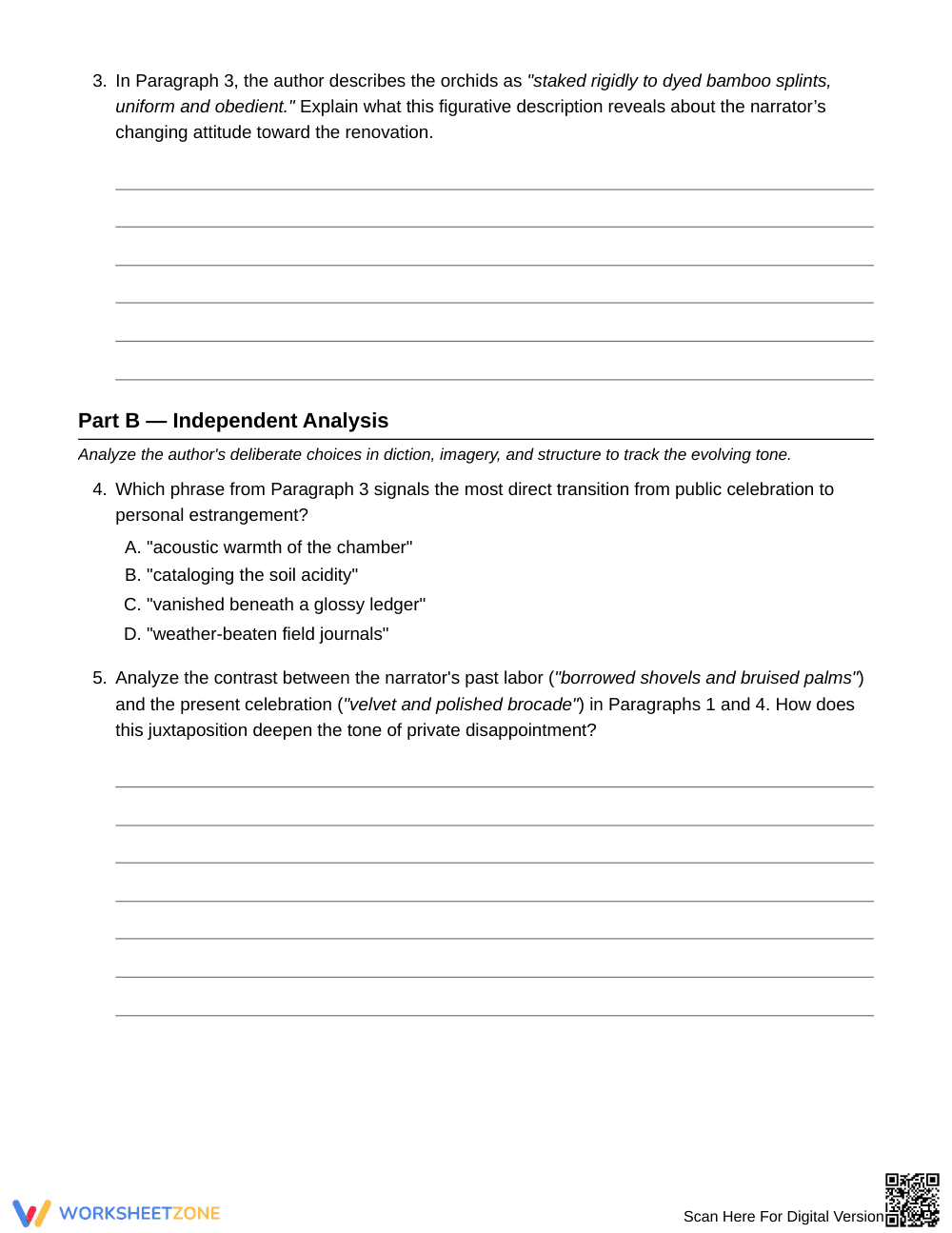
The 6-page printable resource centers on an original multi-paragraph passage, featuring a dedicated core concept anchor box and an explicit worked annotation model. Students complete 10 analytical prompts divided into scaffolded evidence tables, selected and short-response tracking questions, and multi-paragraph synthesis checks. A complete 3-page teacher answer key provides thorough sample responses and textual evidence.
Skill Progression
- Guided Practice: A core concept box defines cumulative diction and internal dissonance, paired with a two-part worked model demonstrating how to spot turning points between euphoric and sterile language.
- Supported Practice (Part A): Three scaffolded evidence links require students to complete a sensory imagery table and contrast juxtaposed municipal language against natural imagery across paragraphs 1 through 3.
- Independent Practice (Parts B & C): Seven rigorous analytical items guide students through multiple-choice transition identification, mechanical simile analysis, counterargument construction, and full developmental arc mapping.
This structured progression reflects the gradual release of responsibility model, moving students systematically from supported phrase-level observation to independent, comprehensive tone tracking.
Standards Alignment
This resource aligns directly to `RI.9-10.4`: Determine the meaning of words and phrases as they are used in a text, including figurative, connotative, and technical meanings, and analyze the cumulative impact of specific word choices on meaning and tone. It also supports `RL.9-10.1` by requiring students to cite strong and thorough textual evidence to support complex literary inferences. Both standard codes can be copied directly into lesson plans, IEP goals, or district curriculum mapping tools.
How to Use It
Deploy this worksheet immediately after direct instruction on connotative diction and tonal complexity. For formative assessment, monitor Part A to ensure students recognize how words like "industrialized" signal an emotional shift before they begin independent analysis in Part B. It also serves effectively as a focused paired-text activity or remediation assignment, taking approximately 40 to 50 minutes to complete.
Who It's For
Designed for tenth-grade English II students, this activity targets intermediate and advanced analytical reading skills. The embedded model supports striving readers, while Part C offers high-level synthesis for advanced learners. Pair this worksheet with an anchor chart on tone descriptors or a direct instruction lesson on rhetorical framing.
According to research by Fisher & Frey (2014), explicit instructional modeling of text-dependent questions significantly strengthens high school students' capacity to evaluate implicit textual shifts and complex authorial attitudes. By isolating diction markers and examining cumulative phrasing under standard RI.9-10.4, secondary learners construct the critical close-reading stamina necessary for high school literature analysis and advanced rhetorical evaluation. This structured 10-task worksheet reinforces systematic text examination, allowing educators to monitor individual student comprehension and document mastery of sophisticated word-choice patterns with concrete accuracy. When tenth-grade readers learn to recognize the subtle pivot points where descriptive diction diverges from surface meaning, their analytical writing gains substantial clarity and depth. Implementing research-backed annotation frameworks ensures that struggling readers receive scaffolded support while advanced students practice rigorous textual synthesis across complex multi-paragraph passages during every instructional unit.


