




























Views
Downloads




Essential Tone and Diction Worksheet | Grade 10 English II

Paste this activity's link or code into your existing LMS (Google Classroom, Canvas, Teams, Schoology, Moodle, etc.).
Students can open and work on the activity right away, with no student login required.
You'll still be able to track student progress and results from your teacher account.
This Grade 10 English II worksheet trains high school readers to analyze tone and authorial diction across a complex narrative essay. Students analyze figurative language, track connotative shifts, and evaluate how cumulative word choices convey institutional alienation. Through 12 text-dependent tasks, learners build rigorous analytical skills aligned with state standards.
At a Glance
- Grade: 10 · Subject: English II
- Standard:
RI.9-10.4— Analyze how specific word choices shape meaning, tone, and authorial purpose- Skill Focus: Tone and Diction Analysis
- Format: 6 pages · 12 problems · Answer key included · PDF
- Best For: Close-reading assessments and analytical writing practice
- Time: 45–55 minutes of instructional time
What's Inside
The 6-page printable resource includes the complete text "The Gilded Annex" and a Diction & Tone Reference Guide defining denotation and connotation. Twelve analytical tasks span multiple-choice evaluation, textual contrasts, and constructed synthesis. A comprehensive 4-page answer key provides complete model responses and rationales for classroom evaluation.
Skill Progression
- Guided Practice (Part A): Three introductory questions focus on discrete connotations and vocabulary in context, supported by a reference guide defining core analytical terms.
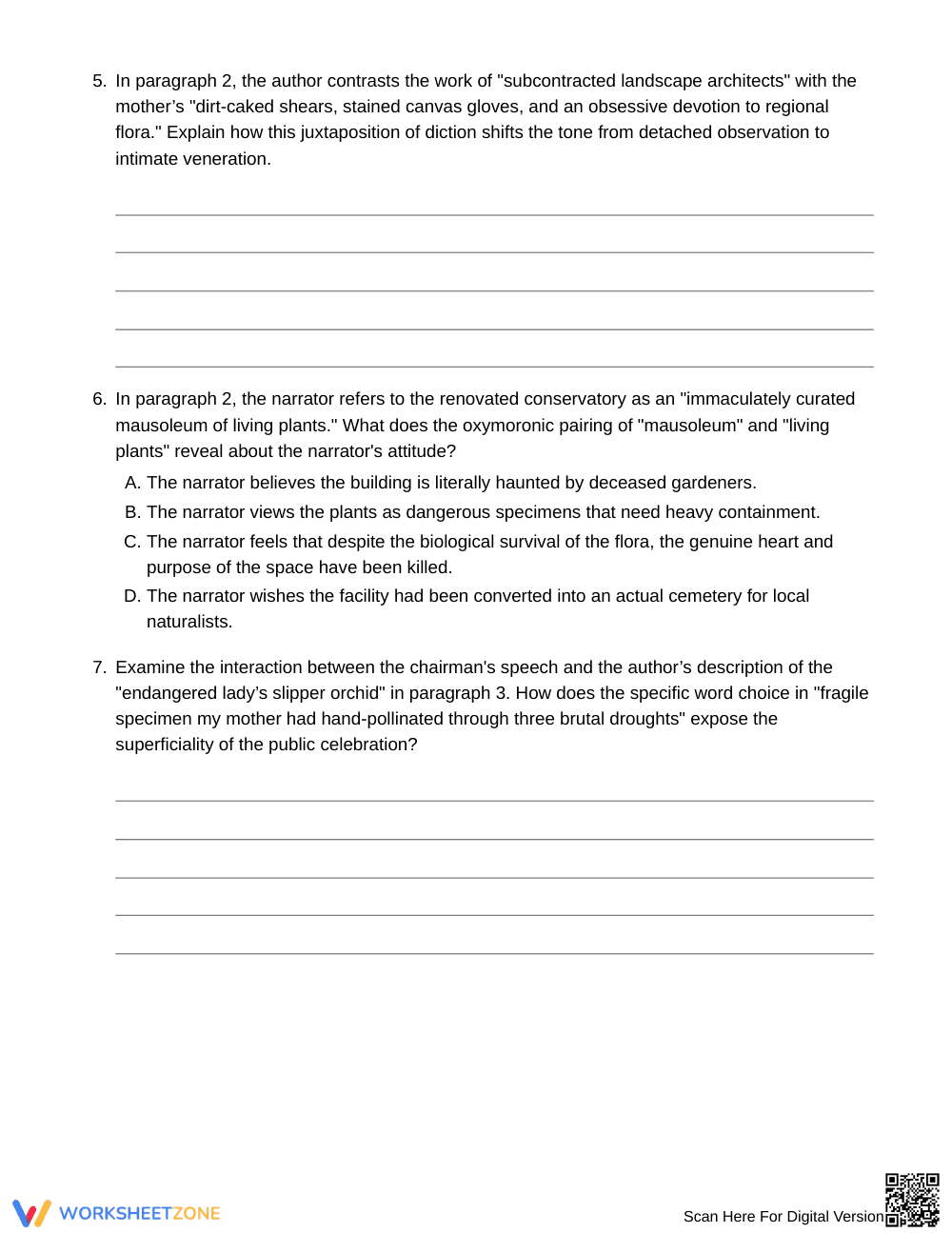
- Supported Practice (Part B): Six scaffolded tasks prompt students to examine cumulative diction, oxymoronic phrasing, and tone shifts between corporate jargon and organic imagery.
- Independent Practice (Part C): Three evaluative prompts require students to refute counterarguments and compose a cohesive analytical response evaluating institutional diction.
This structured sequence follows the gradual release model from vocabulary identification to independent stylistic analysis.
Standards Alignment
This resource focuses on `RI.9-10.4`: "Determine the meaning of words and phrases as they are used in a text, including figurative and connotative meanings; analyze the cumulative impact of specific word choices on meaning and tone." It also reinforces `RI.9-10.1` through rigorous text evidence requirements. Both standard codes can be copied directly into lesson plans, IEP goals, or district curriculum mapping tools.
How to Use It
Assign this worksheet after direct instruction on authorial tone and rhetorical devices. Use Part A for guided practice to check comprehension of connotation, then release students to complete Parts B and C independently. As a formative assessment checkpoint, review student explanations of corporate diction in Part B. The activities require 45 to 55 minutes.
Who It's For
This resource serves general education Grade 10 English II students, pre-AP learners, and readers preparing for close-reading assessments. Embedded definitions support developing readers without diluting text complexity. Pair this printable with a direct instruction lesson on stylistic registers or an anchor chart detailing emotional connotation.
Under educational research by Fisher & Frey (2014) on close reading and text-dependent questioning, secondary students require explicit, sequential prompts to transition from identifying isolated vocabulary to interpreting complex authorial attitude. This worksheet fulfills standard RI.9-10.4 by systematically structuring tone and diction analysis across 12 targeted tasks. Learners examine how denotative definitions interact with connotative emotional charges, tracing shifts between commercial language and organic imagery across an original text. By moving from multiple-choice recognition of localized connotations to constructed synthesis evaluating cumulative stylistic patterns, students develop the analytical stamina necessary to articulate authorial purpose. The embedded reference guide and detailed 4-page answer key support precise pedagogical feedback, ensuring students accurately evaluate how lexical choices establish tone. Grounded in intentional instructional design, this comprehensive resource prepares tenth graders for rigorous high school textual analysis and standardized assessment demands.


