


























Views
Downloads


Essential Thermal Phase Changes Worksheet | Grade 7 Science
Paste this activity's link or code into your existing LMS (Google Classroom, Canvas, Teams, Schoology, Moodle, etc.).
Students can open and work on the activity right away, with no student login required.
You'll still be able to track student progress and results from your teacher account.
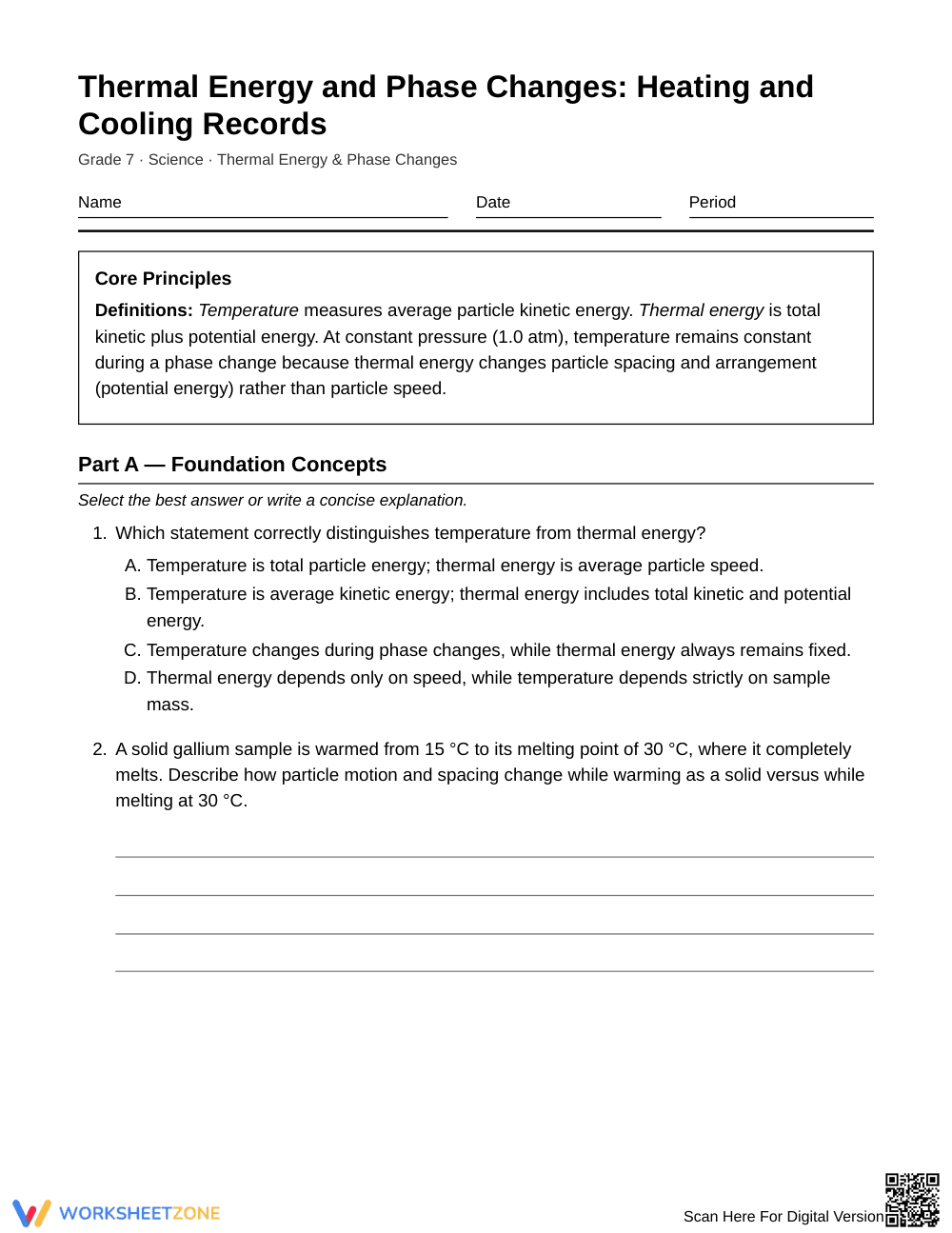
This thermal energy and phase changes worksheet equips middle school students to distinguish kinetic energy from thermal potential energy and interpret heating records. Through rigorous data interpretation, learners connect particle motion, temperature plateaus, and molecular attraction to master core physical science principles across 12 structured items.
At a Glance
- Grade: 7 · Subject: Science
- Standard: Relate thermal energy transfer, particle motion, and state changes during heating
- Skill Focus: Thermal-Energy and Phase-Change Check
- Format: 5 pages · 12 problems · Answer key included · PDF
- Best For: Mid-unit assessment and data analysis
- Time: 35–45 minutes
What's Inside
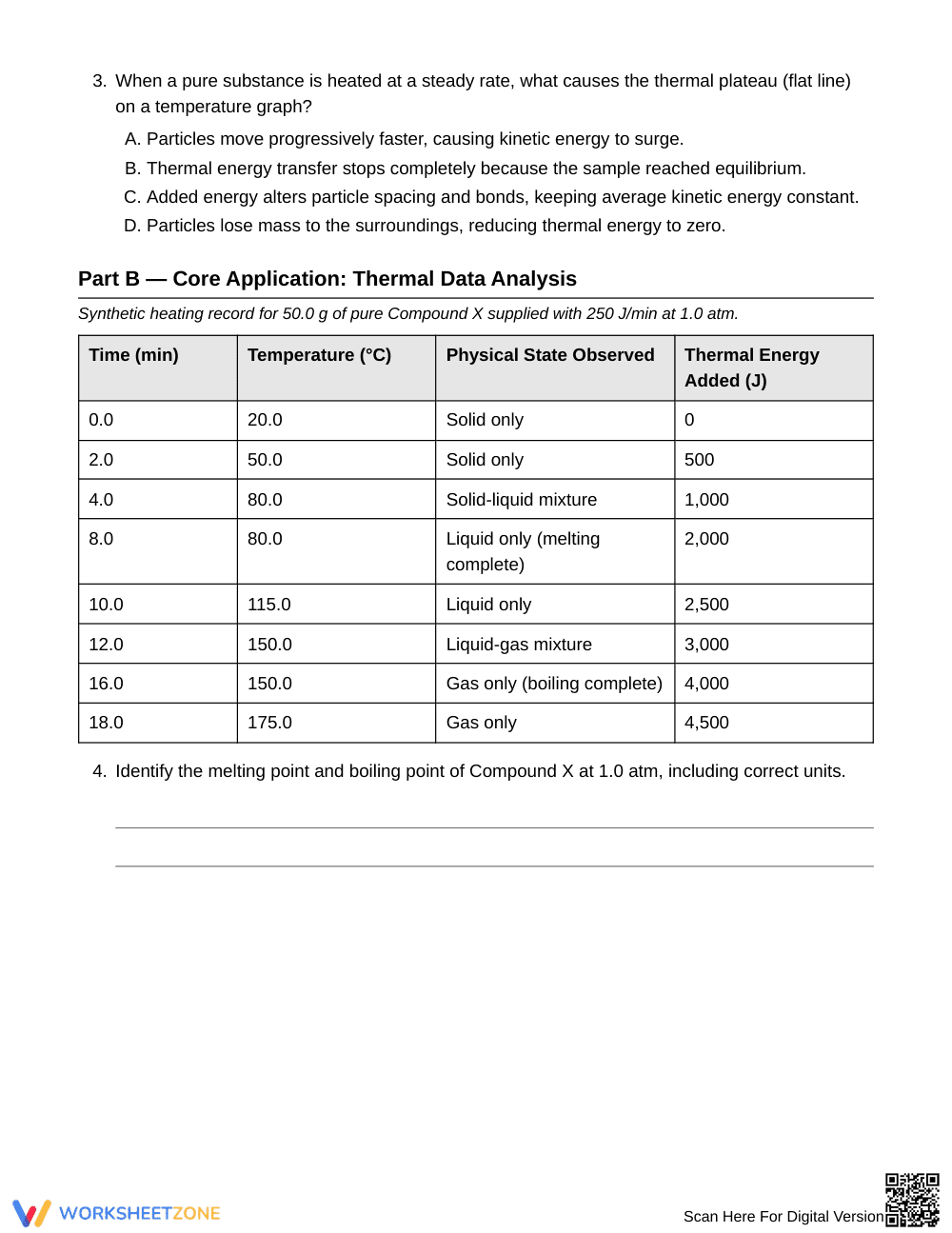
This comprehensive 5-page science resource features a core principle reference box, structured multiple-choice questions, and extensive free-response data analysis. Students analyze a synthetic heating record table for Compound X (with time, temperature, physical state, and energy values) and evaluate an experimental cooling scenario comparing two distinct substances. A complete 3-page answer key provides full explanations and particle-level reasoning for every item.
Skill Progression
- Guided practice (Part A, Items 1–3): Students recall core definitions, contrast average kinetic energy with potential energy, and explain thermal plateaus using scaffolded foundation prompts.
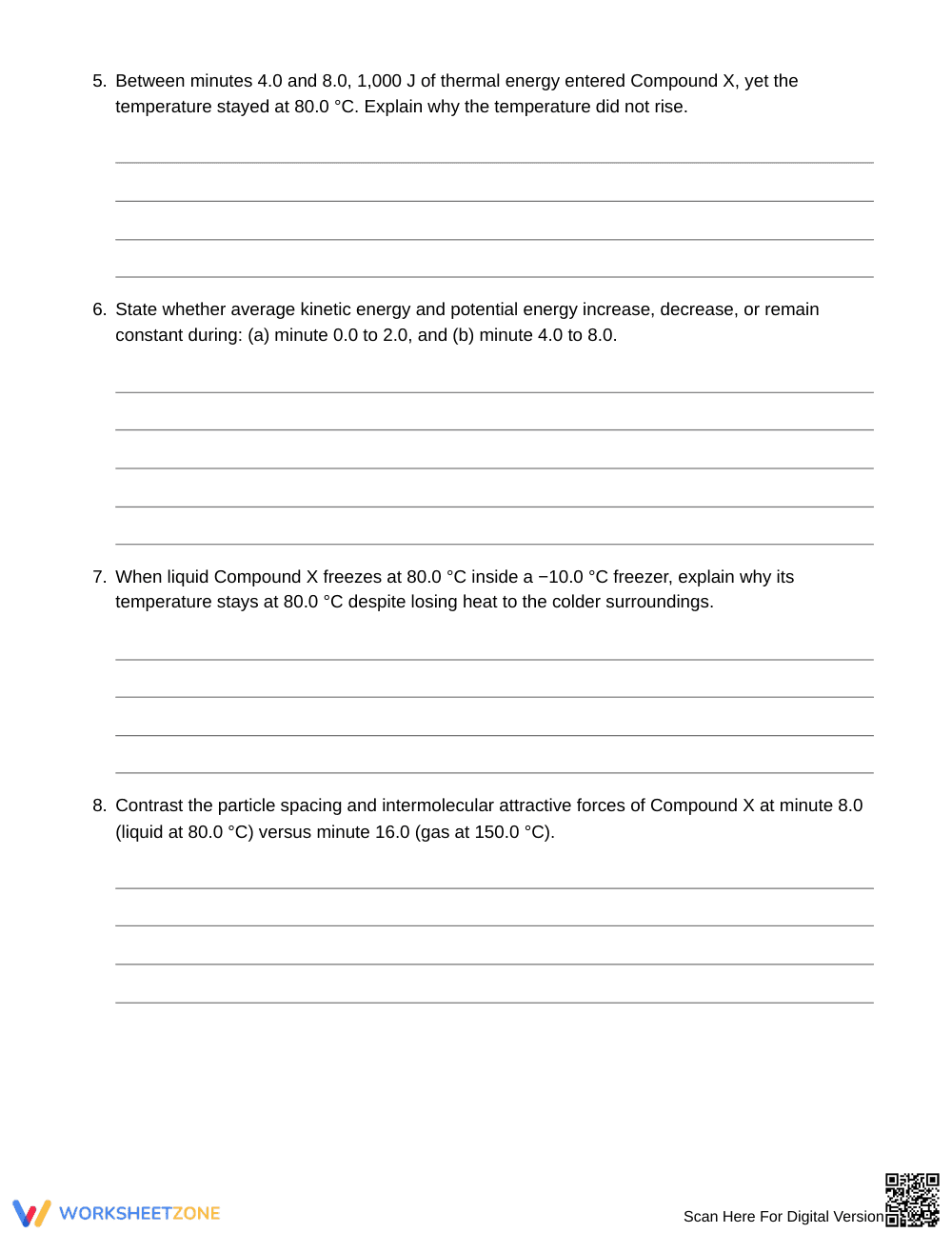
- Supported practice (Part B, Items 4–9): Students interpret a quantitative heating data table, calculate melting and boiling points, evaluate energy shifts at constant temperatures, and predict the impact of changing sample mass.
- Independent practice (Part C, Items 10–12): Students analyze a novel comparative cooling experiment, evaluate a common student misconception regarding thermal transfer, and construct evidence-based claims about intermolecular forces.
This structured sequence follows a gradual-release instructional model that transitions students from fundamental vocabulary recall to complex scientific argumentation.
Standards Alignment
This worksheet aligns directly with middle school physical science performance expectations requiring students to develop models showing that thermal energy transfer changes particle motion, temperature, and physical state. Students demonstrate that adding or removing thermal energy during a phase change alters intermolecular spacing rather than particle speed. These alignment specifications can be copied directly into lesson plans, IEP goals, or district curriculum mapping tools.
How to Use It
Deploy this worksheet after direct instruction on kinetic theory and phase changes. For formative assessment, examine student responses to Item 5 and Item 11 to observe whether learners recognize that heat transfer continues even when temperature graphs plateau. The activity fits cleanly into a 35–45 minute science lab period or serves as a targeted review before summative testing.
Who It's For
This resource is designed for general Grade 7 science classrooms, introductory physical science units, and targeted intervention groups. The reference box scaffolds instruction for developing readers, while Part C offers rigorous analysis for advanced learners. Pair this printable with a heating curve anchor chart or an interactive phase change simulation.
Middle school science instruction demands rigorous tasks that bridge observable temperature patterns and unobservable molecular behavior. According to Fisher & Frey (2014), structured instructional progressions that guide students from concept definitions to data-driven justification significantly boost scientific reasoning and retention. This 5-page worksheet provides Grade 7 students with 12 targeted items requiring them to analyze quantitative heating records, distinguish kinetic from potential energy, and evaluate authentic student misconceptions. The clear layout, coupled with an exhaustive 3-page answer key, enables teachers to pinpoint particle-level misunderstandings during phase change units without requiring extensive prep time.


