




























Views
Downloads




Essential Thermal Insulation Worksheet | Grade 6 Science

Paste this activity's link or code into your existing LMS (Google Classroom, Canvas, Teams, Schoology, Moodle, etc.).
Students can open and work on the activity right away, with no student login required.
You'll still be able to track student progress and results from your teacher account.
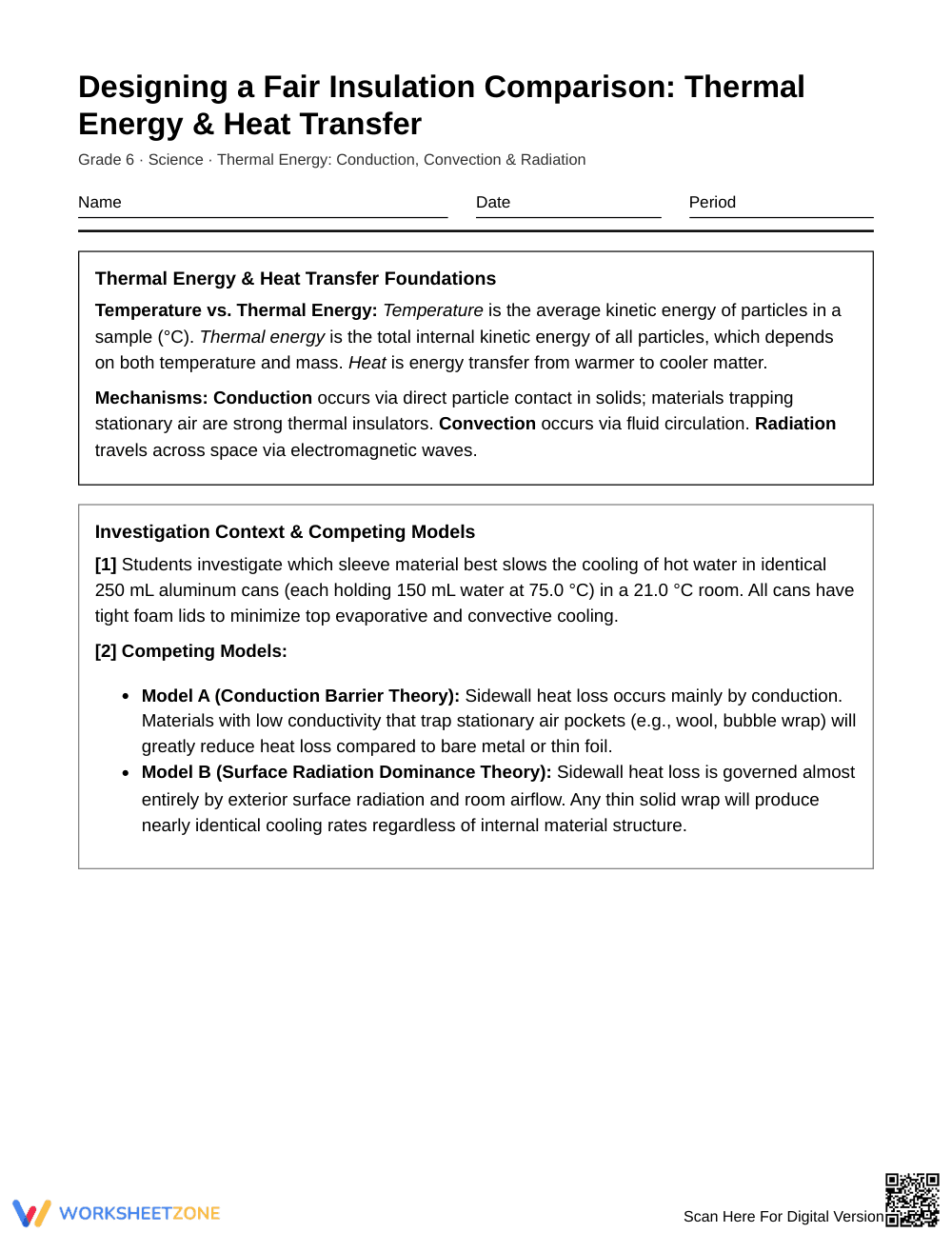
This thermal energy worksheet develops Grade 6 inquiry skills by guiding students through fair test design in insulation experiments. Learners examine conduction, convection, and radiation while contrasting temperature with thermal energy. By testing competing scientific models against synthetic cooling data, students determine how sleeve materials affect thermal energy transfer.
At a Glance
- Grade: 6 · Subject: Science
- Standard: Thermal Energy Transfer — Plan and conduct fair tests evaluating thermal insulation and heat transfer mechanisms
- Skill Focus: Conduction, Convection & Radiation in Fair Insulation Testing
- Format: 5 pages · 10 problems · Comprehensive answer key included · PDF
- Best For: Mid-unit lab analysis or conceptual assessment
- Time: 45–60 minutes
This 5-page packet features 10 rigorous problems across three scaffolded sections. It opens with essential foundational definitions of heat transfer, followed by two competing theoretical models. Students complete prediction prompts, experimental variable controls, error analyses, and synthetic data interpretations comparing cooling curves. A 2-page answer key provides complete model explanations and exemplar responses.
Skill Progression
- Guided practice (Part A, 2 problems): Uses reference definitions and competing models to scaffold initial student predictions and material rankings.
- Supported practice (Part B, 6 problems): Targets variable controls, confounding factors, repeated trials, and the distinction between temperature and thermal energy.
- Independent practice (Part C, 2 problems): Requires students to independently analyze synthetic data, evaluate theoretical models, and design a follow-up test.
This sequence implements a gradual-release framework, moving learners from structured conceptual review to independent empirical inquiry.
Standards Alignment
This resource aligns with middle school physical science standards for thermal energy. Students plan investigations and evaluate how heat transfers through conduction, convection, and radiation. Both standard codes can be copied directly into lesson plans, IEP goals, or district curriculum mapping tools.
How to Use It
Use this activity as a post-instruction application lab or mid-unit assessment across 45 to 60 minutes. As a formative assessment check, monitor Part B, Question 4 to ensure students distinguish water mass and thermal energy from initial temperature.
Who It's For
This worksheet serves Grade 6 science students learning experimental design. Differentiate by using the page 1 definitions for emerging learners, while challenging advanced students to graph Part C data. Pair with an anchor chart on particle kinetic motion.
According to Fisher & Frey (2014), structured inquiry materials that integrate guided modeling, collaborative variable evaluation, and independent empirical analysis establish the necessary scaffolding for enduring conceptual transfer in secondary science. This Grade 6 physical science worksheet operationalizes that pedagogical framework through a rigorous 10-problem sequence focused on designing fair insulation tests and evaluating conduction, convection, and radiation. By prompting students to evaluate competing theoretical models, control confounding variables, and interpret synthetic cooling curves, the resource directly supports mastery of middle school thermal energy transfer concepts. Students progress from basic definitions to nuanced scientific critiques, successfully distinguishing temperature from total internal kinetic energy. The embedded five-page structure, paired with a complete two-page answer key, provides educators with a classroom-tested assessment instrument that bridges core physics principles with authentic scientific reasoning and data-driven argumentation across diverse learning environments.


