




























Views
Downloads

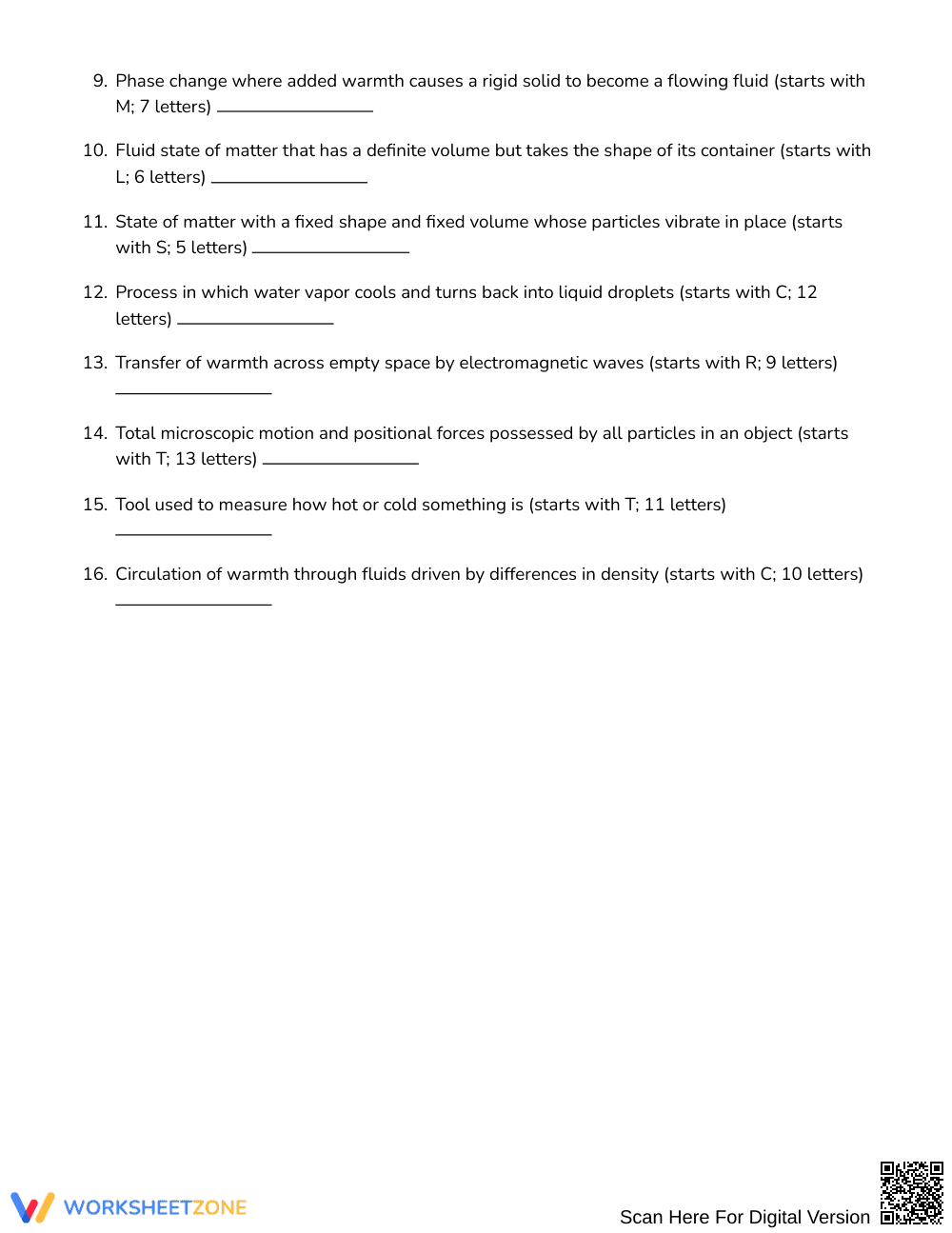


Essential Thermal Energy Word Search | Grades 6–7 Science

Paste this activity's link or code into your existing LMS (Google Classroom, Canvas, Teams, Schoology, Moodle, etc.).
Students can open and work on the activity right away, with no student login required.
You'll still be able to track student progress and results from your teacher account.
Strengthen physical science vocabulary with an active retrieval word search targeting temperature, heat transfer, and states of matter. Designed for middle school science classes, this resource requires students to recall foundational terminology from conceptual definitions before locating 16 core vocabulary terms hidden across a challenging letter grid, ensuring rigorous concept reinforcement.
At a Glance
- Grade: Grades 6–7 · Subject: Science
- Standard: Not standards-assessed — vocabulary enrichment
- Skill Focus: Temperature and thermal energy vocabulary
- Format: 3 pages · 16 words · Answer key included · PDF
- Best For: Vocabulary review and unit introduction
- Time: 25–35 minutes
What's Inside
This 3-page printable science activity features a complete clue sheet alongside an intricate letter search. Rather than offering a passive word bank, the activity presents 16 rigorous scientific definitions spanning thermal expansion, particle motion, and heat transfer mechanisms. A comprehensive 3-page answer key provides clear solution paths for efficient teacher grading or student self-checking.
How the Puzzle Works
This no-bank challenge raises word searches into genuine conceptual retrieval tasks. Students analyze descriptive clues to identify specific vocabulary before searching an 18 × 18 grid. Hidden terms run in all eight possible directions: North, Northeast, East, Southeast, South, Southwest, West, and Northwest. Because students work purely from contextual clues rather than a visible term list, they actively rehearse key physical science definitions throughout the entire activity.
Standards Alignment
This word search serves as targeted vocabulary enrichment and is not directly aligned to a single state or national assessment standard. It provides supplementary terminology support across general physical science units on thermal energy, particle movement, and phase changes, helping learners master essential academic language before summative evaluations.
How to Use It
Introduce this puzzle immediately after direct instruction on conduction, convection, and radiation to consolidate domain-specific vocabulary. Alternatively, assign it as a collaborative warm-up or independent station task during mid-unit review. While students work, monitor whether they correctly identify phase-transition definitions such as sublimation and condensation before locating the letters. Most learners finish within 25 to 35 minutes.
Who It's For
This activity is designed for Grades 6–7 science students learning introductory thermodynamics and particle theory. It offers engaging vocabulary reinforcement for general education classrooms, support for English language learners acquiring specialized science terms, and independent enrichment for early finishers. Pair this puzzle with hands-on lab investigations or thermal energy anchor charts.
Academic vocabulary acquisition in middle school science directly supports reading comprehension and conceptual reasoning across physical science curricula. According to Fisher & Frey (2014), intentional exposure to disciplinary vocabulary through clue-based retrieval strengthens memory consolidation and concept retention more effectively than rote word searches. By requiring students to read detailed definitions of heat transfer and kinetic motion before searching an 18 × 18 letter matrix, this activity activates prior knowledge and cements domain-specific scientific language. The challenging multi-directional layout prompts deliberate spatial scanning and focused engagement, turning basic vocabulary review into an active learning experience that solidifies core concepts like thermal energy, conduction, and sublimation across physical science units.


