




























Views
Downloads



Essential Successive Percents Worksheet | Grade 7 Math

Paste this activity's link or code into your existing LMS (Google Classroom, Canvas, Teams, Schoology, Moodle, etc.).
Students can open and work on the activity right away, with no student login required.
You'll still be able to track student progress and results from your teacher account.
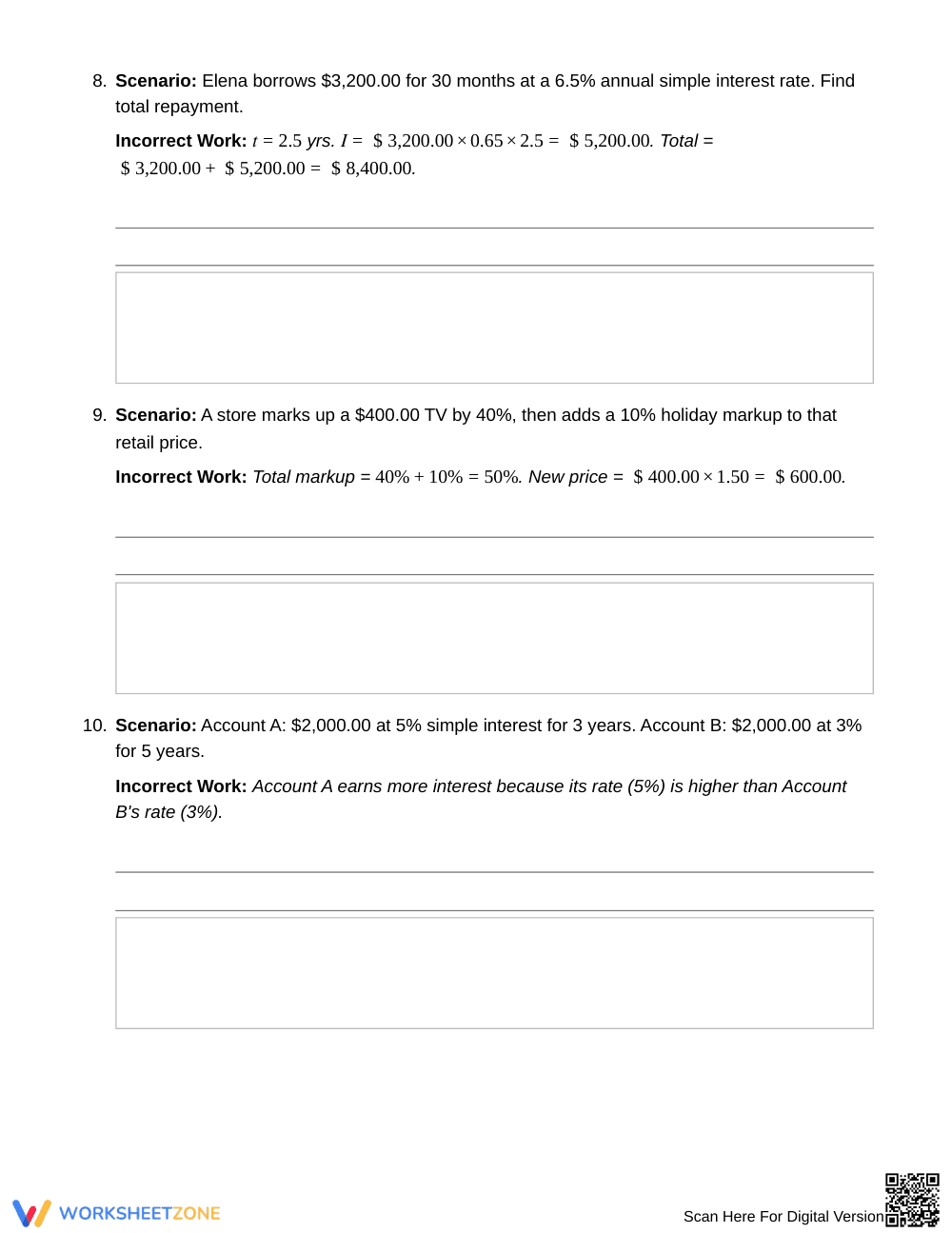
This Grade 7 math worksheet eliminates the misconception of adding consecutive percentages through 10 targeted error analysis scenarios. Learners evaluate flawed retail discounts, sales tax, markups, and simple interest calculations, identify the structural breakdown, and compute correct values to achieve genuine multi-step problem mastery.
At a Glance
- Grade: 7 · Subject: Math
- Standard:
7.RP.A.3— Solve multi-step real-world percent problems involving successive changes and interest- Skill Focus: Correct Additive Combination of Successive Changes
- Format: 4 pages · 10 problems · Answer key included · PDF
- Best For: Remediation of percent misconceptions and exam prep
- Time: 35–45 minutes of analysis
What's Inside
This 4-page printable resource includes an explicit Key Rules reference section, a modeled error analysis, and 10 non-routine tasks. Part A targets 6 retail situations involving discounts, markups, and gratuity. Part B provides 4 financial scenarios analyzing simple interest and rate conversions. A 2-page answer key provides complete corrections, mathematical explanations, and solutions.
Skill Progression
- Guided practice: Students examine the modeled error analysis, observing why a 20% discount after a 20% markup modifies the updated base price rather than canceling to zero.
- Supported practice: In Part A (Problems 1–6), students correct retail discounts, sales tax, and dining subtotal errors using formula prompts.
- Independent practice: In Part B (Problems 7–10), students autonomously analyze simple interest calculations, month-to-year conversions, and account comparisons.
This gradual-release progression moves students from modeled critique to independent error identification and remediation.
Standards Alignment
This worksheet targets `7.RP.A.3`: Use proportional relationships to solve multistep ratio and percent problems, including simple interest, taxes, markups, markdowns, and fees. It supports standard `7.EE.B.3` as students convert between fractions, decimals, and percents during multi-step computations. Both standard codes can be copied directly into lesson plans, IEP goals, or district curriculum mapping tools.
How to Use It
Deploy this worksheet after direct instruction on multi-step percents as a diagnostic check or partner station activity. During work time, observe whether students calculate updated intermediate values or incorrectly add given percentages directly. Plan for 35 to 45 minutes of completion time.
Who It's For
This activity is built for Grade 7 math classes, remediation groups, and Grade 6 advanced learners. Differentiate by having students highlight changing base amounts across steps. Pair this practice with an anchor chart outlining multi-step percent and simple interest formulas.
Mastering standard 7.RP.A.3 requires Grade 7 learners to recognize that successive percent adjustments cannot simply be combined through addition because each subsequent change operates on a newly transformed base amount. According to Fisher & Frey (2014), intentional error analysis accelerates mathematical reasoning by requiring students to articulate why an algorithm fails rather than merely executing procedural steps. This worksheet operationalizes that instructional principle across 10 rigorous multi-step tasks addressing discounts, retail markups, dining gratuities, and simple interest calculations. By auditing incorrect student solutions, learners confront the widespread misconception that adding consecutive percentages produces an equivalent rate. The structured transition from guided analysis to unassisted financial problem-solving strengthens proportional reasoning and reinforces precision in mathematical discourse. As a result, students develop durable conceptual foundations that transfer directly to algebraic functions, compound financial problems, and standards-aligned summative assessments.


